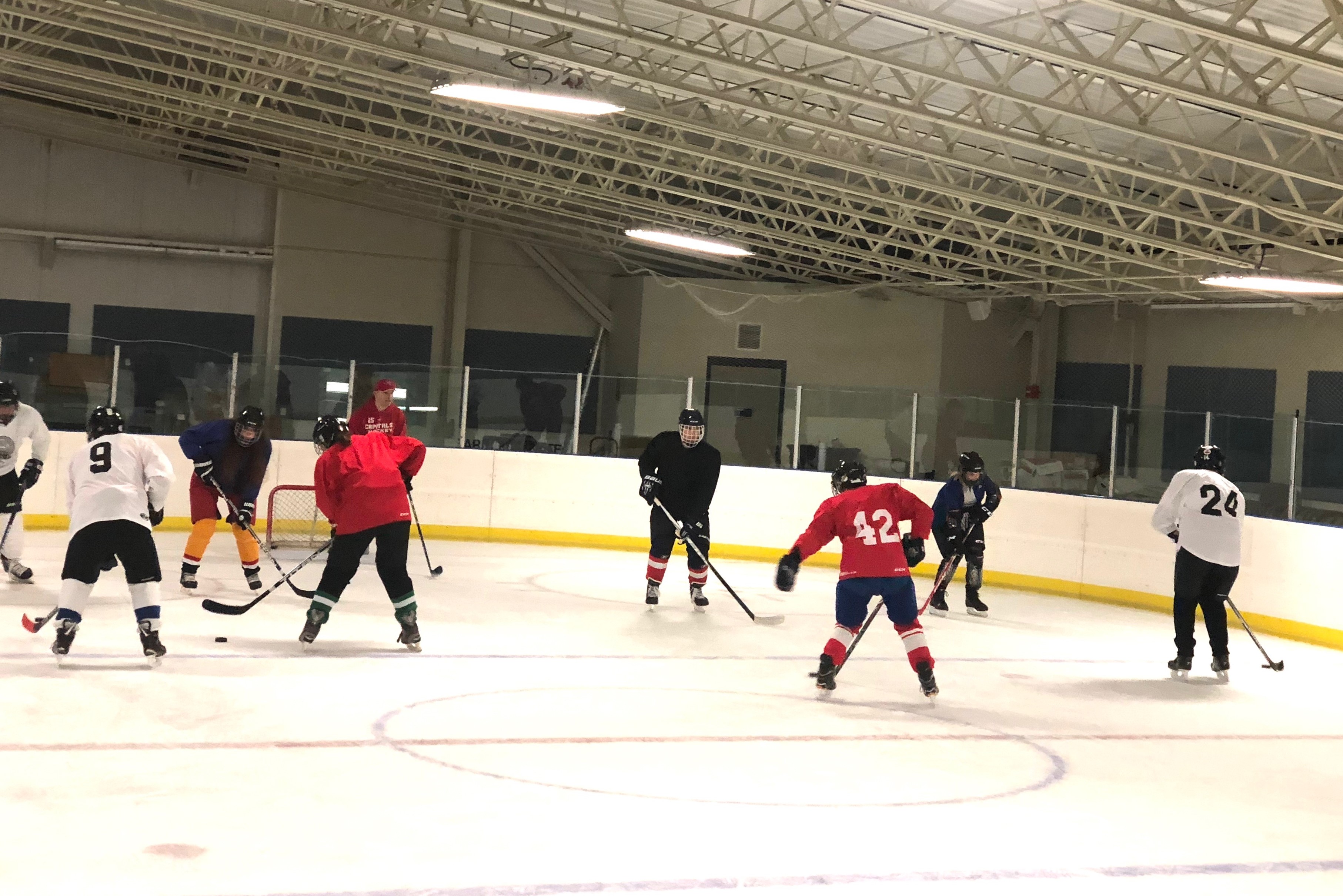
Sue me, I want to play ice hockey. I figure skated when I was young, but I hung up my little skating dresses at age 10. I did not aspire to be the next Peggy Fleming. Hockey looked exciting to me, but it was for boys only. So I gave up skating.
But today is a new day and age! There’s Title IX, and girls play football, so why can’t I play hockey? Maybe I’d even be good at it. Girlfriends tried to dissuade me. I’ll get hurt, they said. Worth it, I thought. Despite shoulder pains from a ski injury, my age (I’m 54), and my small size—I wanted in.
I found a beginner hockey class at Cabin John Ice Rink in Rockville, Maryland. Group lessons are $162 for six sessions and include rental skates. Before I knew it, I was headed to the shop to buy a mound of gear.
8:35 p.m.: I lug my bag and stick into the rink, pick up my rental skates, and start putting on pads: huge padded shorts, right knee pad, left knee pad. Right skate, left skate, lace them as tight as I can. Right elbow pad, left elbow pad, helmet.
8:52 p.m.: I hobble over to the practice rink. I have to ask a man standing nearby to snap the bottom of the cage onto my helmet. He also kindly notices that I’d put my elbow pads on the wrong elbows and helps me switch them. I feel like a kid who needs help getting dressed for school.
8:57 p.m.: A few parents are watching their kids skate in the class before mine. I see them staring at me in my pads. “Just what do you think you’re doing?” their looks seem to say. I want to laugh—I’m in on the joke—but instead I keep a straight face, as if seeing me on the hockey rink is as expected as seeing me at the grocery store.
9:00 p.m.: I don the gloves. Eight of us adult beginners take the ice. I’m pretty sure I’m the oldest person in the class. Most of my classmates are men. I know their skates and pads are making them appear taller and larger than they are, but I still find their size intimidating. There are two other women in the class tonight. I smile at them, but I don’t know whether they smile back because their expressions are hidden behind their face cages.
9:04 p.m.: Will and Greg, the instructors, explain that tonight we’re going to be learning backward crossovers. Will demonstrates how back crossovers allow a player to move backward at great speed. He has us match up in pairs, with one person holding up a hockey stick horizontally and the other holding onto the stick for balance. The skater lifts one leg and crosses it in front over the other while moving backward, without looking down.
9:06 p.m.: It’s my turn. When I was 10, I could do backward crossovers perfectly, with my arms stretched out to my sides as figure skaters do. But hockey skates don’t have a toe pick so there’s more risk of falling. Like everyone else, I move slowly, like a toddler taking her first steps.
9:09 p.m.: We’re doing backward crossovers without the stick now—one at a time, moving around the whole rink. I purposely go last, disliking the idea that everyone will be watching me. My balance seems okay, and I’m actually traveling backward. Maybe I’ve got this!
9:10 p.m.: Never mind. I can’t control where I’m going and I don’t make it to the other side of the rink. I do an extra loop to compensate. I am thoroughly frustrated and embarrassed. I take myself to the back of the line. No one says anything. It’s challenging for all of us.
9:12 p.m.: Now we’re doing back crossovers in the other direction. The lefties in the class find this easier. I don’t.
9:15 p.m.: We line up on the blue line in the middle of the rink and simultaneously try to go backwards in a relatively straight line by doing a backward crossovers. This feels like doing an obstacle course backwards on skates—it’s not a movement I’d ever do off the ice. I can do it, but not smoothly.
9:19 p.m.: Of course, as soon as I feel halfway decent at this skill, the instructors add a puck and I’m deflated again. We’re now supposed to practice skating backwards and passing at the same time. We get back in our pairs, with one person skating forward and one backward, passing the puck back and forth. Lo and behold, my partner and I are quite good at this drill, which makes it fun. Skating forward and backward slowly isn’t hard, and we figured out that if we make nice, easy passes at short range, we could keep the puck between us. But on our fourth go, we get too far away from each other and one of us makes a pass that’s out of reach. The puck slides clear across the ice and we lose it entirely.
9:21 p.m.: Now we’re going to skate out into the middle of the ice one at a time and pivot backwards. Another student makes a pass and the skater has to take a swing at the moving puck and try to score in a tiny practice goal. When it’s my turn to shoot, I have no problem skating out and pivoting, but my swing completely misses the puck. Which reminds me of my golf game. Which is not a happy thought.
9:23 p.m.: Play is stopped. Greg says it’s really important for the passer to aim the puck between the shooter’s legs. We try again.
9:24 p.m.: “Good pass, Amy!” Greg calls from the sidelines. Twice. Is that surprise in his voice?
9:25 p.m.: There are a dozen pucks on the ice now and I trip over one. I sit on the ice for a second wondering if anyone is going to help me up. I’m not really hurt due to all the padding, but the ice is definitely a hard surface and it’s jarring to fall, especially when you don’t see it coming. No one comes to helps me up. I manage to get my padded self onto all fours and I clumsily make my way to standing. I skate away and pivot like nothing happened, but I know I’ll feel achy from the thud later. I receive the next pass and this time I score. The class hits their sticks on the ice as a way of clapping.
9:28 p.m.: We get ready for the scrimmage. Everyone loves this part. Black jerseys and white jerseys are on one team, colors on the other. I am on the colors team, as are the two other women.
9:30 p.m.: No one from my team volunteers to do the face-off, so I go into the center. My opponent puts his stick between my stick and the puck—is that allowed? I have no chance to get to it. The other team easily wins the puck.
9:42 p.m.: I lose track of the score. I fight for the puck a few times, skating right at the guy in possession and lunging my stick at the little black disc. I give up quickly because I’m afraid that I will get knocked down. Will skates over and tells me to use my butt to push the other players out of the way. In other words, be aggressive, and don’t let these guys intimidate you. But I can’t shake the fear of being smashed onto the merciless ice. And I don’t want to trip anyone else. What if they get badly injured and have to miss work? Betcha Alexander Ovechkin doesn’t think like that. I have to toughen up.
9:45 p.m.: The class is technically over but no one heads for the door. It’s tie score, and the coaches call overtime. The next goal wins. I’m exhausted. I station myself to the left of the goal. It’s something I learned from years of watching my kids play soccer. I’m open for a pass or a rebound, but those come at me so fast that I keep losing the puck.
9:48 p.m.: A player on my team shoots and misses, but I get to it and tip it in the goal. We’ve won! My team fist bumps each other with our gargantuan hockey gloves on our way off the ice.
9:50 p.m.: Lesson over. I unsnap and lift my face cage, remove my gloves, helmet, elbow pads, knee pads, skates, and hip-pad shorts. I stuff them all into my bag. I return my rental skates, put on my own boots, and lug my equipment bag and stick back to the car.
10:20 p.m.: Arrive home. Take Aleve, pour Epsom salt into the bath. I’m completely wiped—but in a good way. Even though hearing “No girls allowed” all those years ago still stings, I’m proving my merit as a lady hockey player. It’s not only exhilarating, it’s vindicating.