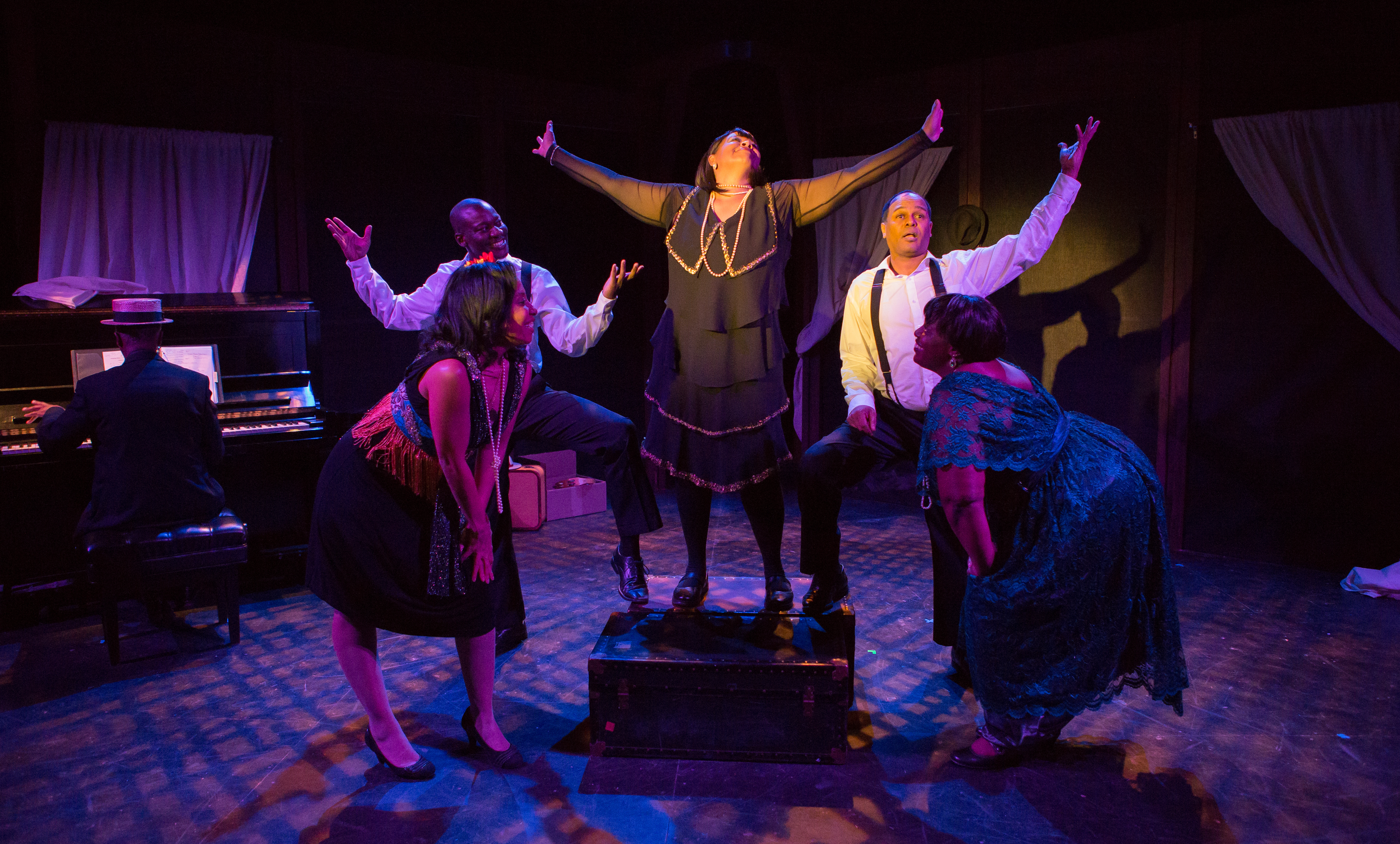
The In Series’ latest production at Source Theatre draws inspiration from the neighborhood just around the venue’s corner. From U Street to the Cotton Club, an experimental jukebox musical that premiered in 2009 at In Series, features jazz standards of the ‘20s and ‘30s, and is partially set in the U Street area of D.C. where they came to life. It’s a thrilling showcase for an era of music beloved by many as well as an opportunity to explore the cultural tether between D.C. and Harlem. In 2019, however, its true power lies not just in its celebration of black music, but in its framing of the harsh realities that inspired that music.
The show began its life 10 years ago as an idea from In Series founding artistic director Carla Hubner, an ethnomusicologist who wanted to put together an exhibition highlighting several classic songs from the era. In collaboration with director Kenyatta Rogers and playwright Sybil R. Williams, they built a narrative framework around this musical kernel.
Williams’ role in shaping the story was to find a way to dramatize historical context surrounding the core songs of the text.
“We began with the jazz standards, but we also wanted to talk about why those standards became standards,” Williams says. “Kenyatta and I incorporated spirituals and blues songs because, and this is maybe just the scholar in me, I don’t think you can have a conversation about jazz and African-American music without having a conversation about the blues.”
The fictional play follows the life of Grandma Lena, stage name “Sassy,” who grew up in the South, migrated to the U Street area of D.C. and then traveled to Harlem, where she was a traveling musician and performed at New York’s famous Prohibition-era nightclub The Cotton Club. In this revival, Michelle Rogers, Kenyatta’s wife, plays both Lena and her granddaughter living in D.C. as she explores her grandmother’s life through a book she finds after her death. Finding the book summons a small ensemble of performers (Detra Battle Washington, Brian Quenton Thorne, Pam Ward, and Greg Watkins), each of whom portray bit parts in her life story in between renditions of songs from each era.
Songs by Duke Ellington, Cab Calloway, and Fats Waller bleed into one another, painting a picture of a life in which musical expression is nourishment. But the show is deeper than just a revue. In her writing, Williams captures a universal story of black migration.
“It’s a collective history of African women in the cities,” Williams says. “Every black woman has a grandmother, or a great-grandmother, who made Marlena’s journey. I’m a native Washingtonian. But everyone from D.C. is either from Virginia, South Carolina, or North Carolina. It’s much the same for New York City. All those stories involve matriarchs, women who said ‘I can’t build the life I want here in the South,’ so they walk north to do just that.”
The In Series is offering a guided walking tour of U Street before performances to share the history of “Black Broadway” with theatergoers, complete with a dinner at Ben’s Chili Bowl. But the show itself feels less interested in talking about D.C. or New York as art spaces and more as individual push pins on a map of black cultural evolution. The real meat of the show isn’t in the vivacious reproductions of Cotton Club reverie, but in the interludes between those songs, tethering that reverie to the pain endured to inspire it.
There’s a telling line in the second act, as Lena describes the majesty of Harlem and how working the Cotton Club felt, where she points out that “the only yellow silk or indigo gold in the Cotton Club was on the stage or in the kitchen.” This was black art sustained by white gaze. For Williams, a program director for African-American studies at American University and a self-professed history buff, it was important to place the consumption of black art with the necessary education for those same spectators.
“In anything I do, there’s a history lesson I want people to have,” Williams explains. “There are these wonderful cultural products, i.e. jazz, but they came at a cost. Art is making the case for survival, as John Edgar Wideman says. The only mode of expression blacks had then was the arts. They’re not going to go down and protest and have a sit-in. That’s not coming for another forty years.”
So amid the juke joint reverie, the play tackles topics like the Red Summer of 1919 and the Great Depression, making sure these songs don’t come off purely as good time anthems, but black gold mined from years and years of systemic oppression.
“While we celebrate these songs as objects of beauty, they had a protest function,” Williams says. “These cultural products came at a cost. We’re not singing ‘This Joint is Jumpin’ only for you to have a great time. You’ve been able to do that and that’s great, but that’s not what this is about.”
Williams notes that this play also has plenty of resonance in today’s political landscape. It’s not enough to simply enjoy the fruit of other cultures’ labor, she says, if we’re not also willing to do the work of understanding what produced it.
“We can enjoy each other on the common grounds of art and culture, but we have a lot of work to do beyond that,” she says.
From U Street to the Cotton Club runs through Jan. 20 at Source Theatre. Tickets $20-$45. Walking tours of U Street start two hours before performances, tickets $15.