Natalie Delgadillo
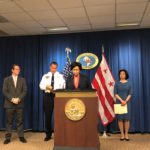
Mayor Muriel Bowser presented a series of violence-reduction strategies on Tuesday during a monthly breakfast with the D.C. Council, announcing continuing efforts to get illegal guns off the streets and curb retaliatory violence through the “Violence Interrupters” program and other public health initiatives. Her presentation comes in the wake of some particularly troubling crime data in the District: There were 160 homicides in D.C. in 2018, a nearly 40 percent increase over 2017 numbers. This year there have already been 18 homicides—including a recent triple homicide—a 64 percent jump from this day last year.
Puzzlingly, homicides are going up even as every other category of violent crime has dipped, according to data from the Metropolitan Police Department: There were 313 fewer total violent crimes in D.C. in 2018 compared with 2017. There were 2,233 fewer violent crimes last year than in 2015, the last significant crime spike in D.C.
The phenomenon has a relatively simple explanation, according to MPD: It’s not that the number of shootings happening in the District is going up—it’s just that they’re getting more lethal. The total number of shootings in D.C. has been about 500 for the last several years, according to MPD, but in 2018, 23 percent of the people who got shot died. That’s a significant jump from 2017, where 16 percent of the people shot died, according to the department. Thirty-four of 2018’s shootings are attributable to this increased lethality, police say.
Police Chief Peter Newsham told reporters after the breakfast that recent shootings are likely deadlier for a variety of reasons. More shootings are happening from a closer range, he said, often with more shots fired.
“We are seeing more daylight shootings, we are seeing shootings with multiple rounds being fired, we are seeing shootings where the suspects are closer to the victims, they’re getting in very close proximity during daylight hours, and the wounds are more significant,” Newsham said. “That’s one of the things we’ve got to take a look at is the capacity of the weapons that are out there … and the availability of these weapons in our community and more specifically the repeat violent offenders and folks that are involved in this behavior.”
The Deputy Mayor for Public Safety and Justice, Kevin Donahue, spoke at the breakfast about several strategies the mayor’s office is undertaking to prevent violence, generally listing existing programs like the Violence Interrupters, in which residents who used to be involved in violent crime themselves are deployed into high-risk neighborhoods to try to prevent retaliatory killings. Donahue said the mayor’s office is approaching violence-reduction strategies both from a public health perspective, and a more traditional criminal justice perspective.
https://twitter.com/ndelgadillo07/status/1090260902589358080
One of the mayor’s public health-centered proposals is sealing peoples’ criminal records so they have less trouble getting jobs after being arrested or serving a sentence; another is helping address people’s trauma before it manifests in community violence. On the criminal justice side, Donahue said his office will work to ensure better accountability for gun crimes, including the possession of illegal firearms. “We know we have too many illegal guns. And we also know that the penalty when you’re caught is neither swift nor certain,” Donahue said. The city will also partner with an outside firm to collect better crime data, allowing for more targeted policing.
https://twitter.com/ndelgadillo07/status/1090262285623279616
The mayor’s office hopes to increase the police force to 4,000 officers from its current 3,850, which will require both gathering new recruits and stemming losses.
Chief Newsham also proposed some specific policing tactics the city will take to address the violence concentrated in various neighborhoods.
“We’re going to be a little bit more precise with our deployment with regard to the areas where the shootings are happening. Like the deputy mayor said in there, the number of shootings that we’ve had in our city really hasn’t changed, the lethality has, and there are some precise areas in the city where that’s occurring,” Newsham said. “We’re going to ensure we have patrols in those precise areas, but through investigations we are also going to look at the folks that are involved in violence in those areas and we’re going to be precise about targeting in those individuals.”
Ward 8 Councilmember Trayon White spoke up at the breakfast to say he does not believe that the city has gotten any safer, at least not in his ward.
“The city is not getting any safer … There’s been several nights where we sound like we’re in a third world country, like we’re in Baghdad. You hear 30, 40, 50 rounds” of gunfire, he said. He said the presence of outreach workers isn’t making a dent in the activity of gangs or crews present in Ward 8, and that the city should be allocating more money into public safety. “We should be in a state of emergency when it comes to the state of violence and crime in our city,” White said.