Natalie Delgadillo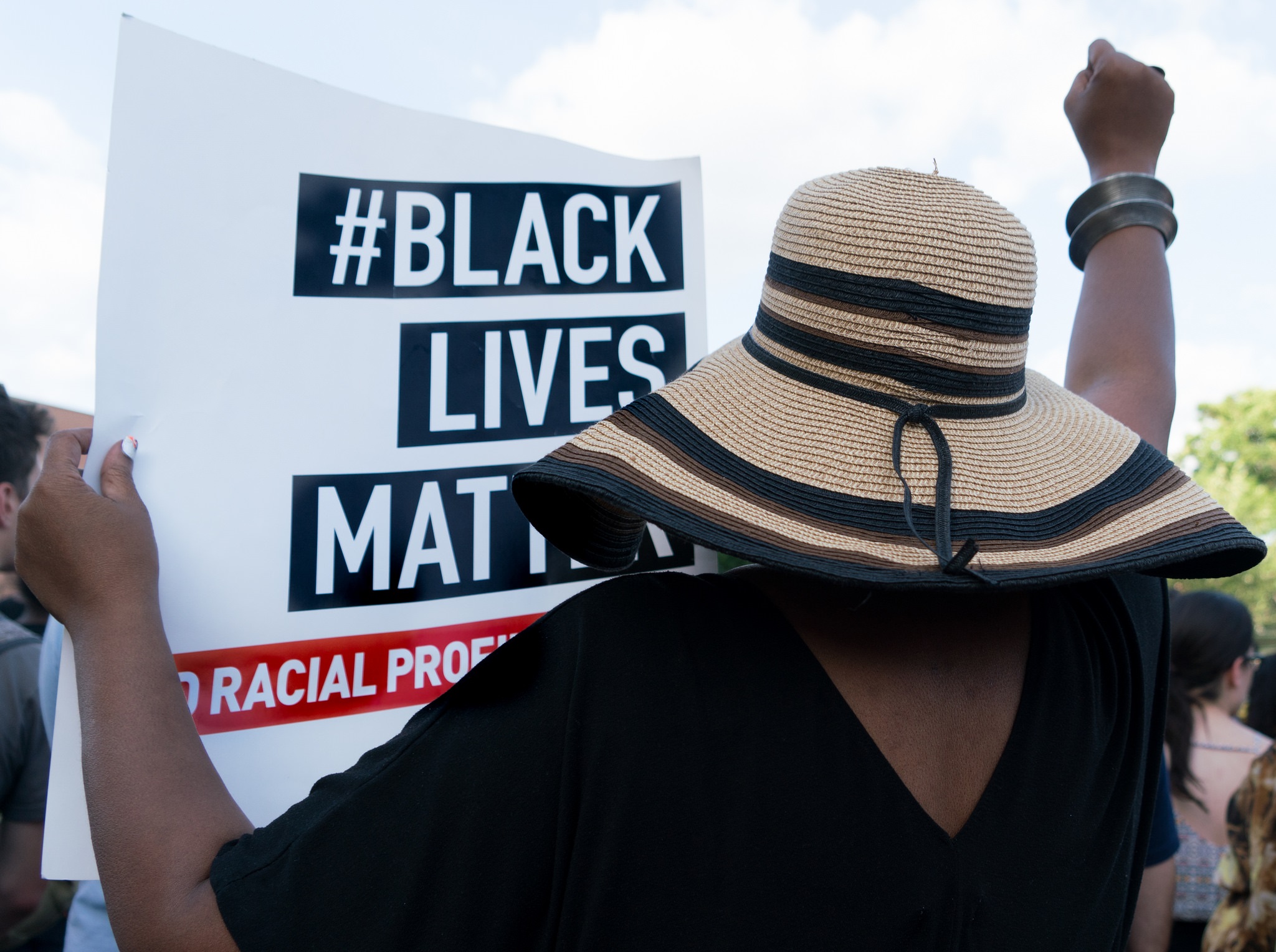
Almost every other night for a span of weeks in 2015, April Goggans says, a D.C. police cruiser parked in an alley across from her home, directly facing her bedroom window.
The cruiser turned on “both the large spot light and the flashing lights,” according to an email Goggans sent to then-Metropolitan Police Chief Cathy Lanier in September 2015. “All of the lights shine very brightly all the way through both levels of my home and wakes everyone up and makes hard to get back to sleep again. This is incredibly intrusive and unnecessary. Please make this stop,” Goggans wrote.
A police official responded that she would “look into the positioning” of the lights. But Goggans says her experiences with intrusive cruisers and police interaction didn’t stop there. “A lot of times I just go live on Twitter [to document it],” she tells DCist.
Goggans is a core organizer for Black Lives Matter D.C., a group that has protested the Metropolitan Police Department, including the fatal police shooting of Terrence Sterling in 2016 and a controversial search of black men on a corner in Deanwood last year. She believes police have been monitoring her activities for more than three years, and has been seeking to prove it through a Freedom of Information Act request.
Black Lives Matter activists around the country have made similar claims, digging up evidence that shows police departments have conducted surveillance of activists using undercover police officers and “social media collator software.” In New York, a court recently ruled in a FOIA case that the NYPD must acknowledge if it has been using devices that mimic cell towers to intercept activists’ communications.
In a 2017 filing, Goggans asked for documents pertaining to officers’ “monitoring and surveillance” of her. The Metropolitan Police Department has admitted that it has thousands of documents that could potentially refer to Goggans. But the department has not turned them over, saying they aren’t relevant to the request, prompting a lawsuit that has been winding through the court for more than a year.
Surveillance suspicions
Goggans is a well-known activist in D.C. She’s lived in the city for more than a decade, and served as the president of the Tenants’ Association that led the Marbury Plaza rent strike in 2012. Her brother first got involved in Black Lives Matter organizing, according to her bio on the BLM website, but she became heavily involved in 2015, after Mayor Muriel Bowser had a press conference touting more tough-on-crime policies.
Goggans suspects that police began surveilling her activities after BLM activists disrupted that press conference in August 2015. She grew increasingly suspicious about D.C. police officers’ continued presence in and around her Anacostia neighborhood, and her residence specifically.
Here’s how she describes their interactions from 2015 to the present day: Officers showed up around her home when she hosted an event for Black Lives Matter and questioned people as they were leaving; They were sometimes parked right outside her home when she got back from meetings or Council hearings, and once an officer that had been parked came up to her door to ask for her full name; Two particular officers took to calling her by her full name when they saw her around the neighborhood, especially when she went to the 7-11 near her home, a practice she thinks they undertook to intimidate her; Officers mentioned content she posted to her Twitter account, in particular videos where she described ongoing surveillance, when they saw her in her neighborhood; officers drove by her house frequently while she hosted community events; and officers shone flashlights into her home while she held a community meeting there.
Once, while she was driving with a friend, Goggans says she noticed a cruiser behind her, and began taking completely random turns to see if the car would follow. “They followed us for like 20 minutes,” she says.
MPD referred all comment to the D.C. attorney general’s office.
In court filings, though, the department disputes some of Goggans’ interactions with police officers in her neighborhood. The lights she said were coming from a police cruiser parked outside her window, MPD says were coming from a light tower set up in the neighborhood due to a recent homicide. Regarding the incident when officers questioned people leaving her home after a community event, police say they were responding to the area for a nearby domestic violence call. In another incident where Goggans said police shone flashlights into her home during a community meeting, an MPD official testified that police were responding to a domestic violence call from a neighbor when officers saw someone run into a backyard; they gave chase and turned on their flashlights because it was nighttime and it was dark, according to the department.
Even in instances when MPD doesn’t directly dispute Goggans’ accounting of events, the department says she has no proof that officers ever created any paperwork surrounding the activities she describes.
Regarding several of her allegations about officers watching her home or following her, MPD has several versions of the same response in its own court filings: Goggans’ “own speculation that she was followed or otherwise watched does not establish it as an undisputed fact.” Furthermore, “even if the Plaintiff was followed as she believes, it does not demonstrate that documents were created to reflect this activity.”
What counts as monitoring
Still, MPD has confirmed it has 9,000 pages of documents with hits for two different spellings of Goggans’ last name (which could also refer to other individuals), as well as her address and her specific Twitter handle.
“The short version of events is that MPD has pulled out every trick in the book to avoid giving April anything in response to her request,” says Andrew Mendrala, a supervising attorney at the Georgetown Law Civil Rights Clinic, which is representing Goggans in this case. First, he says, police wouldn’t confirm or deny the existence of any of the requested documents because it could jeopardize an ongoing investigation. “Then they said we … found a whole host of docs that hit on BLM, April’s name, and her Twitter handle, but it’s not about surveillance so we’re not going to hand them over.”
At a summary judgment hearing on Friday, a judge heard final arguments to make a determination about whether MPD owes Goggans access to the documents.
At the hearing, Goggans’ lawyers conceded that MPD has technically performed the correct searches according to Goggans’ request, but argued that the department is applying an “unreasonably narrow” definition of the terms “monitoring and surveillance” when deciding if a particular document should be handed over.
MPD originally only applied that definition to departments like narcotics or intelligence, which are technically the only ones that “monitor” or “surveil” people. But that would exclude more run-of-the-mill situations, in which patrol officers were parking outside Goggans’ home, for example. Goggans’ lawyers argued that MPD should be applying the dictionary definition of the words “monitor” and “surveil,” to include things like watching Goggans, checking on her, driving by her house, or parking outside her property.
In testimony provided in court filings, MPD FOIA officer Vendette Parker confirmed that she did not apply this definition when she assessed whether a document was responsive to Goggans’ FOIA request.
“If there were records of a … patrol officer monitoring [Goggans’] block in the sense of driving by every 30 minutes, you would not consider that responsive to Ms. Goggans’ request; is that correct?” Goggans’ counsel asked Parker during a deposition.
“No, I wouldn’t,” Parker answered.
“If you saw a document that says [an officer] was watching Ms. Goggans, would you produce that document as responsive to the FOIA request?” the counsel asked in another part of Parker’s questioning.
“No, I would need additional information,” Parker said.
The lawyer for the city, Charles Coughlin, said on Friday that MPD has “gone above and beyond” the call of duty in the various searches it has performed trying to comply with Goggans’ requests.
“There simply are no records that April Goggans was monitored or surveilled by the Metropolitan Police Department,” said Coughlin, an assistant attorney general in the civil litigation division of the D.C. attorney general’s office. He accused Goggans of trying to “shift the scope” of her search and the lawsuit, saying the original FOIA request emphasized “monitoring and surveillance.” He also said that expanding the search to include simply “watching” Goggans would be a herculean effort for the department, as the definition of that word is simply too broad.
Coughlin declined to comment about the case after the hearing.
D.C. Superior Court Judge William Jackson seemed sympathetic to some of MPD’s arguments, in particular the one about the difficulty of establishing the definitions of “monitor and surveil” to include patrol duties like “watch.”
“I’m not really sure how the word ‘watch’ illuminates anybody,” Jackson said at Friday’s hearing. “It’s so broad that it may as well be meaningless.”
In the end, Judge Jackson chose not to rule immediately from the bench. He will write an opinion from his chambers, and issue an order that either forces MPD’s hand in sharing the documents, or does not.
Whatever happens in her case, Goggans plans on getting her hands on the documents one way or another, no matter how many more FOIAs she has to file—particularly because, thanks to this process, she is now sure that they exist. She says she is tired of being made afraid by the comments and actions of officers in her neighborhood.
“There’s just a lot of fear,” she says. “There’s a lot of PTSD from this stuff.”