The title of a public forum held in Woodrow Wilson High School’s auditorium on Tuesday night seemed to offer a concise statement of purpose: “Time to Consider Changing the Name of Wilson High School.”
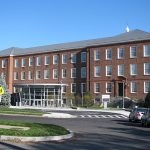
The Tenleytown school was built in 1935 and named after Woodrow Wilson, the nation’s 28th president and the only one buried in D.C., upon his death in 1924. The former president’s policies and prejudices, widely viewed among scholars as threatening to black Americans, came under the microscope at Princeton University in 2015, when student protesters urged the institution to remove Wilson’s name from one of its school buildings. Princeton eventually declined, but the discussion inevitably filtered to Wilson High, the District’s most-enrolled public high school.
Students, teachers, and administrators have been debating the merits of the name internally since then, and perhaps even before. With Tuesday’s forum, the school’s diversity task force has begun ramping up a public campaign for a name change. They have help from the D.C. History and Justice Collective, a group of D.C. residents raising awareness of black families driven out of Ward 3 during Wilson’s administration in the early 20th century. Still, discussions at the event confirmed that the matter isn’t quite as simple as erasing one name and writing another.
Proponents of the name change argue that Wilson’s policies of marginalizing black federal employees and segregating residential neighborhoods, among others, don’t reflect values that ought to be associated with the school community, which is among the most diverse in the city. Roughly one-third of current Wilson students are black, one-third are white, and 20 percent are Hispanic, according to D.C. Public Schools data.
Challenges to moving forward with a name change include resistance from critics and the cost of building new signs and branding materials. The process would also be lengthy—gathering community consensus, securing an endorsement from the local Advisory Neighborhood Commission, and eventually petitioning the D.C. Council.
When Kimberly Martin, the school’s principal since 2015, gave the forum’s introduction, she urged the audience to think about not just whether the name should be changed, but “about what it means to be a Wilson Tiger, what it means to be a student of color, an out-of-boundary student.”
“Whether it stays the same, whether it changes, that’s an important topic, but let’s set that aside and really talk about the kind of school we want to be,” Martin said.
During the two hours of panelist comments and audience Q&A that followed, approximately 100 current and former students and parents, teachers, concerned citizens, and community leaders remained largely quiet and respectful, aside from brief bursts of applause and laughter, and a few eye rolls. But tensions were high as conversations exposed new complexities.
Historians on the panel recapped Wilson’s perennially acclaimed policy achievements, like advocating for the League of Nations and establishing a nationwide standard of an eight-hour workday. Then they highlighted his efforts to ensure that federal employees rarely had to interact outside of their race, and to turning a blind eye toward acts of violence perpetrated against black D.C. residents, including during the five-day race riot of 1919.
Two student panelists said they rarely identify themselves as being from “Woodrow Wilson High,” but the president’s image inside the building and his name outside don’t sit well with them, or many of their peers.
“I know that his history doesn’t represent my history, doesn’t represent what I stand for, what I believe,” said Ayomi Wolff, a Wilson High junior.
Meanwhile, local resident James Fisher told audience members that in the 1910s, his black family was driven from its Broad Branch Road home in the neighborhood, their land claimed by the federal government for public works projects that eventually became Lafayette Elementary, Deal Middle, and Wilson High. A handful of descendants of Reno City, a black neighborhood formed near the current Wilson High site after the Civil War, remain there today—but their community was decimated by real estate developers and the federal government.
“Woodrow Wilson stagnated a whole race of people who helped build this country,” Fisher said. “He set us back…It hurts.”
Onstage, students, teachers, and historical experts all said they support changing the name, with the exception of John Milton Cooper, a history professor emeritus at the University of Wisconsin-Madison and a Woodrow Wilson biographer who graduated from Wilson High in 1957. Cooper advised caution on allowing Wilson’s racism to obscure his achievements in other areas or assuming that Wilson prioritized racial division among his issue priorities.
Support for the name change came from the audience as well.
“This event tonight is a small footnote in history,” one parent said. “In a knowledge-based democracy, we learn from the past and make changes in the future. This is the least we can do.”
But dissenting voices also rung out, arguing that removing the Wilson name would dampen school spirit for decades of graduates who treasure their diplomas, and that Wilson’s positive achievements outweigh his negative ones.
“I want my daughters to go to a school where they tolerate a diversity of thought, and teachers are open to having that thought,” said one parent of two Wilson students. “I don’t believe having that name puts a bad name on this community.”
Others took more conflicted positions. Hugo Keesing, a board member of the school’s alumni association, said much of the membership generally supports the name change, though some members worry that removing the name implicates them in racist practices over which they had no control.
Excising Wilson’s name from the school wouldn’t be unprecedented in the District or neighboring jurisdictions. Orr Elementary in Northeast last year became Lawrence Boone Elementary, renamed for the school’s first black principal after students discovered that Benjamin Orr, D.C.’s fourth mayor, had owned slaves. Since 2017, at least two Northern Virginia schools — Washington Liberty High in Arlington and Justice High in Fairfax — have shed their Confederate namesakes. Just last week, the Montgomery County Council president urged Brooke Lee Middle School in Silver Spring to change its name because E. Brooke Lee implemented racially restrictive policies while serving in the Maryland state government.
These conversations aren’t new to Wilson either. A 2016 op-ed in the school’s student newspaper, the Wilson Beacon, called renaming the school “a vital step in the path to social justice.” During Tuesday’s event, Michelle Bollinger told the audience that her Wilson High history students vote at the end of each year on contenders to replace Woodrow Wilson. Recent victors include gay rights activist Frank Kameny, NAACP luminary Archibald Grimke, and statehood advocate Hilda Mason. Last year’s winner, according to Bollinger? Cool “Disco” Dan.
Martin, the school principal, told DCist the discussion went exactly as she’d hoped, and nothing like she’d feared. She hasn’t publicly taken a position yet but expects to facilitate more community discussions in the coming months.
At the beginning of the event, Martin had warned audience members that such topics often prompt tears and expressions of guilt and anxiety. Seeing people with opinions across the spectrum searching for common ground left her optimistic that the process will be productive.
“I didn’t sleep at all last night,” she said. “I’m going to go home and sleep like a baby tonight.”