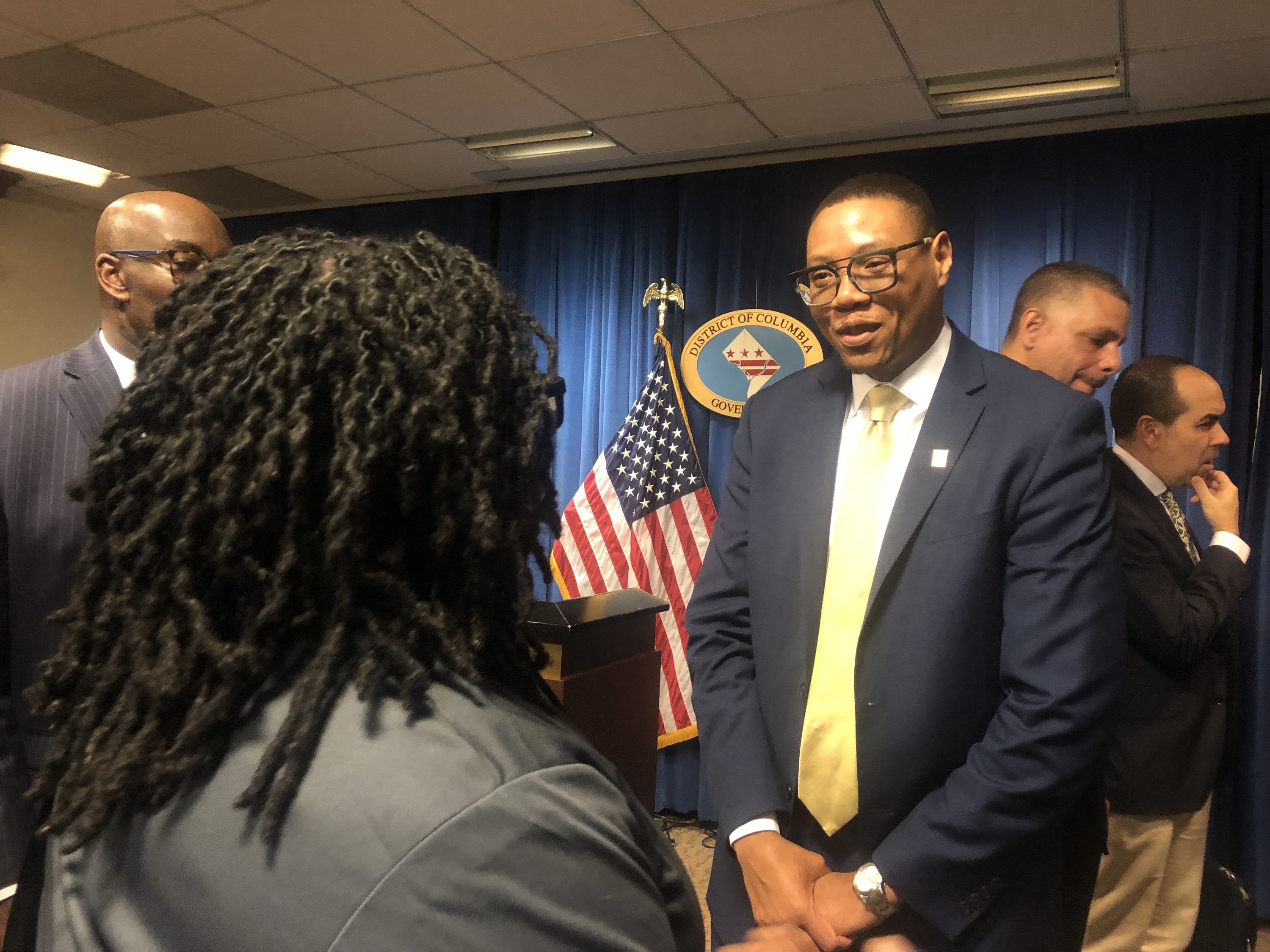
The top three educational leaders in the District of Columbia all have one thing in common: they’ve all studied under a wealthy philanthropist’s educational leadership program that promotes a business perspective in the management of public schools and the use of charters.
The D.C. state superintendent Hanseul Kang, the deputy mayor of education Paul Kihn, and acting schools chancellor Lewis Ferebee have each been through training at the Broad Center for the Management of School Systems, which houses both the Broad Academy and the Broad Residency in Urban Education.
Those who support the training program say it offers a unique corporate-like training experience for school leaders and helps them form lasting friendships. Critics of the program say the teachings encourage school leaders to undermine democratic control of public education by making top-down reforms and promoting charter schools.
There have been hundreds of school leaders that have gone through Broad training, including former DCPS chancellor Antwan Wilson. Kaya Henderson was also named a superintendent in residence at The Broad Center in 2017. But, if Ferebee is confirmed, this will be the first time all of D.C. Public Schools’ top public education leaders will be Broad scholars.
What Is The Broad Academy?
The Broad Superintendents Academy was formed in 2002 as an alternative school leadership program by billionaire philanthropist Eli Broad. Broad Academy officials did not respond to repeated requests for comment from WAMU, but their goals and history are publicly documented by many of their founding leaders.
The original goal of Broad’s academy was to recruit leaders from outside of the education sphere and train them to use corporate strategies to manage urban public school districts, according to founding Managing Director Tim Quinn, who wrote about the goals of the Academy’s mission extensively for the School Superintendents Association.
Quinn described students as “products” in his writing and compared district leaders to “CEO[s] of a major corporation” to emphasize the business perspective the program took.
Throughout the years, however, many school leaders from a variety of backgrounds, including education, have entered the program. Program officials have also promoted their focus on equity, or closing achievement gaps between white and minority students.
Ferebee says during his tenure at the Broad Academy between 2017-18, the scholars also studied the leadership styles of people like Martin Luther King Jr. and Gandhi.
“When you are studying leadership and change theory, there is a lot that you can learn from the business sector, and we obviously take advantage of that,” Ferebee said in an interview with WAMU. “[But] it’s not limited to business principles.”
Seeking Efficiency And Equity
In Quinn’s explanation of the program, maximizing student outcomes is the equivalent of maximizing profits. Ferebee says it’s possible to merge these business concepts with equity in public education.
“Maximizing resources is obviously a part of the business community. Often times it is how you impact your bottom line,” Ferebee said. “Maximizing your resources is also one way to address equity, ensuring that you get the most out of the public dollars you have access to.”
Ferebee put that philosophy into practice in Indianapolis, where he was superintendent for the last five years. There, he says, he saw a lack of communication between traditional public schools and charters that resulted in oversaturation of schools in certain neighborhoods and a lack of “quality” options in others. So he sought to maximize resources, and part of that included communication with charter schools about where new schools would be opened.
It also included sometimes closing or merging campuses that were under-enrolled. In Indianapolis, he closed three out of seven district-run high schools, despite community opposition, according to the nonprofit education news website Chalkbeat.
During a confirmation hearing last week before the D.C. Council, Ferebee told council members: “There was oversaturation [of schools] in certain communities that were draining public resources where there was underutilization.”
He also noted that this is something he may need to think about in D.C.
“I think that if we had several under-enrolled schools [in the District of Columbia], regardless of the type in a particular neighborhood, I think it bears the conversation of how we could better utilize those resources,” Ferebee continued.
Charting A Pathway For Charters
Part of the Broad Academy lessons, according to Quinn, teach school leaders strategies for using charter schools and other choice models in their districts.
Ferebee and Kihn, who was the deputy superintendent of the School District of Philadelphia for three years before coming to D.C., both used school turnaround methods that often resulted in low-performing public schools being converted to charter management.
Both leaders said they didn’t plan on repeating what they did in their previous districts, but both also said they wanted more opportunities to “collaborate” with the charter school sector in D.C.
More Bang For Broad’s Buck
Eli Broad, who founded the Broad Center for the Management of School Systems, is known as an “aggressive advocate” for charter schools. He is also a different kind of philanthropist, one who says he wants a return on his “investments.”
Unlike most education philanthropists, who have focused investments on classroom-level goods and services, Broad has focused his wealth on changing district leadership. At a business forum in Los Angeles in 2008, Broad said the “return” on his education investments would be increased academic achievement for students.
In Los Angeles, Broad has donated large sums of money to pro-charter school groups that advocate for political candidates. Last year, he gave about $1.5 million to Families and Teachers for Antonio Villaraigosa for Governor 2018, which is sponsored by the California Charter Schools Association, according to the Los Angeles Times. He also donated nearly $1.9 million in 2017 to help charter advocates win a majority of seats on the Los Angeles Board of Education. Those donations helped to make that election the most expensive school board race in U.S. in history.
The Broad Center for the Management of School Systems, which houses both the Broad Academy and the Broad Residency in Urban Education, has received over $90 million from the Broad Foundation, according to the organization’s website.
When asked about venture philanthropy, Broad told the business forum audience during the 2008 interview, “I think we are all looking for a return and not just writing checks to maintain the status quo.”
‘Undermining Democratic Control Of Public Education’
Vachel Miller, an associate professor at Appalachian State University, teaches courses on education and leadership and is critical of Broad and the superintendent training school.
“The new philanthropists … use their vast resources to influence the system in the way they want to see it,” Miller said. “And a lot of people are concerned that it is really undermining public education and democratic control of public education because they can have so much influence on their own terms.”
Miller is concerned about the corporate outlook on education that the Broad center promotes. He does note, however, that the academy has offered “healthy” competition in the school leadership training realm.
“They are trying to do a very applied, very intense leadership training … They are doing some things that we can probably learn from,” Miller said.
Miller added, “It’s a heavy influence they have, and they are tilted in a certain direction.”
He says that traditional university leadership programs don’t often have the resources to strongly promote particular ideologies the way philanthropists do.
Ferebee says the program didn’t give him a “blueprint” of what to do, instead he felt like there were a lot of open discussions. It did teach him business theories like customer service, ideation and forecasting for the future, and he thinks the education world can learn from those practices.
“You have to be thinking about what is your next, new way of thinking and new way of teaching and learning,” Ferebee said. “That’s something that sticks with me today in the work that I do, and I am pleased that we do have a design arm in DCPS and we are thinking about new ways of learning and forecasting for the future.”
Although Ferebee hasn’t been specific about what those “new ways of learning” would look like.
This story originally appeared on WAMU.