Natalie Delgadillo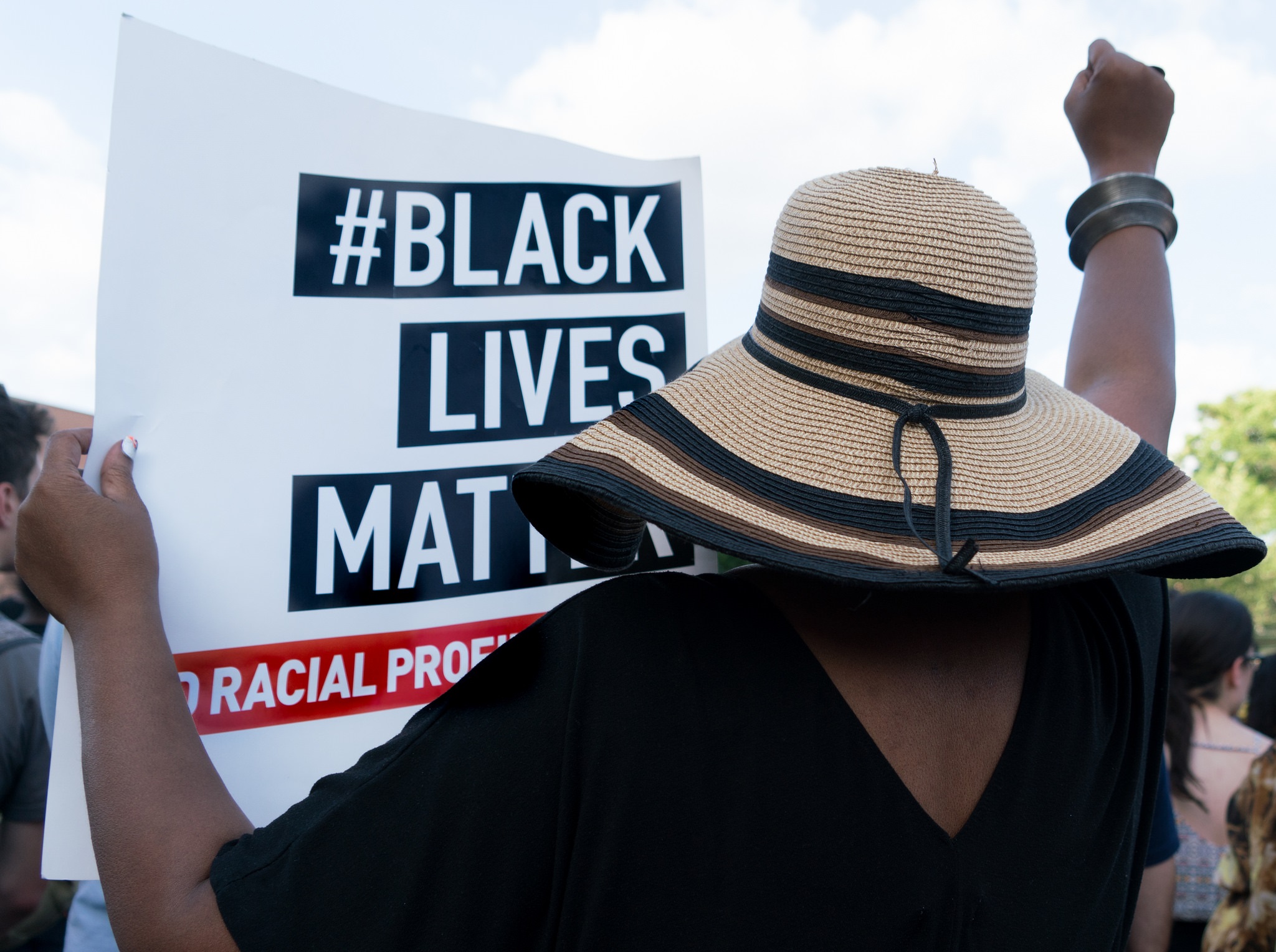
A D.C. Superior Court judge last week rejected a prominent D.C. Black Lives Matter activist’s request to compel D.C. police to hand over documents she says indicate that the Metropolitan Police Department has been surveilling her for years. The ruling ends a years-long court battle over the documents, which April Goggans claims will show Metropolitan Police Department officers have been watching her home and even following her in police cruisers around the city.
The judge, William Jackson, ruled that MPD had met its obligations to provide Goggans with relevant documents under the Freedom of Information Act. Now, she and her lawyers are looking at their potential next steps.
Goggans is a core organizer for the D.C. chapter of Black Lives Matter, a group that has often protested the mayor and D.C. police department over matters including stop-and-frisk practices and the fatal police shooting of Terrence Sterling in 2016. Goggans contends that in 2015, shortly after she and a group of other activists disrupted a mayoral press conference in which Mayor Muriel Bowser announced new tough-on-crime policies, she began noticing elevated police presence around her and her home in Southeast D.C.
With time, she began to suspect that she was being surveilled in her capacity as an activist. In 2017, she filed a Freedom of Information Act request to try to get her hands on internal police documents that would prove it. She asked for any documents having to do with police “monitoring and surveillance” of her in the filing. MPD has denied that it has any responsive documents. Goggans does not believe them, leading her to sue the department for not fulfilling its obligations under FOIA law. That case has been winding its way through the courts for years.
In court filings and conversations with DCist last month, Goggans says that when her involvement with BLM grew, she started noticing police cruisers parked around the front and back entrances of her home. Once, she says that an officer parked in a car outside her home knocked on her door and asked for her full name. Another time, she says that officers stopped and questioned her guests as they left a community event at her home. She says that police officers shone flashlights into her windows once while she was having a meeting in her home, and that, for a period of weeks, another police cruiser parked across the street from her home and shone its lights into her bedroom window. While she was in a car with her friend, she contends that she saw an MPD cruiser behind them and began taking completely random turns to see if the cruiser would follow. “They followed us for like 20 minutes,” she said.
MPD contests Goggans’ characterizations of many of these events—in court filings, it says that the flashlights in her windows, for example, were because officers were responding to a domestic violence call at a neighbor’s house when they saw someone run into a backyard. They had to turn their flashlights on because it was dark, the department contended. Moreover, even in cases where the department did not directly contradict Goggans’ claims in the court filings, it argued that Goggans had no proof the department had created any paperwork to reflect what happened.
“Even if the Plaintiff was followed as she believes, it does not demonstrate that documents were created to reflect this activity,” the department said in a court filing.
The gist of Goggans’ legal argument is that MPD was searching its database in bad faith. At one point, a broad search for several terms, including two different spellings of Goggans’ last name (which could have referred to other individuals with that last name), her specific Twitter handle, and her address turned up 9,000 pages of documents. The problem was that MPD did not deem any of those documents “responsive” to her FOIA request because they did not have to do with monitoring and surveillance.
Goggans and her lawyers at the Georgetown Law Civil Rights Clinic argued that MPD was applying an unnecessarily strict definition of the words “monitoring” and “surveillance” when it decided that none of the documents that turned up applied. MPD was excluding any documents or communications that might exist recording run-of-the-mill police work, like officers watching Goggans’ home, according to court documents. Goggans wanted them to apply a basic, dictionary definition of “monitoring and surveillance” when deciding what documents apply to the FOIA request.
A D.C. Superior Court judge heard arguments in a summary judgment hearing last month. Last week, Judge William Jackson issued a ruling in favor of MPD, holding that the department had met its obligations under FOIA law.
“MPD conducted its searches based on the language of Plaintiff’s FOIA request, and searched places that were reasonably likely to have records responsive to Plaintiff’s requests,” Jackson wrote in the order. “The fact that the searches did not turn up more responsive documents does not make the search unreasonable.”
Andrew Mendrala, a supervising attorney at the Georgetown Law Civil Rights Clinic, says he is “disappointed that the judge didn’t engage more directly the argument we made that MPD was using really technical and jargony and bureaucratic explanations to refuse producing the documents that they have sitting in front of them and ready to hand over.” He says that both the clinic and Goggans are “exploring all options to figure out what makes the most sense for her” in terms of continuing to try to obtain documents from MPD.
“I think it’s certainly not the outcome that we or Ms. Goggans expected, and we certainly don’t think it’s the right outcome,” Mendrala says.
MPD did not respond to a request for comment on the judge’s ruling.
Previously:
A Prominent Black Lives Matter Leader Is Suing D.C. Police To Prove She’s Been Under Surveillance