 Jordan Pascale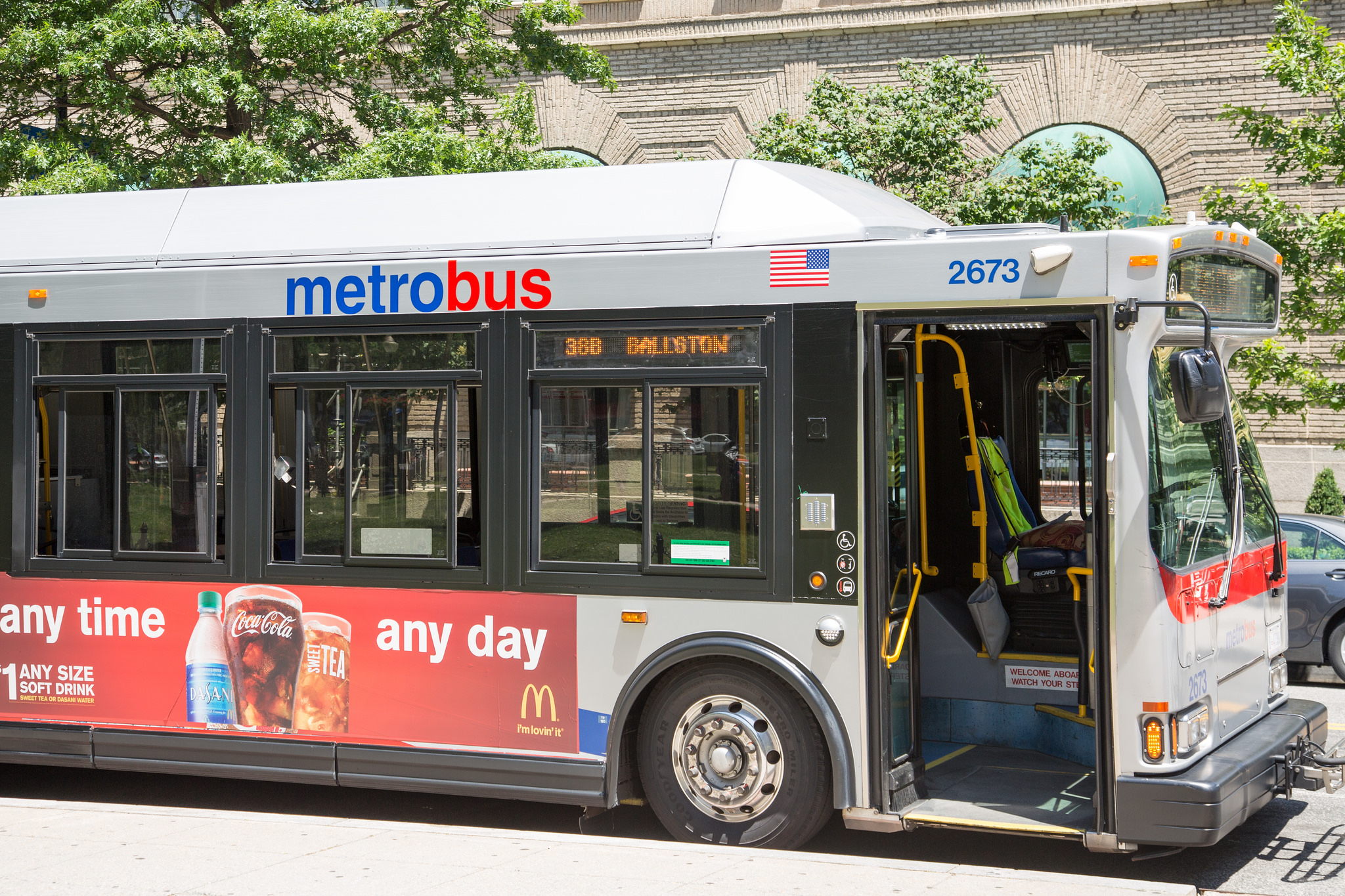
If you’ve ridden Metrobus in the past few months, you’ve probably heard something more than just the usual “Next stop is…”
For the last few months, Metro has run GPS-enabled audio ads on certain bus routes promoting everything from spring break transportation to local hospitals. And people are starting to notice.
The ads are bringing in money — $250,000 a year over five years — at a time when Metro needs it. A recent report highlighted advertising as one way to raise money to address Metro’s budget concerns, and one marketing professor says that while some riders are upset about the ads now, that ire will fade over time.
Rider Reaction Varied
A Northern Virginia Community College ad, among others, took Tajha Chappellet-Lanier by surprise when she was riding the 42 bus recently. She found it so striking that she tweeted about it.
they are playing ads for things like megabus and GW hospital in this WMATA bus and that seems….. new? ?
— Tajha Chappellet-Lanier (@TajhaLanier) February 14, 2019
“It feels like a new level for sure,” Chappellet-Lanier said. “We’re constantly surrounded by advertisements, so conceptually it’s not strange… but it felt quite different.”
She isn’t alone.
Just heard a Megabus ad on a @wmata bus. Is that new?
— Chris Kelly (@leninstomb) February 19, 2019
Ok @Wmata I am fine with one ad per 45min on the bus. My bus just played 5 consecutive ads. That’s too much. #wmata
— WMATAstuff (@wmatastuff) January 15, 2019
NOT A FAN of these auditory ads on the bus @wmata. As if the dc metro experience wasn’t dystopian enough @unsuckdcmetro
— Sam Klein (@SamKleinOnline) February 14, 2019
Chappellet-Lanier knew the transit agency was strapped for cash, but she wondered if the ads could really be bringing in much money. And, if so, how much?
“I felt like it couldn’t be that much,” she said. “It didn’t seem like they were, I don’t know, it didn’t feel prestigious.”
As it corresponds to the overall Metro budget, Chappellet-Lanier was right.
Acting On Recommendations
The $250,000 a year Metro collects from the program is an infinitesimally small amount of the transit agency’s $3.4 billion annual budget — about .007 percent.
Metro did not make staff available to explain the decision, but sent a statement saying it has an obligation to customers and taxpayers to maximize revenue.
The statement said that Metro is always looking for new ways to help keep fares stable while maintaining service.
Indeed, the 2017 report by former Transportation Secretary Ray LaHood highlighted several ways for Metro to right its financial ship.
LaHood Report – WMATA by on Scribd
It found Metro was making the least amount of money from advertising when compared to other large transit agencies. The report also suggested that Metro has the capacity to boost ad revenue by $10 million a year.
The advertising revenue stream is among the less lucrative recommendations in the report, but one of the first to make it down to riders.
Metro has added more print ads on turnstiles and the exterior of trains in addition to the audio ads on buses.
“It’s in their best interest and their fiduciary duty to find every penny possible,” says Russ Gottesman, CEO of Commuter Ads, the company providing the technology for the ads.
Location, Location, Location
Gottesman founded the company 11 years ago when he was riding a train home after a baseball game in Chicago. He was hungry and thought, “Why can’t restaurants advertise deals before each stop?”
Now the audio ads are in 14 cities. Targeted, 15-second ads play over the speakers at relevant points on the route.
As the bus gets near a stop with a college, you’ll hear about spring break vacation deals; near a hospital, you might hear ads trying to recruit nurses. Gottesman and Metro both say businesses are interested.
“We want to make sure they’re a valuable addition to the commute,” Gottesman said. “If it’s relevant to you as a rider and you’re interested in it, you’ll engage with it.”
But some riders say the ads invade their commute and make them want to ride the bus less. They consider the bus their space to decompress after work.
Katherine Kortum, head of Metro’s Rider Advisory Council, said the group wasn’t consulted before the change. Anecdotally, she hasn’t heard any positive reviews.
“We’ll Get Used To It”
Georgetown University marketing professor Rebecca Hamilton says that riders have been noticing the audio ads because they’re new.
“After a while, when we adapt to it, it may not be such a big deal,” Hamilton said.
She says ads have proliferated over time. In the 1970s, people were exposed to about 500 ads per day. Now it’s 5,000 a day.
“If you think about display ads online, consumers hate them,” Hamilton said. “And yet, companies still use them, because they’re able to grab the consumers’ attention, and they can show [the ads] work.”
So, it might not matter if people like the new ads or not. They’re now more subconsciously aware of a brand.
Some riders are concerned that audio ads may make their way to Metrorail, but Metro says there aren’t currently any plans for that.
And Metro probably won’t get as extreme with its advertising as one company in South Korea. Hamilton said that Dunkin’ Donuts piped the smell of coffee into buses in Seoul. The scent was paired with an audio ad on the bus that suggested riders go to the coffee shop when they got off.
Print ads? Check.
Audio ads? Check.
Scented ads? Well, not yet.
This story originally appeared on WAMU.