 Mikaela Lefrak
 Lori McCue
The D.C. government introduced a mammoth project on Thursday evening: The city’s first-ever Cultural Plan. The 224-page document describes the Washington’s cultural community in detail and lays out a plan for growing it through investments, infrastructure, and programming.
The Cultural Plan was an inter-agency effort five years in the making. It was developed by the D.C. Office of Planning, “in consultation with” the D.C. Commission on the Arts and Humanities and the D.C. Office of Cable Television, Film, Music and Entertainment, and it includes input from more than 1,500 artists, art consumers, and experts from the cultural sector, according to Mayor Muriel Bowser’s office.
Still, the city government’s relationship to the arts community—and the Cultural Plan itself—hasn’t been without controversy in recent months.
When a draft of the plan was released last April, a group of local artists wanted it to be revised to focus on keeping artists in the city. As the Washington City Paper reported at the time, “a lot of people in D.C.’s numerous creative communities—artists, musicians, dancers, actors, educators—are skeptical of the Cultural Plan. Not the idea of it … but rather, what it lacks and how the agencies that authored it will put it into action.”
And now the release comes amid concerns over Bowser’s plans to reorganize the Commission on the Arts and Humanities, which oversees public art projects (DCCAH caused a minor uproar last year when it slipped a new amendment into its agreement for grant recipients banning “lewd, lascivious, vulgar, [or] overtly political” works. After backlash, it was scuttled within a week.)
A bill proposed last year would place DCCAH under the mayor’s control as a new Department of Arts and Humanities and expand its purview to include “cosmetology and culinary arts.” The Washington City Paper reported this week that Bowser plans to reintroduce that legislation.
Rouse-Rosario says the change—if it happens—wouldn’t affect the Plan’s implementation.
“If the mayor were to introduce more legislation, it just heightens our ability to do what we do, because it clarifies for everybody what our relationship is with the District of Columbia. Which is, we are the District of Columbia,” she says.
Bowser formally unveiled the Cultural Plan at the Anacostia Playhouse on Thursday night. Here’s five takeaways from the report:
1. Affordability is the biggest issue facing artists and arts organizations. Surprise!
Artists are more likely to be burdened by the city’s ballooning housing costs than many other residents, according to the report. On average, artists in Washington spend 39 percent of their income on rent.
That figure might be leading new artists to settle outside the District. While the number of artists in the metropolitan region grew by 20 percent over the last decade, the share of artists living in D.C. remained flat.
Struggles with rent extend to cultural organizations and businesses, too. More than 70 art galleries have closed in the city since 2005, and closures have far outpaced openings. Small arts organizations with budgets under $250,000 spend 31 percent of their budgets on rent. The Cultural Plan notes that those costs result in “lower compensation for staff and lower levels of programmatic investment.”
One of the Cultural Plan’s recommendations only highlights the extremity of the problem: The city plans to develop a toolkit aimed at the cultural community with consolidated information about government-funded housing programs, including homelessness assistance.
2. The city is creating two funds in an attempt to help with costs.
Mayor Muriel Bowser’s budget earmarks $8.4 million for the Cultural Plan. Most of that money will go towards two funds: $5 million for a Cultural Facilities Fund and $2 million for an Innovation and Entrepreneurship Revolving Loan Fund.
The Cultural Facilities Fund aims to help small- and medium-sized cultural organizations secure long-term leases in commercially owned buildings. “People in this industry often don’t have access to that type of credit mechanism,” says Terrie Rouse Rosario, the acting director of the Commission on the Arts and Humanities, who was appointed by Bowser in December.
The other fund will provide smaller loans—typically less than $50,000—with repayment terms of less than a year. Those loans will be aimed at artists looking to, say, buy merchandise to sell at concerts or purchase equipment without relying on credit cards or unsecured business loans.
The funding for those programs has been redirected from three grant programs managed by the D.C. Commission on the Arts and Humanities, according to WCP.
The city also plans to create a tax credit programs to encourage property owners to incorporate cultural spaces with affordable rents in their developments.
3. There are 310 musicians living in D.C.
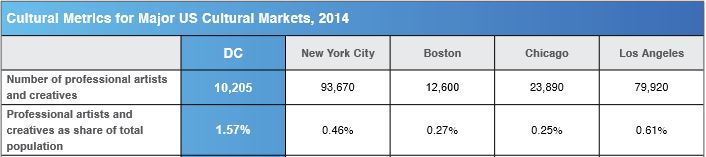
Well, not really. But the city did try to measure how many people work full-time in cultural occupations, based on Bureau of Labor Statistics data. It found there are 310 musicians, 300 photographers, 60 actors and 20 dancers, to name a few.
Despite these seemingly low numbers, the report says that D.C. residents are three times more likely to be professional artists than New Yorkers and six times more likely than Chicagoans on a per capita basis.
Some members of the cultural community say these numbers vastly underestimate the number of working artists in the District. The Office of Cable, Television, Film, Music, and Entertainment is working with Georgetown University to release a music census this year to better measure the city’s music industry.
4. The city needs to improve how it manages its public spaces.
Interest in using public spaces for cultural events has grown dramatically, but the process can be a nightmare.
Organizers who want to host events like parades or bike rides in the city’s streets or parks might need to get permits and approvals from a half dozen city agencies. Prices for using public facilities aren’t standardized either.
The Cultural Plan outlines some planned fixes, including creating an online portal to streamline the permitting process, reviewing the city’s noise ordinances, and developing “frequent expression zones”—a formal name for spots in commercial areas where people can perform without needing a bunch of permits.
“Our roads are for cars, but they’re for people too, and they’re for cultural organizations,” says Andrew Trueblood, the Office of Planning director.
5. The arts have a major impact on D.C.’s economy
Data collection aside, it’s clear that the arts are important to D.C.’s economic health. The cultural industry is responsible for more than 150,000 jobs and $12.4 billion in wages, according to an economic impact analysis from 2016.
D.C. Cultural Plan by on Scribd