Martin Austermuhle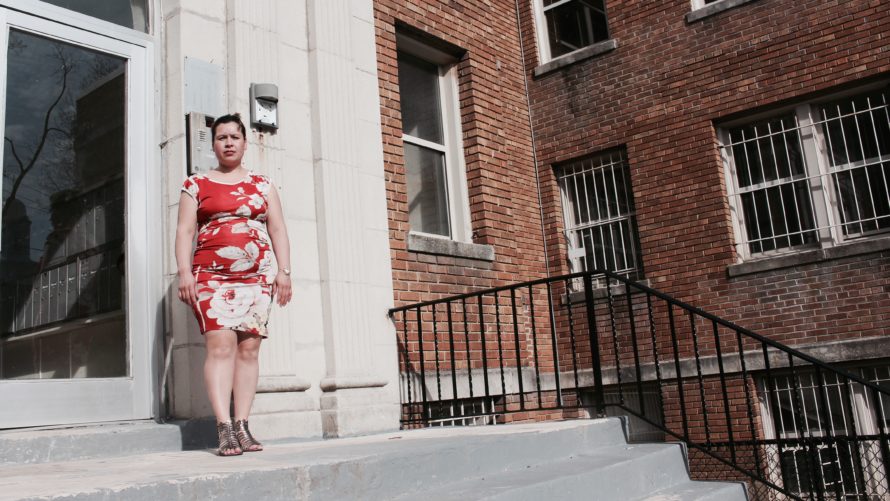
The walls of Dania Rivera’s apartment building have a unique feature.
“I have a saying that these walls, it’s like they’re pregnant and they’ll give birth any minute,” she says in Spanish, laughing morosely.
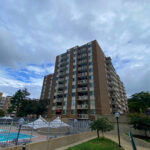
The unnatural state of the bulging walls is in part because of water-logged and moldy insulation. It’s one of a menu of problems Rivera, the president of the tenant’s association, rattles off during a tour of the 39-unit building located at 5320 Eighth Street NW in Brightwood Park.
“The electricity, the plumbing, the heating, the walls that aren’t insulated, and rats and cockroaches,” she says of the complaints residents have had with the aging building. “The truth is that this building was basically abandoned.”
Not abandoned in that it didn’t have residents living there, she says, but rather ignored by its owner, a Virginia-based limited-liability corporation. Things got so bad that at one point last year Rivera and some of her neighbors — many of whom are low-income — went on a “rent strike,” refusing to pay any rent because of the conditions they said they were living in.
To address what Rivera says were significant housing code violations — including a faulty electrical system the resulted in a fire in late 2017 that displaced six families — D.C. Attorney General Karl Racine opted for a simple solution last year: he got someone else to start making the repairs the owner wouldn’t.

A notice of receivership hangs in the lobby of 5320 Eighth Street NW.Martin Austermuhle / WAMU
Known as receivership, Racine’s request that a D.C. judge turn the building over to a temporary guardian charged with overseeing necessary repairs and upgrades is part of what housing advocates say is a newly aggressive — and long overdue — approach to force landlords to keep their housing in habitable condition.
The building on Eighth Street was the fourth residential building Racine had successfully gotten turned over to a receiver; a request for a fifth building is currently pending in Superior Court.
“We’ve seen cases where, candidly, the landlord cannot be trusted to make the repairs that are necessary because in many instances they’ve had months and years to do so and haven’t done so,” says Racine, who often uses “slumlords” to refer to the worst of the owners he deals with. “In those cases, we’ve sought the appointment of a receiver.”
So far, those receivers have overseen hundreds of thousands of dollars worth of repairs, and in some cases wholesale renovations are taking place. In Rivera’s building alone — where a receiver was appointed in late December — the estimated price tag for the necessary fixes is roughly half-a-million dollars.
During an initial inspection of Rivera’s building in January, four gas leaks were discovered, requiring the gas to be turned off — which impacted heat in the building for a week. The building’s boiler was found to be unsafe, certain areas were determined to be structurally unsound, and the infestations of rats and cockroaches were reported. In his initial report to the court, the receiver said that the “single largest contributing factor to the Property’s dangerous condition is its ownership.”
The owner of the building did not respond to a request for comment, but in court filings says repairs had been made over the years and that some of the problems stemmed from the residents themselves.
Housing advocates say Racine isn’t the first attorney general to use receivership to improve housing conditions at some of the city’s worst residential buildings. But he is the city’s first independently elected attorney general, and he’s using the tool more aggressively than his predecessors did.
“We have seen a significant uptick in the housing work that the attorney general’s office has been focused on even in the last two or three years,” says Rachel Rintelmann, a housing attorney with the Legal Aid Society of D.C.
Tenant organizers like Rob Wohl of the Latino Economic Development Corporation cheer Racine’s use of receivers. Wohl, who has organized in other buildings where receivers have been appointed, says that the attorney general came to a realization he says many housing advocates have long been aware of: the normal process of fining landlords wasn’t always working.
“The problem with that is that a lot of landlords have a business model where they’re trying to vacate their properties by neglect. They’re trying to make them uninhabitable so tenants will leave. And the fines are just not enough to change the economics of that business model,” he says.

D.C. Attorney General Karl Racine.Tyrone Turner / WAMU
Even the D.C. Department of Consumer and Regulatory Affairs, which conducts housing inspections, has admitted its current system isn’t working. This week it said that of the 30,700 inspections of properties by DCRA inspectors over the last three years, only in 10 percent of cases were problems abated.
And receivership is not the only new tool Racine is using to go after bad landlords. He says that in the worst of cases, he’s forcing them to pay back the rent that tenants already paid.
“It is of course a great deterrent to those would-be slumlords who now know that in addition to having a receiver come in, they also will be called upon go into their pocketbooks and purses and bank accounts to pay back tenants,” he says.
In one building on 11th Street in Columbia Heights, Racine got the two: a receiver, and back payments to tenants for the time they had lived with housing code violations. And attorneys in Racine’s office forced the owner of the building — who lives in Florida — to pay for all of it out of his own pocket.
But for as much as these new approaches to getting housing up to code has it supporters, it also has its downsides. Mostly, it takes a long time to get a receiver appointed or to force a landlord to pay back rent.
“By the time gets to a point where it’s referred to the attorney general or where it’s on their radar, it’s often been years that the property has been languishing in pretty terrible conditions,” says Rachel Rintelman, a housing attorney with the Legal Aid Society.
The worse the conditions, the more work that’s needed. And as Wohl said he’s experienced with some of the buildings that have gone into receivership, that means fully moving tenants out so extensive renovations can be done.
“If you want to replace plumbing, if you want to replace heating systems, if you’re going to rip a bunch of mold out of the walls, you need to empty the apartments first,” Wohl says. “Relocation is a real challenge. There are so few existing affordable apartments it can take a long time to lease people up in another place.”
That could well be the case at the next building Racine is targeting on Hamilton Street NW. The building had been owned by a notorious D.C. slumlord for decades until 2017, when it was sold to a new owner. But residents say circumstances still haven’t improved there.
Racine says there’s only so much his office can do. It has four attorneys and two investigators working on housing cases. He says that more could be done to help relocate residents when they have to move because of significant repairs that need to be done.
“If the condition of the dwelling is so bad that folks can’t live in that condition, it would seem that allowance for temporary housing, perhaps coming out of the bad landlord’s pocket, would be yet another tool,” he says.
Rivera says she’s happy that there’s a receiver for her building now. But, she says, the pace of change is still too slow given what she and her neighbors have endured.
“We’re not going to give up until we get what we want,” she says. “What do we want? To live in a safe place, a good environment for us and for our kids.”
This story originally appeared on WAMU.