Rachel Kurzius
Update, 4/10/19: The Metro PCS store is cranking go-go once again. T-Mobile CEO John Legere tweeted that “the music will go on and our dealer will work with the neighbors to compromise volume.” Read the full story here.
Original:
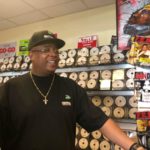
For 24 years, Donald Campbell has been playing go-go music from his Metro PCS storefront in Shaw, at the corner of 7th Street and Florida NW. Until now.
Campbell says that T-Mobile, which acquired Metro PCS, reached out to him about a month ago: “They said, ‘get rid of the music.’ It came from up top that we had to get rid of it,” he says.
According to Campbell, T-Mobile told him that a nearby resident threatened the company with a lawsuit over the sounds that have blared from the speakers since 1995. He says that he had to turn off the music two weeks ago, and since then, “Every day all day, people think we’re closed. People have been complaining, asking what’s going on.”
He’s still been playing the music inside the store, but “the vibe is totally different,” he says. (Some people have said they’ve heard the go-go more recently than that, which Campbell attributes to the speakers inside. “If you walk by, you can hear it a little bit,” he says.)
“Generations of Howard students, generations of people know that I play music every single day,” says Campbell. The shop houses smaller businesses that offer repairs, and sells phones and go-go CDs. “We started selling [go-go] tapes, now we’re selling CDs,” he says. As a former club owner, he says, “I always liked the go-go bands, I always tried to keep the music alive.”
The identity of Campbell’s store, incorporated under the name “Central Communications,” is so closely intertwined with the music known to play out front that three of the four Yelp reviews mention it, and one is solely about the go-go. “I cannot speak on the phone services. I try not to drop my phone,” says one reviewer. “My two visits were to buy music that I’ve heard playing … For $10.00 you can get a nice Cd to play for a weekend trip, a cookout or to kick it old school with family and friends.”
Campbell is speaking with T-Mobile higher-ups again on Monday evening, he says, and hopes to reach a resolution that will allow him to turn up his speakers again. T-Mobile did not respond to DCist’s request for comment.
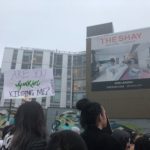
According to Campbell, the complaint came from a resident in The Shay, a nearby luxury mixed-use development. “We can’t confirm or deny that,” says the person who answered the phone at The Shay’s office, and declined to provide their name. “There have been complaints about the music being extremely loud, but it’s not just The Shay. It’s people who live all over or are visiting the area. It’s not The Shay that has the issue.”
The building, which was developed by JBG Smith, said in a public statement following the publication of this story that it is “not involved in any action regarding the Metro PCS store. The opinion of a purported resident is theirs alone and does not represent The Shay, or the entirety of its residents or management.” While the statement doesn’t specifically take a stand on the music’s volume, it goes on to say that “We respect the importance of Go-Go music to the local and indeed regional culture. We believe we can all enjoy Shaw when we respect one another.”
The question of the go-go music from the store hasn’t come up in the area’s Advisory Neighborhood Commission, according to Robb Hudson, an Advisory Neighborhood Commissioner in 1B, which includes Metro PCS. “In my five years on the ANC, we have never once discussed the music from the Metro PCS store … I’ve never had a conversation about it. And it has never once been mentioned, in my recollection, at any of the open meetings the ANC has had (that I’ve attended),” he tells DCist via Twitter direct message.
Yet, for Anita Norman, the commissioner for 1B01, which includes the Metro PCS storefront, the volume of the go-go music “has been such a problem for years.” Norman was born in D.C. and went to Howard University, and has heard the sounds for decades. “I don’t have a problem with the music,” says Norman. “I have a problem with anything that disturbs the quality of life of residents, whether it’s music coming from them or a nightclub. I’m all for them playing music, but at a reasonable volume.” She says that the sound from the speakers was so loud, that “people who are blind and rely on a little beep sound to cross the street were unable to hear because of the music.”
Norman says she’s relieved to hear that the store has moved its speakers inside. She says that she has contacted city agencies ranging from the Department of Consumer and Regulatory Affairs to the Department of Transportation to assist residents in getting the volume turned down, and representatives of those agencies have measured the decibels from Metro PCS. But because of how noise is measured under current law, she says, the store is not in violation of sound regulations so “no one will do anything—that’s the dilemma.” The D.C. Council is working on a bill this session to address challenges officials face while measuring sound by limiting music played through amplified devices in the city.
Campbell says he has been visited before by police officers telling him to turn his music down, especially in the last five years, but “nobody has ever written up anything on me ever.”
Community activists including Ron Moten are organizing on behalf of Campbell and his right to play music. “The community has been pressing him to say what’s going on, but he’s been reluctant [to share] because this is his livelihood,” says Moten. “He wants to save his culture but this is his livelihood.” Moten has started a petition to call on T-Mobile to “bring back the music.”
Moten characterizes the fight over noise as “an ongoing thing that’s been going on for decades.”
Since one tweet called out the lack of music at Metro PCS on Saturday, people have been using the hashtag #DontMuteDC to talk about the situation. The hashtag is currently trending locally.
“If you choose to live in the U street area, and complain about the gogo, you are an awful, entitled dork who shouldn’t be given any voice or power,” wrote one user. Another tweeter reminded folks that “it’s not JUST a Metro PCS, but one of the last dedicated gogo shops in The District. Go in and buy a few PA CD-Rs (5 for $25!) to show yr support until the music comes back on.”
And Derek Brown, business owner of the Drink Company pop-up space down the block, wrote that “Shutting down the Go-Go music piping out of Metro PCS on Georgia Ave. makes Shaw a less lively and vibrant place. Especially as they put up plaques commemorating the music on the block. Turn it back on and turn it up.”
Ward 1 Councilmember Brianne Nadeau, who represents that portion of Shaw, characterized the news as “frustrating” in a tweet. “People have complained to me about this over the years, but I’ve always said that a small business playing go-go in Ward 1 is a thing we should celebrate,” she wrote. “They only do it during business hours, and there are always people outside enjoying it.”
At-large Councilmember Robert White chimed in on Twitter, too. “When I drive down the Ave, I turn off my radio & roll down my window to hear gogo as I pass the corner of Georgia & Florida,” he tweeted. “I love that people move here from around the globe. But welcoming the new can’t come at the expense of our culture.”
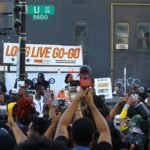
There is an unofficial “emergency go-go protest rally” planned for 6 p.m. on Monday night in support of the Metro PCS, though Campbell will not be in attendance. One of the event’s organizers, We Act Radio co-founder Kymone Freeman, says the idea is to “impress upon T-Mobile is that this man is within the law, and basically everyone who patronizes his business is in support of [playing the music], the community at large is in support, and that should trump the complainants.” Freeman says attendees can expect a “classic go-go party” at the protest, which is organized by We Act Radio, Listen Local First, WPFW, and D.C. Music Review.
“Gentrification is cultural genocide, and this is an example of that,” says Freeman. “If people wanted to move in and respected the culture, this kind of thing wouldn’t happen.”
Long a tight-knit, predominantly black community, Shaw has changed at such a dizzying pace over the past decade and a half that the neighborhood is often used as a symbol of gentrification across the District. Shaw saw its black population plummet from 78 percent in 1990 to 44 percent in 2010 (that’s from the most recent Census data, but the numbers have almost certainly continued to drop in the ensuing years). Meanwhile, property values have jumped—pushing out many longtime residents, while developers co-opt Shaw and U Street’s history in the names of luxury condo buildings.
While some longtime businesses thrived, others have struggled as their regular customers leave the area. “Our base has left the area,” John Goodwin, the owner of Torrie’s, a diner just up the block from Central Communications, told DCist recently.
An employee at the cell phone store echoed that sentiment when talking to the Washington Informer in 2016 about how gentrification has affected the business.
“They have moved out or gotten pushed out. It’s a domino effect. Over 50 percent of the businesses that used to be here are gone. It’s different, way different,” Gregory Mcneill told the Informer. “Once upon a time we stayed packed, and now it’s a trickle … I give it a year, maybe more in my opinion that this will be here.”
Go-go itself has also been pushed out of the very neighborhoods where it was born. Howard University professor Natalie Hopkinson chronicled the genre’s rise and slipping grip in its hometown in her book Go-Go Live: The Musical Life and Death of a Chocolate City.
“Without go-go,” she wrote in a 2010 Washington Post story. “Washington loses part of its soul and continues its steady march toward becoming richer, whiter—less funktified.”
In 2016, Grammy-nominated artist Kokayi collected sounds from residents throughout the city to create an anthem for the Funk Parade. When telling DCist what kinds of clips he sought to help preserve an aural slice of the District, he mentioned the Shaw Metro PCS store’s playing of go-go: “I hear that, and I know exactly where I am.”
Reporting contributed by Rachel Sadon. This story has been updated with additional information, including comment from Advisory Neighborhood Commissioner Anita Norman and Kymone Freeman and a statement from The Shay, the residential component of which is no longer owned by JBG Smith.