Rachel Kurzius
Update, 4/10/19: The Metro PCS store is cranking go-go once again. T-Mobile CEO John Legere tweeted that “the music will go on and our dealer will work with the neighbors to compromise volume.” Read the full story here.
Original: On a block called “Chuck Brown Way,” go-go music blasted through speakers on Monday evening.
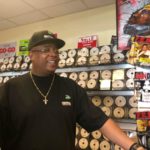
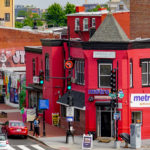
Hearing the sounds of D.C.’s favorite funky genre at the Shaw intersection where Florida Avenue marks the shift between Georgia Avenue and 7th Street NW is nothing new. Since opening in 1995, the Metro PCS store at the corner has become well known for blaring go-go music from speakers outside. Owner Donald Campbell says it’s his way of trying to keep the music alive on a street that used to have its own go-go clubs, and now boasts fast-casual eateries and high-end retail. His store sells Metro PCS phones and offers tech repair services, and he’s played go-go for years to promote the CDs available there.
But on Monday, the music wasn’t coming from the Metro PCS storefront. It came from a gathering of more than than 100 people who came out on a drizzly evening to rally in support of the store, and more broadly, to make a stand against newcomers who move to the heart of the District, drawn to its cultural cache, only to demand that the neighborhood change and displace longtime residents. Protesters gathered under the banner of #DontMuteDC, which had been trending locally on Twitter since the weekend.
For the past two weeks, Campbell has moved his speakers inside. He told DCist that T-Mobile, which owns Metro PCS, told him to turn off the music because a nearby resident was threatening the company with a lawsuit. He says the company told him that the complaint came from someone who lived at The Shay, a nearby luxury mixed-use building that rally-goers booed on Monday, as some residents peeked out their windows to watch the demonstration. (The complex came out with a public statement saying it was “not involved in any action regarding the Metro PCS store. The opinion of a purported resident is theirs alone and does not represent The Shay, or the entirety of its residents or management.”)
It’s not just the newest neighbors frustrated by the noise. Anita Norman, the Advisory Neighborhood Commissioner for 1B01, which includes the Metro PCS storefront, was born in D.C. and attended Howard—she’s no stranger to go-go or the Metro PCS store. She says the music is among the top three longstanding complaints she hears from constituents, and that its excessive volume “disturbs the quality of life of residents” and makes it difficult for visually impaired people to hear the beeps from traffic signals that prompt them to cross the street. She says the way officials measure sound in the city prevents proper enforcement of noise levels.
But for people throughout the city, the go-go on that corner typifies a D.C. that is disappearing amid new development. Campbell is in ongoing talks with T-Mobile to allow the music to return, and says he has a conversation with the company scheduled for Tuesday. During Monday’s rally, he remained working inside the store.
“This is the sound of Florida and Georgia Avenue,” says Mohammed Osman, one of the people who attended the rally. “This is probably one of the last things out here on U Street that’s still D.C. My barbershop plays go-go music. My parents met each other in the go-go. It’s running through my veins. It’s my culture, it’s D.C. culture.” After hearing the news that Metro PCS had to turn off its music, on Monday, Osman parked his car in front of the store and blasted go-go music. He says he’s willing to do that every day until Campbell can bring his speakers back outside. “It’s that serious,” says Osman.
The situation is freighted enough that two councilmembers—Ward 1’s Brianne Nadeau, who represents that part of Shaw, and At-Large Councilmember Robert White—came out to speak at the event. Nadeau also wrote a letter to T-Mobile imploring the company to reconsider its decision to turn off the music. “On behalf of many in the District who consider go-go music an essential part of this neighborhood’s identity, I ask that T-Mobile be a good neighbor and allow the practice to continue,” she wrote, pointing out that the D.C. Department of Consumer and Regulatory Affairs “has taken measurements of noise levels at this corner several times and has never had to take enforcement measures.”
“In Ward 1, we have a lot of residential buildings nestled next to commercial corridors, so it’s a constant balance that we have to strike, and helping people understand when they move to the neighborhood that they’re going to be a part of this vibrant area,” Nadeau tells DCist. “The history of music in this corridor in particular is so important to our heritage, our history, and our present, but we see less and less of it as the neighborhood changes. This corner has been one of the places we all know we can come and hear some go-go during the course of our day, and I think that’s reassuring and comforting to some people that miss that about this area, so preserving that is important to me.”
White says that, growing up in D.C., “go-go music has been playing on this corner for as long as I can remember … When we move to a neighborhood, we have to embrace what that neighborhood is. We can’t feel like we discovered these neighborhoods, like these neighborhoods didn’t have a culture, a sound, a vibe before we got there. One of the things that makes change in D.C. so difficult is a lack of respect for what is and what was before a lot of people got here.” Since the rally, Ward 5 Councilmember Kenyan McDuffie and Ward 8 Councilmember Trayon White have also issued their support for the hashtag #DontMuteDC. On Tuesday, Mayor Muriel Bowser tweeted, “I’m with you #DontMuteDC”

Kymone Freeman, the co-founder of We Act Radio, was the unofficial rally’s emcee, and kept the microphone open for any attendees who wanted to share their perspective. Speakers connected the gentrification they saw in Shaw to broader shifts in the city: As noted by a D.C. Chamber of Commerce report, between 2009 and 2016, the District saw 10,000 families with incomes more than $200,000 arrive, while about 4,300 families with incomes below $35,000 left. Lingering anger about a D.C. Council bill to limit amplified noise on the streets, which was reintroduced this session, emerged as well.
“Let’s be clear: go-go is not noise,” said a speaker, who identified herself to DCist as NeeNee from Black Lives Matter DC.
The rally is one of a slew of #DontMuteDC events planned this week. On Tuesday at 6 p.m., the go-go bands TOB and Mental Attraction are slated to play outside the Reeves Center at the corner of 14th and U streets NW. On Wednesday, Campbell will host an official press conference at noon. There’s also a town hall on Thursday at 6 p.m. at Check It Enterprises. And on Saturday, Ron Moten, a community activist who launched a petition calling on T-Mobile to “bring back the music” that currently has more than 39,000 signatures, says he is planning another D.C. natives photo shoot outside the Metro PCS at 10 a.m.
Before the rally kicked into high gear, Moten also got in a conversation with a nearby resident who wants the music turned down. When Moten pointed out that the music didn’t violate any D.C. codes, the resident responded, “many things are not illegal, but they’re disrespectful.”
But GiGi Thorne, who grew up in Ward 6 and brought a #DontMuteDC sign to the rally, says that “it’s not right” for residents to change Metro PCS’s tradition of playing go-go. “You moved in this area. This is the culture—this is the experience, the ambience that drew you here,” she says. “It’s not fair for you to try to stop the culture of D.C. Y’all have to embrace it or move out.”
Both Thorne and Osman told DCist that they’ve broken up with significant others who didn’t like go-go music. “Go-go music will be played at my wedding reception,” says Thorne.
Thorne brought her five-year-old son, Blake. Other rally-goers were teaching him how to play cowbell with the syncopated rhythm typical of go-go. “I love it,” Thorne says, remembering how she was listening to go-go when she was his age. “It’s symbolic. It’s comforting. It’s like grandma’s pie to Washingtonians.”
Previously:
Shaw’s Metro PCS Store Has Been Forced To Turn Off Its Go-Go Music, Owner Says
This story has been updated with Mayor Muriel Bowser’s tweet.