Washington’s national art museums are globally acclaimed, but beyond downtown lies a growing local talent pool. The city’s ceramics community is gaining greater regional visibility, fueled by residents’ desires for handmade local goods, a tactile hobby, and social media. D.C. is home to hundreds of ceramics hobbyists, and a small group of ceramic artists working or teaching here professionally. Meet five of them.

Sam Briegel
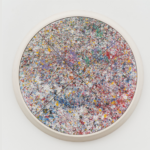
Sam Briegel’s love of design stretches back to a childhood reconfiguring clothing. Now a resident artist at the District Clay Center—where she creates, teaches, and coordinates gallery shows—she repurposes old clothes into silkscreen patterns to decorate her ceramics.
Briegel, 28, first took a ceramics class in college. “It blew my mind,” she says, and she changed her major to ceramics. “I’m drawn to clay because it can be anything; one material, so many possibilities.”
She transitioned from wheel thrown pottery to slab building, but has always been interested in bodies, clothing and how our bodies interact with fabric, a guiding theme in her work. “I’m 4’11” so altering clothes became important to me,” she says.
Incorporating bodies and clothing into ceramics allows Briegel to reclaim negative feelings associated with clothes, replacing them with something nourishing. She likes potters Jen Allen and Julia Galloway, whose work embraces feminine design. “Design history is so male dominated and they inspired me. I wanted to align with them,” Briegel says.
When she began working with clay eight years ago, Briegel says the discipline was less trendy. Today the District Clay Center has 350 students, and is growing. Her resident show Blush will open at the center’s gallery next month. “They opened about five years ago, and I don’t think they knew how popular pottery would become,” she says. “I think Washingtonians want to slow down and experiment.”
Kevin Rohde
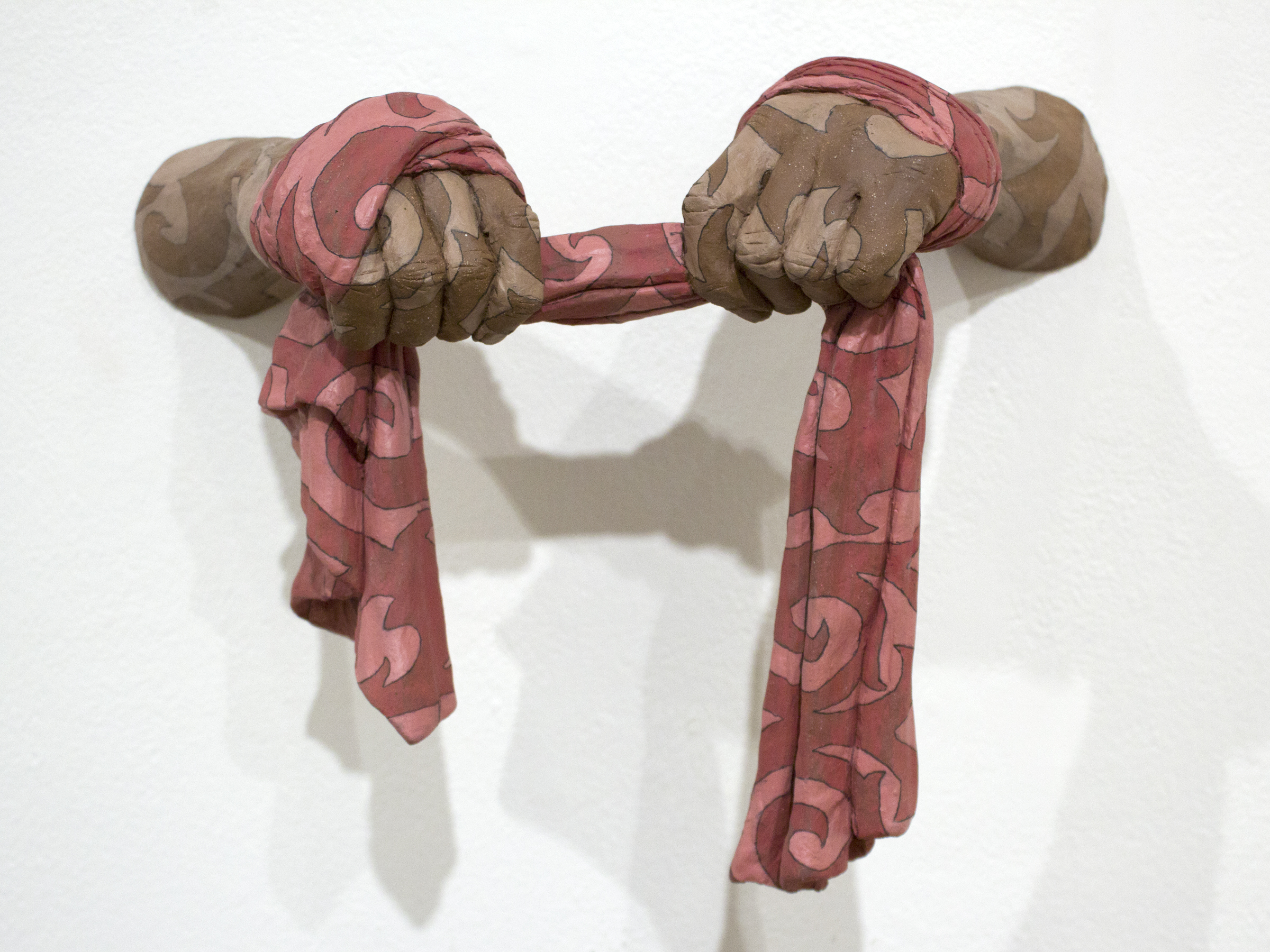
Baltimore resident Kevin Rohde makes art in Maryland and trains a new class of ceramicists in D.C. Rhode is a resident artist at Baltimore Clayworks and teaches ceramics at the George Washington University. He traces his own interest in the art back to college.
“A lot of people fall into ceramics, but I was always interested in it,” Rohde says. The 33 year old likes that clay is malleable, direct, and forgiving. Initially interested in human figures, his sculpture has since expanded to include environmental inspiration.
Rohde hopes his work influences his teaching, “But I’m really influenced by my students.” At GWU he teaches hand building and wheel-thrown ceramics. Leading the introductory class is especially revitalizing for him. “You see cleverness and breakthroughs from first time makers.”
Rohde understands his own work better through teaching. Conceptually, he is interested in the two dimensional elements of a work, and color schemes in fashion, advertisements, and nature all inspire. Rohde also looks beyond the ceramics world for inspiration, including at European wood sculptors, and names Christina West one of his clay heroes.
Living in Baltimore and working part-time in Washington, he acknowledges that the latter has a smaller ceramics community, pointing to its comparatively small concentration of ceramics education programs as one reason. “It surprises me that there isn’t more clay culture in D.C., but I see that some places are revitalizing.” He perceives growth, and demand for much more.

Pegah Shahghasemi
Eight years ago, Pegah Shahghasemi enrolled in a New York pottery class. By 2015 she was co-owner of Kuzeh Pottery with Lisa Ramber. Today she works full time from their Monroe Arts Walk studio, selling pieces and producing wholesale work sold at Shop Made in DC and other boutiques.
Shahghasemi, 41, was a graphic designer who studied pottery to do something for herself. She was soon hooked. When her family moved to Washington, she decided to register Kuzeh as a business. “I was just hoping to make money for classes,” she says, but today, the business makes her an equal financial contributor to her family.
While a resident artist at The District Clay Center, Shahghasemi met Ramber, a 57-year-old fellow District Clay resident who has made ceramics for about 15 years. Interested in having a shop, Shahghasemi discovered the affordable studio spaces at Monroe Arts Walk. After securing one, she invited Ramber to join her, and Kuzeh was up and running.
Kuzeh makes functional pottery for daily life. Shahghasemi is inspired by modern design, kilim (a flat woven tapestry), and Persian architecture. Ramber gravitates towards animals and nature.
Shahghasemi says the challenge of making ceramics a full time job is overwhelming demand—many artists cannot produce enough to wholesale effectively. “There are only a few production potters in D.C.,” she says, mentioning Hollow Work ceramics. “We have figured out pricing and which pieces are efficient to wholesale, but it’s no less craftsmanship—we still hand make and paint each piece.”
Hadiya Williams
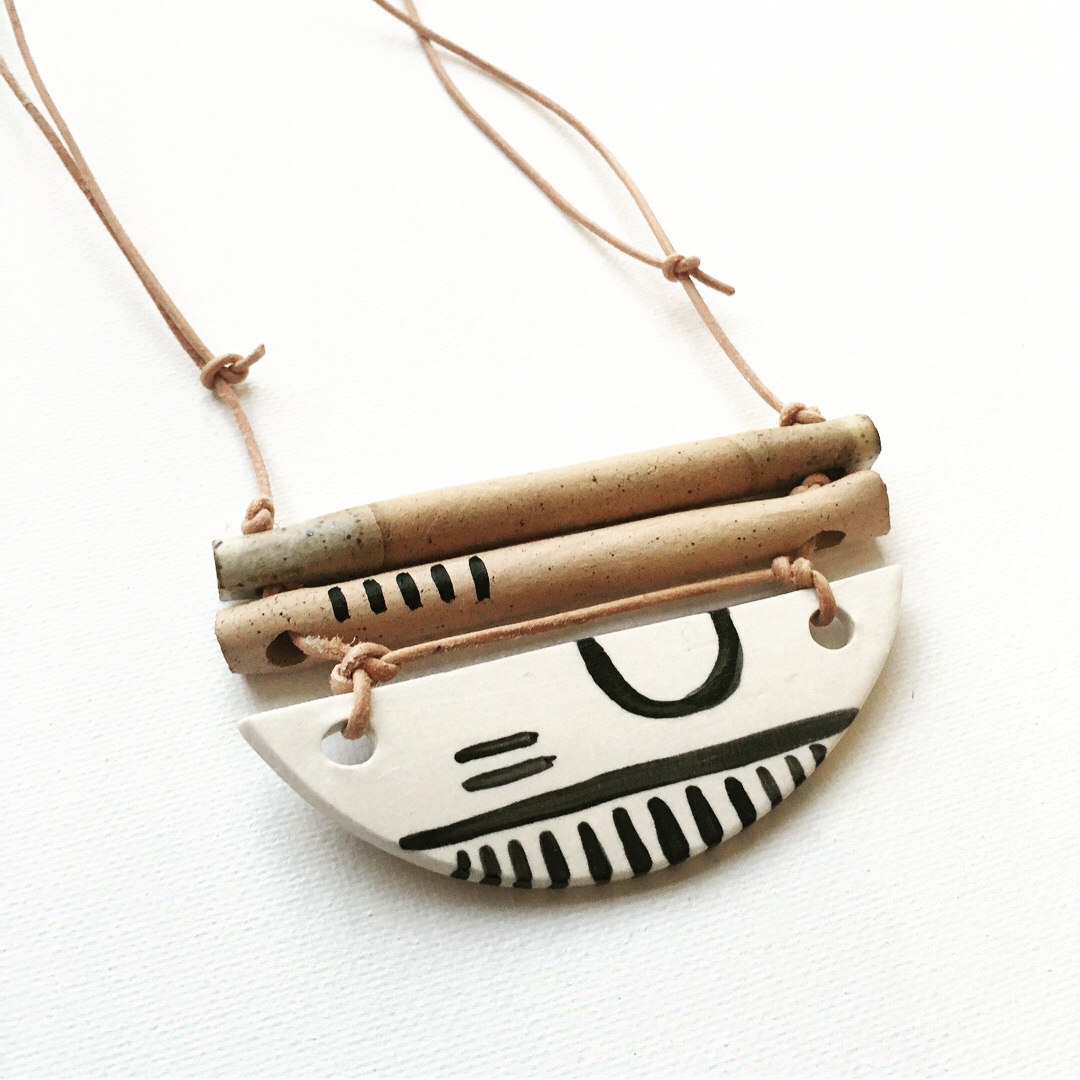
“I don’t consider myself a ceramicist,” says Hadiya Williams, a designer, artist, and maker. Although she emphasizes that she is still learning, Williams’ clay jewelry can be found not only in her online store Black Pepper Paperie Co., but at the National Museum of Women in the Arts and several boutiques.
Williams, 41, specializes in graphic design, art direction, and handmade items. A few years ago, she added ceramics to her range of creative services.
“I always loved ceramic work, and started collecting work I liked about six years ago,” Williams says. That prompted enrollment in a wheel-thrown pottery class at The District Clay Center. Wanting to be able to create at home, she began working with polymer and other air dry clays. She continued taking classes at District Clay in Langdon and at The Art League in Alexandria.
Williams principally makes jewelry and accessories inspired by West African aesthetics, including carvings, architecture, and textiles. She cites Melissa Weiss, Sharif Bay, and The Object Enthusiast as influences.
“Making art has affected my business. I want to make what I love, and have figured out my visual voice.” One of her signature design elements is her dramatic line work.
“I think the local community is growing,” Williams says. Younger and less experienced people are becoming involved, she says, making the community feel less exclusive.
Kim Kawakami
For Kim Kawakami, ceramics unexpectedly became a passion and profession. “After school, I became sick and my plans went awry,” she says. She enrolled in a pottery course and threw herself into it. Today, 39 year-old Kawakami sells her work online and at local fairs, and teaches ceramics at Chevy Chase Community Center.
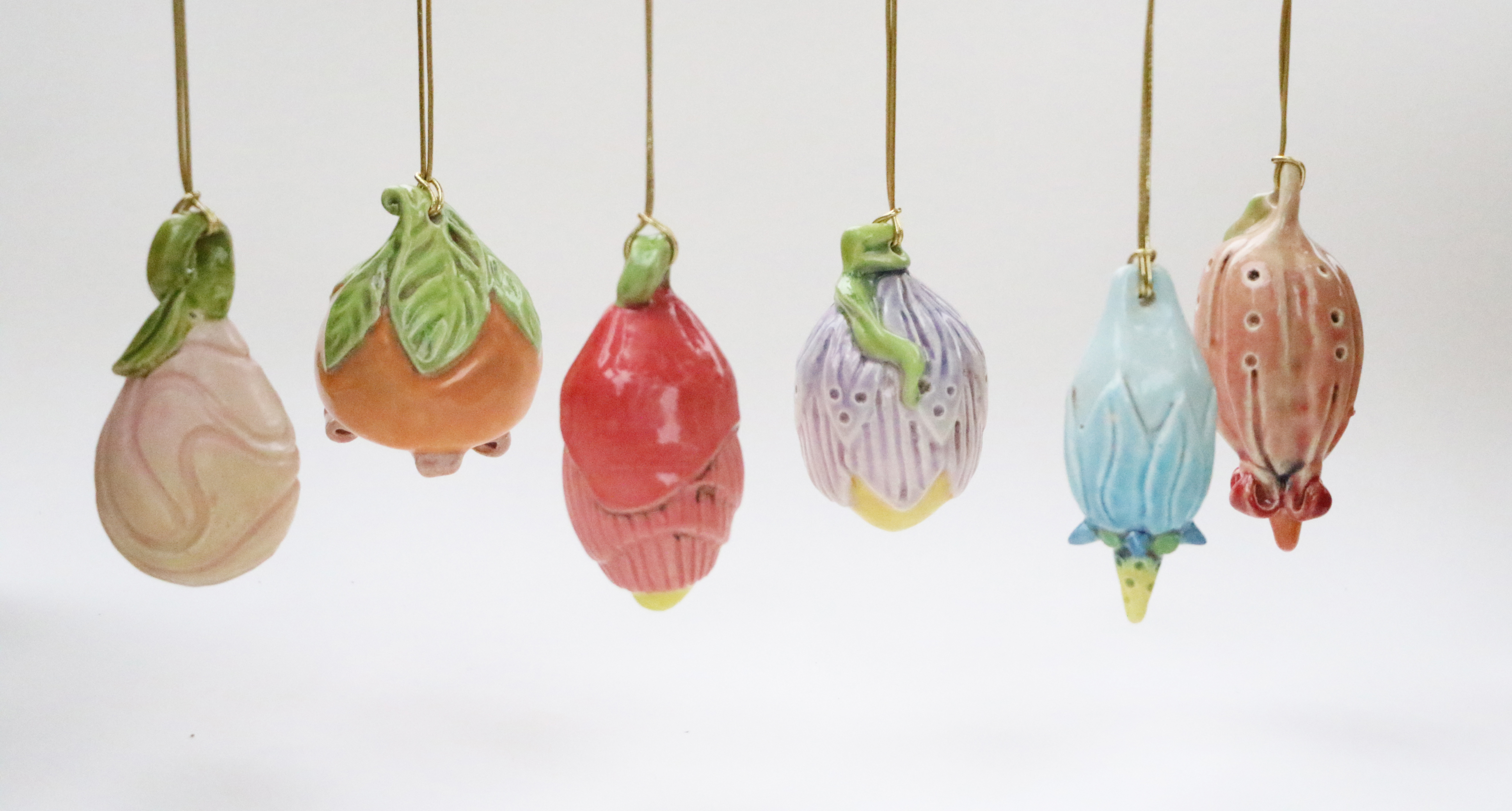
Trained as a graphic designer, Kawakami quickly notes that ceramics did not come easy to her. Today she creates functional ware (think dishes, vases, mugs, etc) and ornaments decorated with row houses and natural motifs. “My work is influenced by design … and potters who use a lot of color,” she says. Inspirational artists include Yayoi Kusama and Claes Oldenburg.
Her work is also influenced by Washington. “What I see here is what I make,” she says. “I take the kids to the zoo … I photograph houses and make a montage of homes that I think define their neighborhoods.”
Kawakami’s work benefits from her experience as a printmaker. She uses cut linoleum and underglaze to print directly onto vessels. Hand-built items are made at her Michigan Park home, and wheel-thrown work is done at Chevy Chase Community Center.
“The art scene here is difficult to be involved in because of cost of living,” she says. However, she says that the ceramics community has perked up in the past two to three years, with many new students.
Kawakami also emphasizes how much Washington residents appreciate handmade objects, pointing out that they’re both willing and able to purchase the work of local artists. “I’ve never felt better about myself than selling in D.C.” she says.