 Rachel Sadon
When Rachel Maisler planned her first memorial ride—to honor Jeff Long, a 36-year-old cyclist who was killed by the driver of a truck making a right-hand turn last year—she sought out Dave Salovesh.
“Dave was the one I reached out to and was like, ‘Dave, is it too much to plan a memorial ride so soon for somebody I didn’t know?’ And he’s like, ‘Absolutely not. Do it.’ And he was there riding with us, holding the 20 minute moment of silence on 21st and M,” Maisler says. “And then we did a ride for Malik Habib. And Dave was there telling drivers to behave themselves, in not so nice terms, because we were holding a moment of silence for Malik, who had been run over by a charter bus. And then we did it for Carlos, who got run over by an Uber riding a scooter in Dupont Circle. And then we did another memorial ride for Tom Hollowell. And Dave was there for all of them. And now we have to do all of this for Dave.”
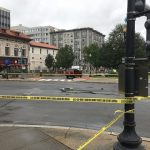
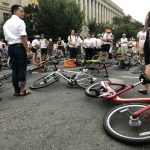
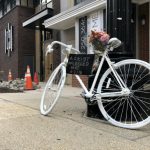
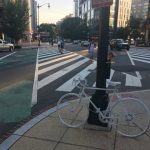
A large crowd of people—some clad in lycra, many in white—gathered at the corner of Florida Avenue and 12th Street NE on Sunday to take part in bicyclists’ most solemn ritual: the installation of a ghost bike, honoring the life of a person killed riding in that spot.
Many had taken part in similar moments before. But this time, they were collectively grieving one of the most active members of Bike D.C., as the city’s close-knit cycling community is often called.
Salovesh was killed on Friday after being struck by the driver of an allegedly stolen van. He died on the scene. Robert Earl Little Jr. has been charged with second-degree murder and unauthorized use of a motor vehicle.
The next day, a pedestrian was killed and five other people were injured in a car crash in Anacostia.
“We really just can’t have this keep happening,” Maisler says. “Our residents are being mowed over.”
And so, in anger and in grief, Bike D.C. is organizing with a renewed commitment to the cause.
There’s a letter writing campaign underway to local politicians. Advocates are pressing on the D.C. Council to introduce legislation. And the Washington Area Bicycle Association, Greater Greater Washington, and other groups are planning a rally at noon in front of the Wilson Building on Friday.
“For a lot of folks, it’s, frankly, personal,” says WABA’s communication’s director Colin Browne. “Dave was a good friend to a lot of people, a known and kind presence to a lot of people. And it’s also like, this just keeps happening, and it needs to stop. So I think that there’s a cumulative exasperation and exhaustion.”
The groups are still figuring out exactly what Friday’s rally will look like (shutting down part of Pennsylvania Avenue is one of many ideas that have been proposed) and which legislative policies they’ll seek. Browne says that details about both will be forthcoming in a couple of days.
District Department of Transportation Director Jeff Marootian attended the vigil on Sunday and told WTOP that the city is committed to long-standing plans to make changes to Florida Avenue, a traffic corridor that the city has been studying for years.
In 2004, two children were killed by a driver fleeing police at the exact same intersection where Salovesh died. Nearly a decade later, an elderly pedestrian was killed in a hit-and-run one block away after leaving a church meeting. DDOT completed preliminary plans to install protected bike lanes in 2017, but there have been few updates since.
Many advocates say they’ve lost their faith in Mayor Muriel Bowser’s administration to effect change. The mayor announced a bold plan in 2015 to end traffic fatalities by 2024 through Vision Zero, a program modeled on a pioneering effort in Sweden. Instead, the numbers have risen steadily; the city recorded 34 traffic deaths in 2018, an uptick of 13 percent from the year prior.
“There’s been a lot of situations where DDOT and the mayor’s office have said to, ‘Trust us, we’re working on this,'” Browne says. “That trust is exhausted. We’re asking the Council to put some teeth behind some of the Vision Zero program.” He notes that this isn’t just about cyclists. “D.C.’s traffic fatality problem is heavily weighted toward pedestrians. Drivers and passengers in cars are killed all the time as well, and that’s not okay. We’re not advocating for bicyclist safety. We’re advocating for people not getting killed, period.”
Ward 3 Councilmember Mary Cheh has already announced her intention to introduce a bill on Tuesday aimed at speeding up the process of building new bike lanes (the legislation was in the works before Salovesh’s passing). If enacted, DDOT would be required to install protected bike lanes that are already in the city’s long-range transportation plan whenever the agency does major repairs on the road in question. The legislation, which is modeled after a “first-of-its-kind” law in Cambridge, Massachusetts, will have at least four co-sponsors.
“Legislatively, I can’t build a road or cycle track. We’ve already said these are the places where we want a cycle track. Now, linked to repairs or reconstruction, you must do this. That’s our legislative mandate,” Cheh says. “I want to provide the impetus not to have a study and say ‘this is what we want to do,’ but ‘this is what we shall do.'”
Allen also says he will introduce a bill Tuesday, this one aimed at enacting plans to redesign Florida Avenue in Northeast.
“I’ve asked, pleaded, criticized, and urged DDOT to take action and make needed decisions. That hasn’t always worked. For every year I’ve been on the Council, I’ve asked DDOT to move forward with the redesign of Florida Avenue NE. And each year, action is promised and then not delivered,” Allen wrote on Facebook. The legislation would set a timeline for the project and a series of penalties if the agency fails to meet the deadlines.
Allen also said he will reintroduce a bill to enhance Vision Zero at the Council’s next legislative session in two weeks, but pledged that the new version will “be much bigger, bolder, and try to represent a comprehensive set of reforms” on enforcement, how the city builds roads, how to slow traffic speeds, and other neighborhood safety issues. “If you knew Dave Salovesh, you knew he would push hard and wouldn’t settle for half measures.”
Cheh had previously announced plans to name her bill for Salovesh, but she now believes that Allen’s more comprehensive legislation would be a better fit. “That bill will be worthy of Dave because he was a big ideas guy. I think that would be a more appropriate tribute to him,” Cheh says.
Indeed, friends remembered Salovesh as someone who was never satisfied with incremental progress.
“What I have seen thus far is nothing but just an outpouring of common support and sorrow and anger that is now being channeled toward hopefully getting the halls of the Wilson Building actually taking these things seriously,” says Rudi Riet, who was a close friend of Salovesh’s (Riet also works in bike advocacy). “Taking seriously the fact that our streets are unsafe. Our streets are incomplete. And our streets are a real embarrassment. Dave never settled for second best, and neither should any of us.”
Cyclists are grieving their friend in other ways. On Wednesday, the weekly bicycle ride that Salovesh co-led will be dedicated to him. Riet says the group will start the hilly, 22-mile ride at 5:45 p.m. at Mitchell Park in Kalorama. They’ll end with a toast to Salovesh’s memory at Glen’s Garden Market.
It’s this outpouring of both advocacy and community that seems to have brought some measure of comfort.
“It’s uplifting. It’s buoyant. That’s the only way I could put it,” Riet says. “There’s a certain lightness that’s come out of it. Out of grief has grown some pretty awesome strength.”
Previously:
Cyclist Killed In Northeast Was A Longtime Bike Advocate Who ‘Lived And Breathed Making The Streets Safer’
This story has been updated with comments from Councilmembers Mary Cheh and Charles Allen.