 Jenny Gathright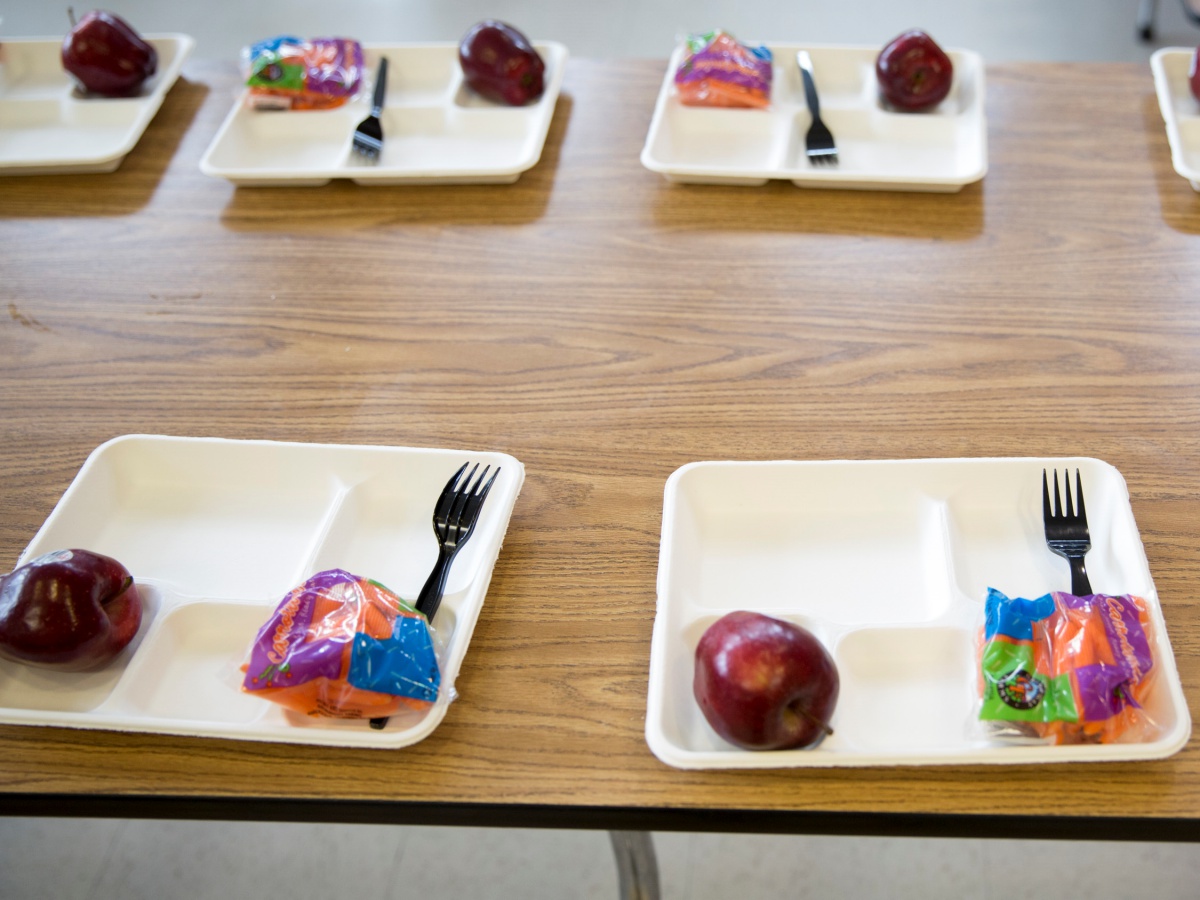
Under D.C. law, every student in the city’s public or public charter schools must be offered free breakfast. But a new report from the nonprofit advocacy group D.C. Hunger Solutions found that while D.C. Public Schools are close to reaching the recommended participation rate, some of the city’s charter schools are falling far below the standard.
D.C. Hunger Solutions recommends that 70 low-income students receive free breakfast for every 100 who participate in the school lunch program. According to data provided by the Office for the State Superintendent of Education, on average DC’s public and charter schools serve 69.1 breakfasts for every lunch — almost at the recommended participation rate. The charter school data, which provides a glance at more individual schools, shows a more mixed picture. Eight of D.C.’s 123 public charter schools had over 95 percent participation in breakfast, while 23 were unable to get more than half of low-income students who participated in lunch to participate in breakfast.
“The schools that are successful really believe in breakfast, and they believe in breakfast after the bell,” said Beverly Wheeler, director of D.C. Hunger. “Breakfast after the bell” refers to alternative ways of delivering breakfast outside the cafeteria, often after classes have already started for the day. The Healthy Schools Act, which instituted free breakfast across the District in 2010, requires that most schools in which more than 40 percent of students qualify for free or reduced-price lunch offer breakfast in the classroom or on “grab-and-go carts.”
The low participation rates in some charter schools, Wheeler said, provides evidence that some schools may not be in compliance with that law.
When the Healthy Schools Act was passed, high-needs schools were given a one-time local subsidy of $7 per student to institute alternative ways of delivering breakfast. Wheeler says this money could have been used to purchase carts for grab-and-go, buy insulated bags for in-classroom breakfasts or acquire other tools to make breakfast delivery easier.
Advocates like Wheeler point out that D.C. used to lead the nation in offering school breakfasts: The Healthy Schools Act propelled D.C. to the number one participation rate in the country for the 2010-2011 school year. Now, according to the Food Research & Action Center, D.C. is fourth.
An amendment to the Healthy Schools act passed by the Council last year and signed by the mayor would have added an annual $2 per pupil subsidy for alternative breakfast delivery, but it was not funded in the mayor’s proposed budget for 2020. The amendment also adds an additional 10 cent local reimbursement for every school breakfast served.
Currently, D.C.’s schools are reimbursed for school breakfast from the federal government on a sliding scale based on whether each student served qualifies for free or reduced-price lunch. D.C. also already provides an additional 10 cents of reimbursement on its own for every breakfast, and an additional 5 cents if at least one component of the breakfast is entirely locally grown and unprocessed.
Still, Wheeler says a combination of more local funding and more local enthusiasm for school breakfast is necessary.
“We don’t want to fall back,” Wheeler said. “We’ve invested a lot in making sure that children get breakfast. We’re working on after-school meals, and we’re working on summer meals. Let’s not fall backwards.”
In 2017, D.C. ranked number one in the country for participation in after-school meals: 21.7 dinners were served for every 100 free and reduced-price lunches.
Making Breakfast Easier — And Healthier
But parent advocates say D.C. needs to do more. LaTón Dicks, whose 11-year-old granddaughter is a fifth grader at Tubman Elementary School in Northwest D.C., started a petition for D.C. to fully fund the amendments to the Healthy Schools Act passed last year. The petition now has more than 33,000 signatures
Dicks says she thinks additional funding for breakfast after the bell is necessary, and that in-classroom breakfast makes sense. If a child is running late, Dicks says, they will choose to get to class on time over stopping by the cafeteria for breakfast “nine times out of 10.”
She also thinks additional funding would help D.C. schools meet the new requirements outlined in the law. Now, schools are required to provide a vegetarian main course at each meal and encouraged to provide more plant-based options at each meal.
Chloë Waterman, a food campaigner at Friends of the Earth who advocated for the vegetarian option, said that parents pushed for those changes.
“A request for more healthy, plant-based options was actually one of the top pieces of feedback we got from parents,” Waterman said. “And it’s not just coming from parents whose kids are vegetarian or vegan.”
For some parents, the plant-based option is a way of ensuring that their kids are getting access to healthier food.
In an emailed statement, the Office of the State Superintendent of Education said it was pleased with the passage of the amendments to the Healthy Schools Act last year and “is eager to begin working toward meeting the newly established requirements.”
In the past, some, including D.C. State Superintendent Hanseul Kang, have raised concerns that the push for breakfast in the classroom and more to-go options could be at odds with the push for better nutrition: Prepackaged meals, for example, are often less healthy than hot breakfast offered in the cafeteria.
Chloë Waterman says those concerns are unfounded.
“It is definitely possible to do a healthy grab-and-go breakfast,” Waterman said. “But DCPS could really up their game with additional funding.”
This story originally appeared at WAMU. It has also been corrected. A previous version of this story incorrectly stated that DCPS served 69.1 breakfasts for every lunch. In fact, that average is combined for DCPS and the District’s charter schools. An earlier version of the story also said D.C. Hunger Solutions research ranked D.C. fourth in the nation for breakfast participation. In fact, that research comes from the Food Research & Action Center.