 Mikaela Lefrak
Fans of Fugazi can now learn about the punk band’s history in an unconventional way—through data.
The bulk of a new exhibition on the legendary D.C. group at Lost Origins Gallery in Mount Pleasant is made up of wall-sized data visualizations. They tell the story of Fugazi’s influence during its active years from 1987 to 2002 (the band is currently on what its members call “an indefinite hiatus”).
The infographics are the work of Carni Klirs, a graphic designer and Fugazi superfan. He dreamed up the project for his master’s thesis in information visualization at the Maryland Institute College of Art last fall.
“This is my fanzine, an obsessive documentation of a band I love, told through their own data,” he wrote on his website. “It’s my contribution to that legacy of precious ephemera, the printed matter that gets collected and obsessed over, or perhaps perused briefly then tossed in the bin.”
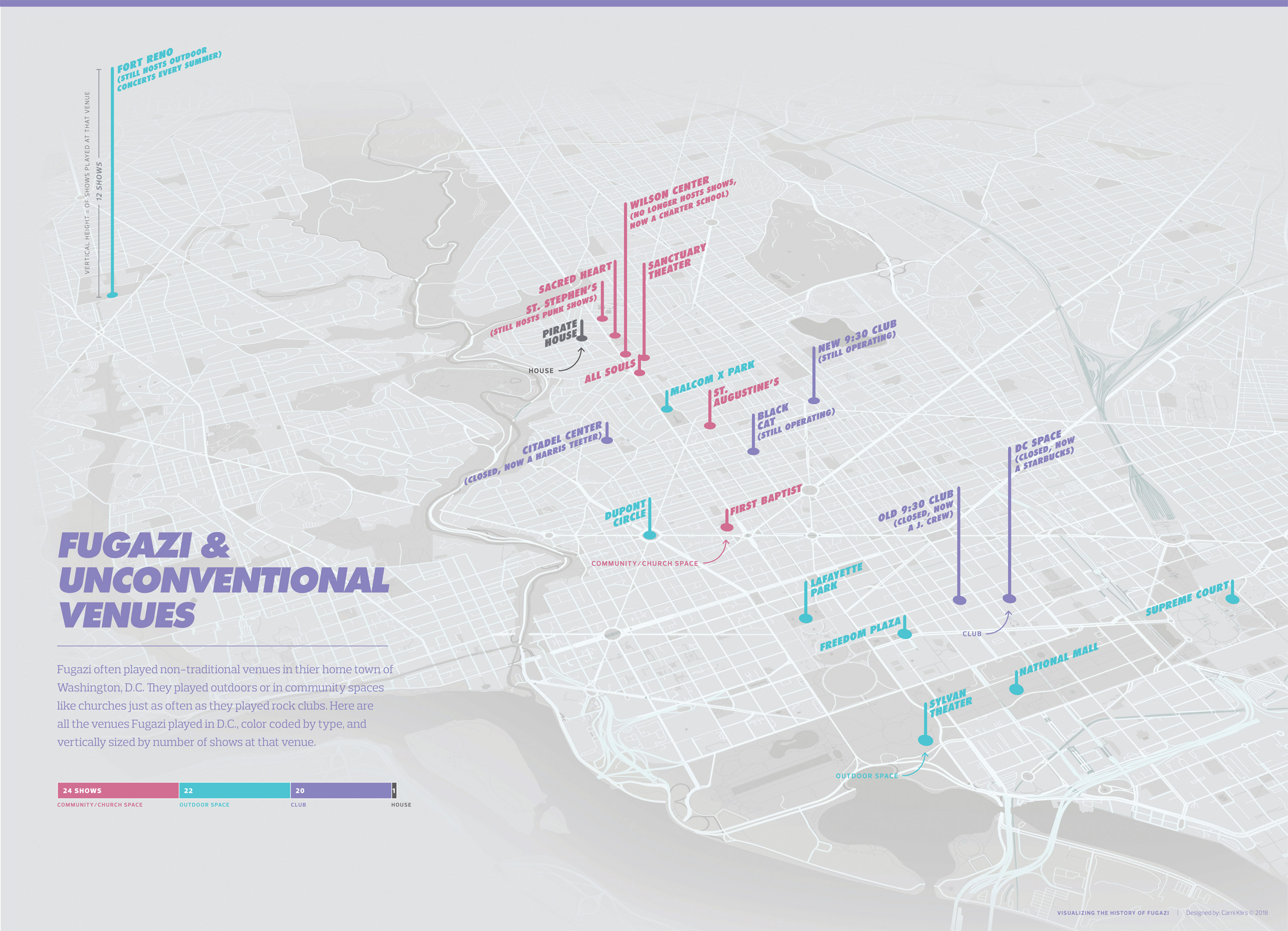
All the venues Fugazi played in D.C. have been color coded by type and vertically sized by number of shows at that venue.
One infographic maps the non-traditional venues where Fugazi played, from outdoor concerts at Fort Reno, to small churches in Mount Pleasant and Columbia Heights, to the original 9:30 Club near Metro Center.
Another work illustrates how Fugazi raised some $250,000 for local charities by playing around 80 benefit concerts. D.C. organizations that benefited included the Whitman-Walker Clinic, Washington Peace Center, Alexandria Tenants Association and the Women’s Crisis Center.
“They had the power to draw in people, and they used that power for good,” said John Davis, an archivist at the University of Maryland and one of the exhibition’s curators. He selected fliers, fanzines, behind-the-scenes photos, and other ephemera from his punk collection to complement the stories told by Klirs’s infographics.

Fugazi’s benefit shows have been grouped by beneficiary. The size of each circle indicates how much money was raised.
Davis hung original fliers for the benefit concerts and thank you letters from the organizations that benefited to complement Klir’s infographic, alongside a quote from Ian MacKaye, Fugazi’s frontman.
“It’s a hometown sort of thing,” McKaye said of the band’s deep Washington ties. “D.C. is our home and, for us, it’s a sense of community service.”
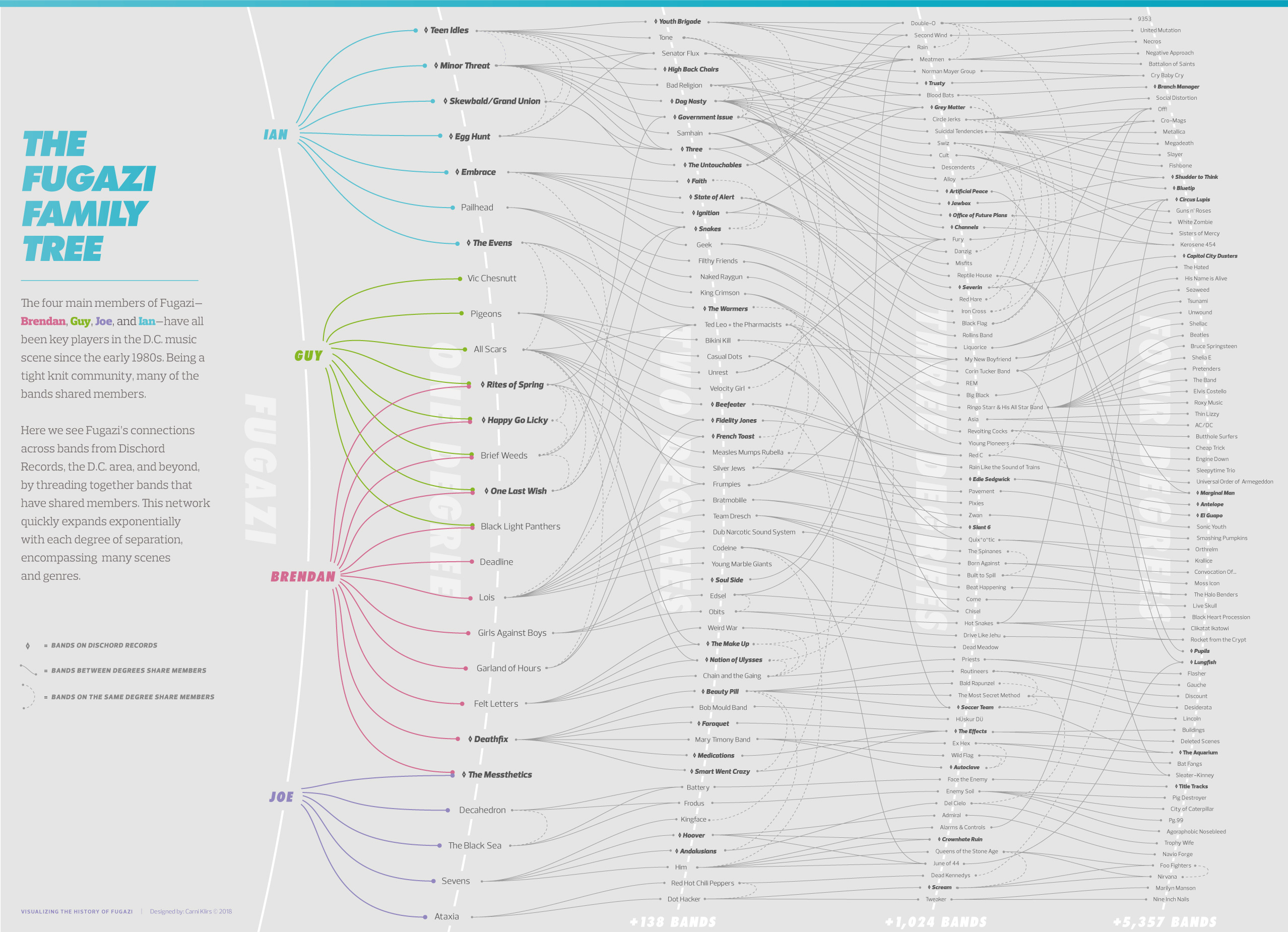
Many bands shared members. This infographic shows how Fugazi’s four core members — Ian McKaye, Brendan Canty, Joe Lally and Guy Picciotto — are connected to thousands of other bands in the D.C. area and beyond.
Klirs mined the data by going through venue attendance numbers and the band’s own meticulously-kept records and concert recordings. He printed his graphics into a fanzine, which is for sale on his website and at Lost Origins Gallery.
“I tried to show the connections between the D.C. music scene in the late 1980s to the community around me today,” Klirs wrote. “There are young bands active today who are only three or four degrees away from Fugazi (when looking at connections between bands by shared members).”
At the gallery recently, Davis noted that both he and Klirs are musicians themselves. Davis saw his first Fugazi concert when he was 15 and fell in love with the “scary, sweaty, joyful” atmosphere of their live shows and the sense of community they fostered. Fugazi’s members prided themselves on that inclusivity: They always played all-ages shows and kept door prices to $5.
The band and the community had a “symbiotic relationship,” said Davis. “Fugazi was always about doing things differently.”
“Action. Reaction. Action: Visualizing Fugazi” is a co-production of Lost Origins Gallery and the Smithsonian Folklife Festival. It runs through May 19th.
This story originally appeared on WAMU.