 Jenny Gathright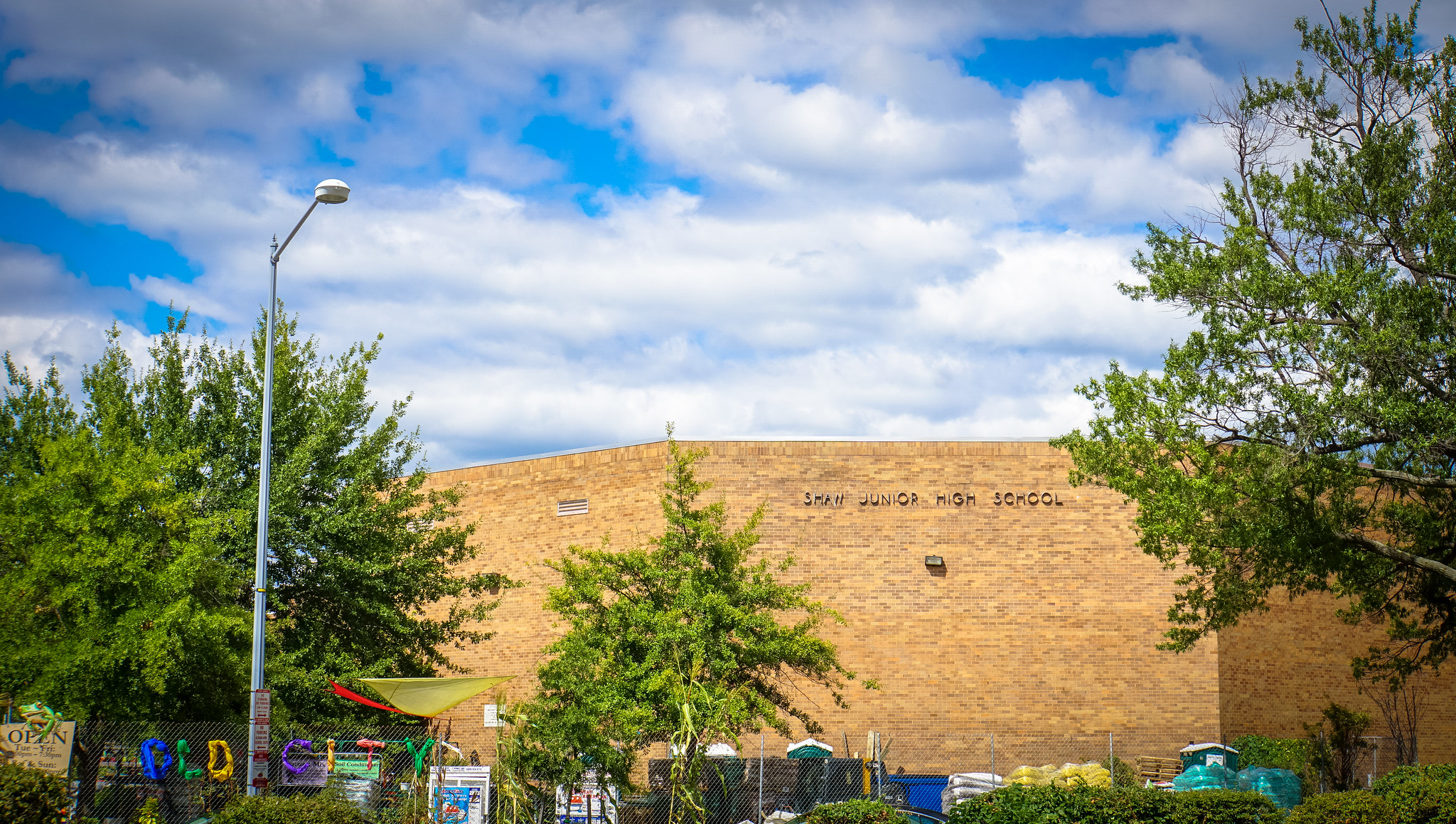
The D.C. Council devoted a significant portion of its daylong budget discussion on Tuesday to one plot of land: The long-closed Shaw Junior High School at 9th St. and Rhode Island Avenue NW.
Mayor Muriel Bowser wants it to be the location of a new, modernized Banneker High School, as does an active group of students and parents at the high-achieving school. But many Shaw residents say that the neighborhood deserves—and has been promised—a new middle school.
A narrow majority of the D.C. Council sided with neighborhood residents on Tuesday.
Lawmakers voted 7-6 against Bowser’s plan to move Banneker to the site. Many cited a longstanding pledge from D.C. Public Schools that a new middle school would be built at that same location.
“Although the middle school is currently closed, DCPS promised the Shaw community that a new middle school would be build [sic] and opened at that location,” reads a budget report from the D.C. Council. “The Council is disappointed that the Mayor made contradictory promises that inevitably led to conflict.”
The Council’s second and final vote on next year’s budget will be held on May 28.
Bowser and others have explicitly positioned the debate as one about gentrification: Banneker High School families have been promised a renovation for years, they say, and a new Shaw middle school would be prioritizing the more recent—and whiter—arrivals to the rapidly gentrifying neighborhood.
Others say that framing is inaccurate, and unnecessarily divisive.
“The story of Banneker and Shaw middle school is the story of two schools, equally deserving, who were both promised beautiful new facilities—two schools who had been made promises and for whom those promises have been broken over and over,” said Ward 1 Councilmember Brianne Nadeau, who opposes Bowser’s plan to relocate Banneker.
Banneker High School, which requires an application for entrance and received the highest score on the District’s star rating system last year, is among the most popular in the city; there were nearly 800 applications for the 170 open seats at the school this year. Bowser’s administration has said building a new facility at the Shaw middle school site would allow Banneker, which currently enrolls close to 500 students, to increase its enrollment by 300.
Ward 5 Councilmember Kenyan McDuffie initially supported the middle school plan, but he changed his position after speaking with a number of Banneker students this week.
“Government officials in the city have taken the Banneker students for granted because they’ve been so successful,” says McDuffie, whose niece attends the high school. “They’ve been able to achieve a level of academic success despite the condition of their school building, and we owe them.”
McDuffie says an on-site renovation at the high school’s current campus would take longer than building a new school—and getting Banneker students to a better facility should be the city’s first priority.
Advocates for a Shaw middle school, meanwhile, say their cause has a long history of its own. The school “became the face of the urban education reform movement” under principal Brian Betts, WAMU reported that year. Betts was murdered in 2010, and the school was closed before the 2013 school year. (That same year, then-Chancellor Kaya Henderson proposed to shutter a total of 15 schools amid dropping enrollment city-wide and the rise of competition from charter schools.)
Currently, Shaw’s neighborhood middle school operates out of the Cardozo High School campus in Columbia Heights, which Nadeau said Tuesday has been “busting at the seams” since Shaw middle school students started being sent to its campus. Jack Pfeiffer, a spokesperson for the deputy mayor of education, says the campus is at 73 percent capacity.
Alexander Padro, an ANC commissioner in Ward 6 who has long advocated for the Shaw middle school to be renovated and reopened, told DCist that some Shaw families feel uncomfortable sending their younger students to a campus that also includes older high schoolers.
Padro says Shaw’s neighborhood middle school has been promised since at least 2008 (when Shaw Junior High School was temporarily moved from its original location to a building at 10th St and V St NW).
Deputy Mayor for Education Paul Kihn wrote in a letter on Wednesday says DCPS data does not support the need for a middle school in Shaw, but Padro questions the accuracy of those numbers.
In the absence of a neighborhood middle school, families in Shaw have sent their kids to charter schools and schools in other parts of the city, he says.
“You’ve caused that middle school population to be decimated by the fact that you didn’t fulfill the promise,” Padro tells DCist.
The mayor has explicitly framed the competing proposals for the site as an issue of gentrification.
In a letter to the D.C. Council on Friday, Bowser brought up recent protests in Shaw, which has been roiled by neighborhood-wide debates about dogwalking on Howard University’s campus and go-go music at the MetroPCS store at the corner of 7th and Florida Ave NW.
Bowser wrote she was “shocked” that a majority of the Council wanted Banneker students to stay put, given “weeks of protests” against displacement in the neighborhood. She noted that Banneker has been “a unique source of opportunity for black students” for years in D.C.
But McDuffie, who agrees with Bowser on prioritizing Banneker, cautioned against making this a debate about gentrification.
“We should not use the policy discussion about building Banneker High School and building a middle school for the Shaw community as a proxy for anxiety about gentrification, black displacement and white privilege,” he tells DCist.
This story has been updated with detail about the current operating capacity of the Cardozo High School campus.