 Rachel Sadon

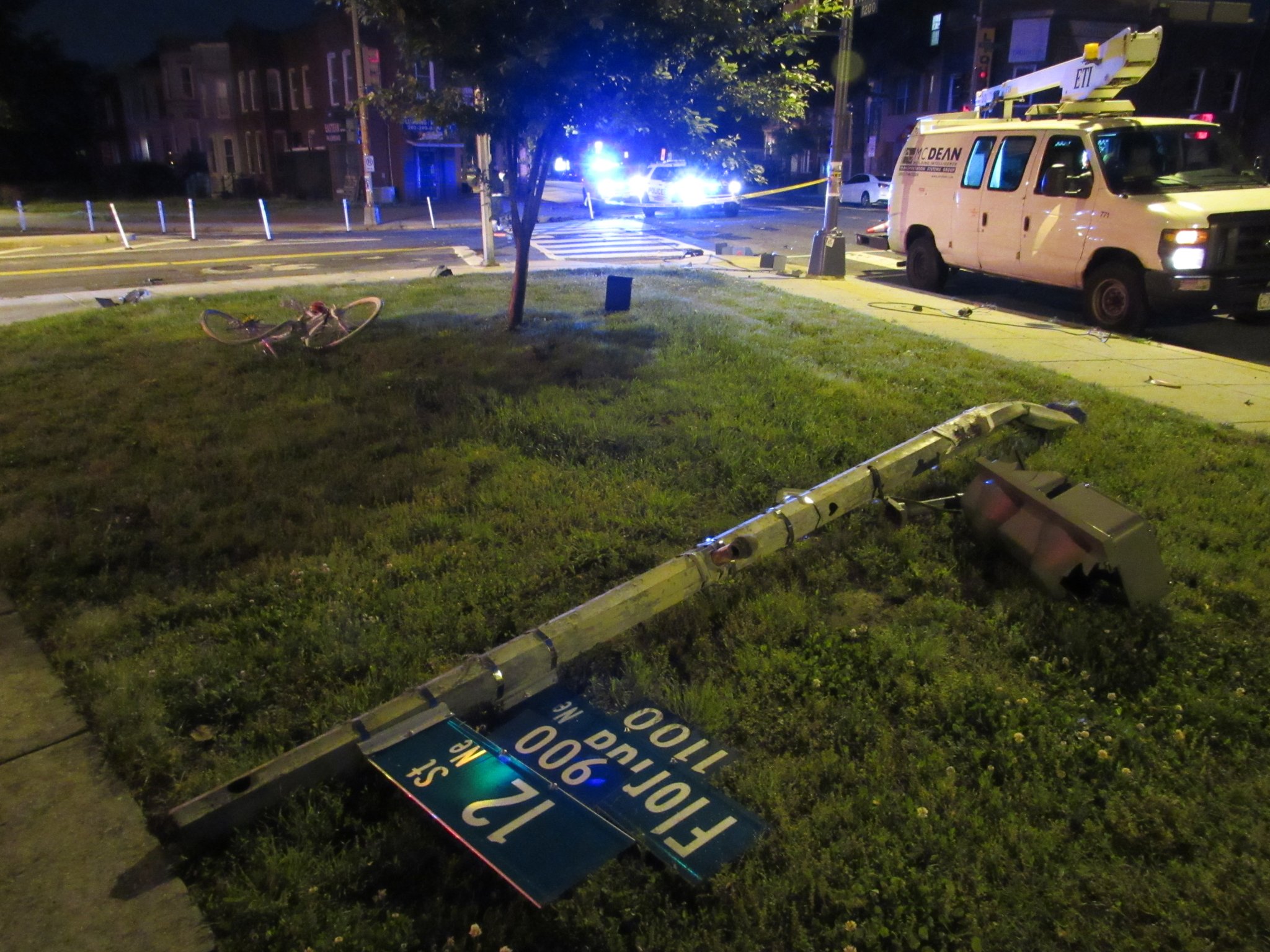

The ghost bike was installed last month to honor Dave Salovesh, one of the city’s most active cycling advocates, after he was killed at the intersection of 12th Street and Florida Avenue NE. It wasn’t even in place for a month before it was struck by a car and flung afield.
On Saturday around 4 a.m., the driver of a Chevrolet Tahoe barreled into the memorial, along with a parked Nissan Versa, a lamppost, a tree, and an iron fence, according to police and neighbors.
The driver fled the scene, according to D.C. police spokesperson Alaina Gertz, and the crash is still under investigation.
A witness retrieved the car keys after the driver left the scene with the car still running, according to Blaise Marion, who lives around the corner and witnessed the aftermath of the crash.
The backyard of Marion’s home abuts Florida Avenue, and on the warm spring night, he and his wife were sleeping with the windows open before they were awoken by a “huge bang.”
“We ran toward the intersection. We knew it was Florida,” says Marion, an IT professional who has lived on the block for almost a decade. “It’s always Florida.”
Two kids were killed in 2004 by a driver fleeing police at that same intersection. An elderly pedestrian was killed in a hit-and-run about a block away in 2013. And on April 19, Salovesh was killed by the driver of a stolen van.
Salovesh’s death spurred a renewed and deeply personal commitment to activism among the city’s tight-knit biking community. Hundreds of people lay in Pennsylvania Avenue at the end of last month to demand change and accountability to Mayor Muriel Bowser’s Vision Zero plan to end traffic fatalities.
Twelve people have been killed in traffic crashes in D.C. this year, including a female pedestrian who was killed while crossing Martin Luther King Jr. Avenue in Southeast, near the St. Elizabeths campus, on Friday night.
Ward 6 Councilmember Charles Allen recently introduced wide-ranging legislation with more than two dozen proposals. He also introduced a bill specifically aimed at speeding up long-planned work on Florida Avenue NE.
“We’ve been saying for 10 years that this intersection is an absolute disaster,” Marion says, pointing out that the ramp to K Street at the triangular intersection puts people in a “highway mentality” in the midst of a residential neighborhood. “It’s always been a problem. I think the biggest change is that people are now aware that they’re not alone in thinking that.”
The force of this latest crash can still be seen in the neighborhood. Tire marks stretch across the crosswalk. At least two trees are scarred. Four or five feet of fencing is missing on the wrought iron fence. The crumpled Nissan remains on the street.
Pien Huang says she bought the car more than a decade ago and has become pretty attached to it after going through some major life events together—including driving it from Boston to move here two months ago. But she didn’t recognize the Versa when she tried to head out for a hike on Saturday morning.
“When I got to where my car had been parked, my initial reaction was ‘Oh no, did my car get towed?’ because the car on the street was much smaller than my car,” Huang says via email. “Then I walked around it, and realized that it was my car, it had just been totaled.”
She says people told her that the intersection was dangerous when she moved in, and the last two months has proven it to be true. “I’ve lived in cities my whole adult life. I don’t think ‘it’s a city’ is a good reason for people’s lives and properties to be casual, collateral damage,” Huang says.
Meanwhile, Marion says he talked to a woman who rents the property where the Tahoe landed. “That Saturday afternoon after the crash, they had a birthday party. … If this same thing had happened while there was a birthday party, you would have had kids dead.”
This story has been updated to include comment from Pien Huang and correct the spelling of Blaise Marion’s name and the model of the Nissan.