Margaret Barthel
Update, 8/26/19:
Spin will start installing its docking stations for the pilot program by the end of the week, according to the scooter company.
Over the next two weeks, 40 docking stations will be placed in D.C., Arlington, and Alexandria, each of which can hold between four and 10 scooters. The company partnered with private property owners to place the docking stations, and the Spin app will show their locations. During the pilot, dockless scooters will remain available.
The timing was first reported by the Washington Post.
Original: This summer, you might see something new on D.C.’s streets: docks for otherwise dockless scooters.
The city will play host to a 60-day pilot program, a partnership between electric scooter company Spin, which launched in D.C. last year, and docking system start-up Swiftmile. The big question: if you provide a place to dock scooters, will people actually put scooters there when they’re done using them?
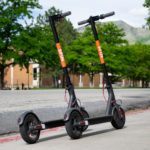
Thousands of scooters have appeared in D.C. over the last year as part of the city’s dockless vehicle program. Each operator can have as many as 600 vehicles at the outset, and companies are allowed to increase their fleets if they meet certain requirements.
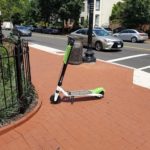
The scooter influx has prompted grumbling from pedestrians that the vehicles are often dumped in inconvenient or unsafe places. And then there’s the matter of needing to charge them. Most companies pay people a flat rate to collect and charge their scooters, while Spin employees pick them up and take them to a warehouse where they’re charged back up, according to Ben Fong, director of business development at the company.
Enter Swiftmile, which has created a solar-powered docking station capable of charging up all brands of e-scooters. Co-founder and CEO Colin Roche tells DCist that the company debuted in February at SXSW and hopes to provide an antidote to the electric scooter chaos.
“We put [the docking system] out on the streets guerilla-style, and it caused a total scene. There was a sea of scooters knocked over, and then you had this system that was very orderly,” he said, also touting the fact that the station’s batteries are fully solar-powered, making the system a fully renewable transit option.
For the purposes of this summer’s pilot, the docks will be exclusively available for Spin scooters. The Washington Post first reported on the plan.
In addition to decluttering streets and saving a trip to the warehouse, Fong believes they’ll make it easier and more reliable to find a scooter—much like riders always know where Capital Bikeshare bikes will be located.
That’s a big selling point for the pilot program, which is on the hunt for private property owners who would be willing to host the docking stations. “It’s a real amenity for residents and employees,” Fong says.
But it remains to be seen if scooter users will use the docks, especially considering the appeal of leaving a scooter behind the instant that it’s no longer needed.
“We’re not saying that these scooters have to be parked in a docking station every time someone ends a ride,” Roche says. “But in busy areas where scooters congregate, and are sort of a nuisance at this point—that’s where you place the docking station.”
Fong agrees, and says he sees it becoming “a hybrid model that retains the flexibility of a dockless model, but the reliability of having a docking station with scooters reliably there,” he says. Though the details aren’t yet clear, Spin plans to put some sort of in-app incentive for riders to bring the scooters to a dock when they’ve finished a ride.
D.C. is one of two cities—Ann Arbor, Michigan is the other—that will host the pilot.
“D.C. is a compact city that we think can benefit from having some dock stations around town, just given the geography,” says Fong of why Spin and Swiftmile chose to test the stations here. He also noted that general excitement from D.C. scooter users and an interest from potential local partners played a role in the decision.
The pilot will focus on putting docking stations in areas that already see high traffic for the existing fleet of Spin scooters and parts of town that aren’t well served by public transportation, according to Fong, who cited Capitol Hill, H Street, and Adams Morgan as neighborhoods that could benefit.
“People that travel more than a mile and a half is where the sweet spot is for when it’s helpful to have a scooter around,” he says.