Rachel Kurzius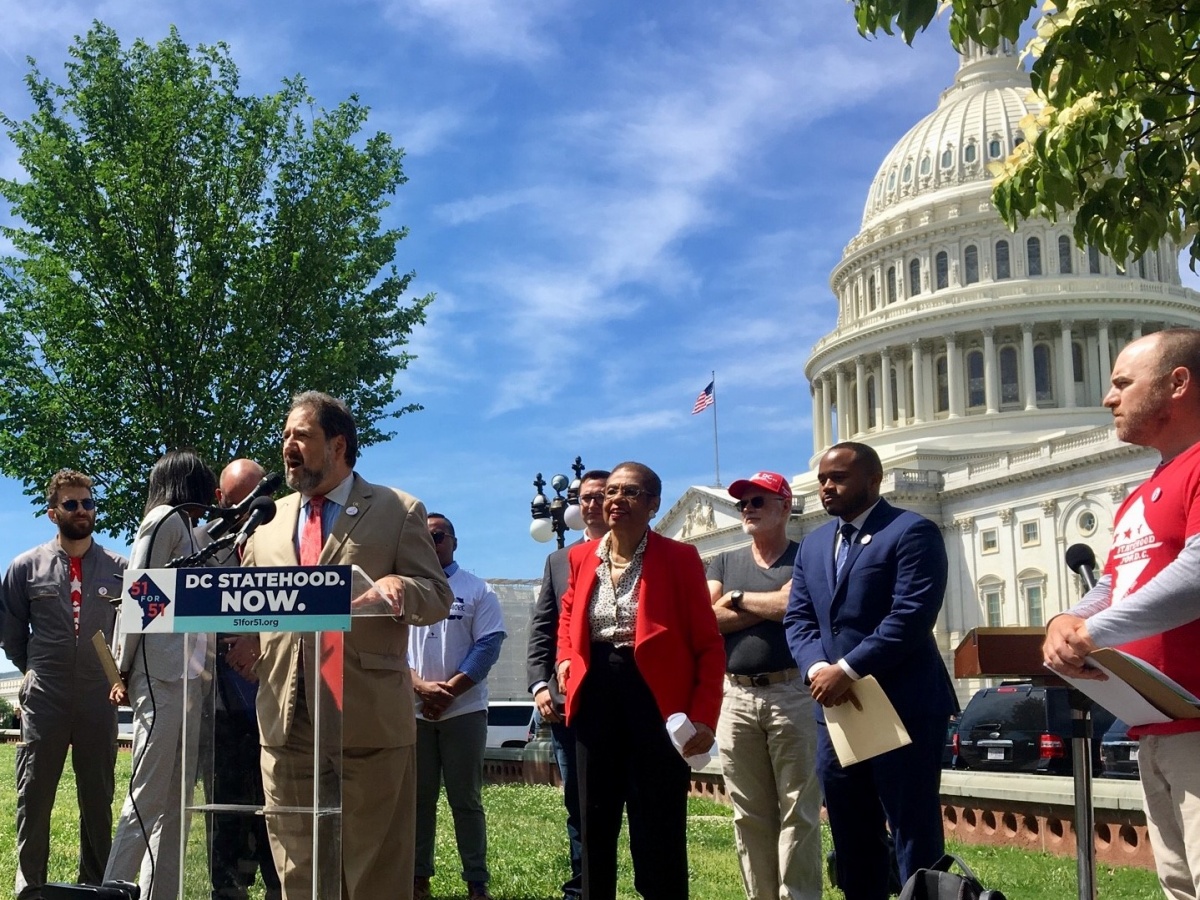
A new statehood push is putting the issue of D.C.’s disenfranchisement in front of presidential candidates, though the campaign is declining to say where its funding is coming from.
The effort, called 51 For 51, officially launched on Tuesday outside the U.S. Capitol, where Washingtonians still don’t have full representation. It describes itself as a “coalition comprised of D.C.-based and national groups committed to equal representation rights for D.C.’s over 700,000 residents.” The local groups involved include D.C. Vote, Neighbors for D.C. Statehood, and D.C. for Democracy, alongside national groups like Indivisible, Town Hall Project, and NORML.
Local proponents of statehood tend to say the idea of enfranchisement for Washingtonians is nonpartisan. But in recent years, there’s been a push among Democrats to prioritize the issue. The idea is that the majority-blue District would likely elect Democrats to two new Senate seats. Republicans are by and large opposed to D.C. becoming the 51st state.
While the population of D.C. is larger than that of Vermont or Wyoming and residents pay federal taxes, the District’s status as a federal city means that Congress can intervene in local legislating, on issues like abortion, gun regulation, marijuana legalization, and more. It’s clear that the vast majority of D.C. residents approve of statehood—a referendum passed in 2016 with about 80 percent of the vote.
51 For 51 is mounting a “seven-figure” education campaign in the first states slated to vote in the presidential primary: Iowa, New Hampshire, Nevada, and South Carolina, according to the campaign. There will be on-the-ground organizing, digital ads, and more, per the campaign. But it won’t be the first introduction to the cause for some voters in these states, which already have small groups like Iowans For D.C. Statehood and Nevadans for D.C. Statehood.
“How great a day is it to strategize over how you’re going to invest seven figures in our movement, as opposed to struggling to raise five figures for the movement,” says D.C. Shadow Senator Paul Strauss, who was at the launch. But it’s not clear where, exactly, the money is coming from.
51 For 51 spokesperson Safiya Simmons says that the campaign has “a variety of funders, including individuals and foundations.” The ads were bought by North Fund, which Simmons describes as a “a non profit ‘fiscal sponsor’ organization that often serves as an incubator for new non-profit advocacy projects.”
Simmons declined to provide any further information. “We don’t disclose the names of our funders,” she says. “We just really want the focus to be on the work.” (While nonprofits can voluntarily provide information about their donors publicly, they’re not obliged to do so.)
The online footprint for North Fund is practically nonexistent, and registration paperwork similarly leads to dead ends.
According to the D.C. Department of Consumer and Regulatory Affairs, North Fund was registered as a nonprofit in the District at the end of December 2018, meaning it has been in existence locally for less than six months. Its Dupont Circle business address matches the listed address for the person registered as its incorporator—Carolyn Klamp, the founder and president of Klamp & Associates, a legal firm that represents nonprofit organizations. Klamp is not listed as an executing officer. She has not returned a request for comment.
The registered agent for North Fund is URS Agents Inc., a nationwide company that offers registered agent services, meaning the company will deal with any important notices sent to North Fund. As URS explains on its website, “If your company were to be served, the process server would come to our address, not yours,” noting that professional registered agents provide “flexibility and freedom.”
Nonprofits have to file a biannual report with DCRA that lists some of their officers and other pertinent information by the following April after they register—meaning last month for North Fund—but the group has not done so yet, according to DCRA records.
51 For 51’s campaign manager is Stasha Rhodes, according to NBC News. Rhodes’ LinkedIn profile and Twitter account list her employment as an engagement manager for Giffords, a gun safety organization founded in part by former Arizona congresswoman Gabby Giffords, since May 2018. She also worked for the Center of American Progress, a liberal think tank, as the director of advocacy for guns and crime policy.
Bo Shuff, the executive director of D.C. Vote, says that his organization is “not engaged at that [funding] level” and that he couldn’t answer questions about funding. However, he says that he knows Rhodes on a “personal and colleague level,” and “knowing some of the folks that are involved with the 51 For 51 campaign made me feel like they’re trying to help … If something were to come to light, then we’d have to reevaluate, but it’s not our campaign. If anyone came to me to ask my thoughts on statehood, I would give them.”
Most, if not all, of the Democratic candidates for president have voiced their support for D.C. statehood, Shuff notes, which is why the 51 For 51 campaign is also focused on the “how” of statehood—namely, how to move statehood legislation through the Senate. “One of the paths through the Senate is to limit the use of the filibuster as it relates to this issue,” Shuff says.
Hence the name 51 For 51—meaning 51 votes in the Senate to create the 51st state. Currently, 60 votes are necessary to break a filibuster, and politicos expect Republicans in the GOP-senate would use that process to flummox any legislation that grants D.C. statehood.
This year has been a momentous one for the statehood movement. D.C. Delegate Eleanor Holmes Norton’s statehood bill, which she has introduced every term she’s served, has a record-breaking number of co-sponsors in both the House and the Senate, including all of the senators currently running for president. In the House of Representatives, Speaker Nancy Pelosi backs the measure, and Norton has been promised a hearing for the bill. (She expects a vote on it either late this year or early next.) In another historic first, the House also voted to endorse the idea of D.C. statehood as part of a larger bill about voting rights. And in April, 20 attorneys general announced their support for statehood.
Shuff says that “whichever groups want to invest in expanding conversations about statehood, I pretty much support that.”