 Mikaela Lefrak
Every Memorial Day, hundreds of thousands of motorcycles rumble through Washington, D.C., to honor veterans and prisoners of war. They call themselves Rolling Thunder, and this Sunday will be their 32nd ride. It will also be their last.
“We thought about it and thought about it. It’s a shame that we’re stopping it. I’m sad in a way, but in another way I’m glad,” said Sgt. Artie Muller, who served in the 4th U.S. Infantry Division in Vietnam. Muller co-founded Rolling Thunder Inc., the nonprofit that organizes the ride, in 1987, and currently serves as its executive director.
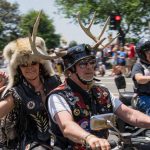
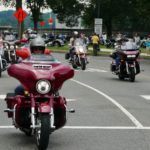
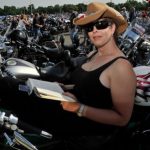
Rolling Thunder attracts a patriotic, leather-loving crowd to Washington. Major highways like the George Washington Parkway and I-66 will fill up with motorcycles, many with American flags waving behind them. The ride routinely attracts more than 500,000 bikers, many of whom ride to Washington with their local Rolling Thunder chapters from all over the country.
But according to Muller, the free weekend of events has gotten more complicated and more expensive to run over the past few years.
Rolling Thunder organizers paid about $200,000 for permits, supplies, security and cleanup last year. Their biggest expense comes from the Pentagon: It charged them about $52,000 this year to rent its parking lot and pay for security, toilets, and cleanup, according to Rolling Thunder president Joe Bean.
A Pentagon spokesperson could not confirm that cost by publication time.

Kevin Hardy, an employee at the Patriot Harley-Davidson dealership in Fairfax, Virginia, holds Rolling Thunder patches that honor veterans and prisoners of war.
The Pentagon parking lot is a key staging ground for the ride. Bikers congregate there Sunday morning before riding to the National Mall for a parade and protest. Muller said he looked around for cheaper options, but found none. The parking lots at Ronald Reagan National Airport had too many obstacles that could lead to accidents, and the lot outside FedEx Field in Landover, Maryland, was too far from D.C.
“We have been really aggravated with the way the Pentagon works and Pentagon security,” Muller said. He cited an issue last year where riders said security personnel redirected them away from certain lots, leading to confusion.
Pentagon spokesperson Sue Gough said no such incident came up in their reviews.
“The Pentagon has not wavered in its support of Rolling Thunder,” she said.
“Just keep in mind that effective preparation for an event the size and scale of the Rolling Thunder ride is a complicated and lengthy process, especially for security. And Rolling Thunder is exceptionally large,” she said.

The shirts say “The Final Ride” but Harley-Davidson dealership staff still have hope Rolling Thunder will return.
About 2,500 bikers showed up to the first Rolling Thunder ride in 1988. Muller helped organize it after being shocked by the ways civilians treated him and his fellow Vietnam veterans.
“We weren’t going to put up with anybody being treated the way we were,” he told WAMU. “Spit at, called names … people really blamed us for everything.”
He plans to ride about 210 miles from his home in New Jersey to D.C.
Not everyone rides that far. Take Kevin Hardy, the marketing director at the Patriot Harley-Davidson dealership in Fairfax, Virginia. On a recent weekday, he watched as staff members drove motorcycles all around the showroom, trying to make space for more bikes and merchandise. They host a weekend’s worth of events at the store, and expect to sell a lot of merch.
Then, on Sunday around 6 a.m., about 5,000 bikers will convene at the dealership. They’ll ride together to the Pentagon to meet up with the rest of the Rolling Thunder crew.
“You can almost smell the patriotism, like in the air and all that,” Hardy said. “It’s really good, it’s palpable, there’s flags everywhere. And it’s so many people.”
Muller said he wants Rolling Thunder chapters across the country to organize their own Memorial Day rides next year. He thinks those local rides will do more to raise awareness about veterans and prisoners of war than one big national event.
Hardy, for his part, is holding out hope that the D.C. tradition will continue.
“What we’re hoping is that somebody either picks it up, or is able to continue it in some form of fashion. We hope it goes a little bit longer,” Hardy says.

Kevin Hardy organizes “Ride of the Patriots” for local motorcyclists heading to Rolling Thunder’s main staging ground at the Pentagon.
Rolling Thunder Schedule and Road Closures
The festivities kick off Friday at 5 p.m. for the “blessing of the bikes” at Washington National Cathedral, followed by a 9 p.m. candlelight vigil at the Vietnam Veterans Memorial.
Vendors will sell Rolling Thunder patches, pins, t-shirts, and biker goods all day on Saturday at “Thunder Alley,” located at 22nd Street and Constitution Avenue Northwest.
On Sunday, the bikers will rally at the Pentagon before departing for the Rolling Thunder XXXII First Amendment Demonstration Run at noon. Ceremonies and celebrations continue through the afternoon and on Monday.
According to Arlington County Police, a number of roads will be closed around the Pentagon on Sunday from 7 a.m. until 4 p.m.:
- Washington Blvd from I-395 to the Memorial Bridge
- Route 110 southbound from Iwo Jima to I-395 (intermittent closures)
- I-395 North Exit 8B
There will also be road closures in D.C. near the National Mall from 10:30 a.m. until 4 p.m. Sunday for the parade. Parking will be restricted on the following streets from 8 a.m. to 4p.m.:
- Constitution Avenue Northwest from 3rd to 23rd Street Northwest
- Independence Avenue Southwest from 3rd to 23rd Street Southwest
- 23rd Street Northwest from Constitution Avenue Northwest to the Memorial Bridge
- 3rd Street Northwest from Constitution Avenue Northwest to Independence Avenue Southwest
The full schedule and parade route are available on Rolling Thunder’s website.
This story originally appeared on WAMU.