 Mikaela Lefrak
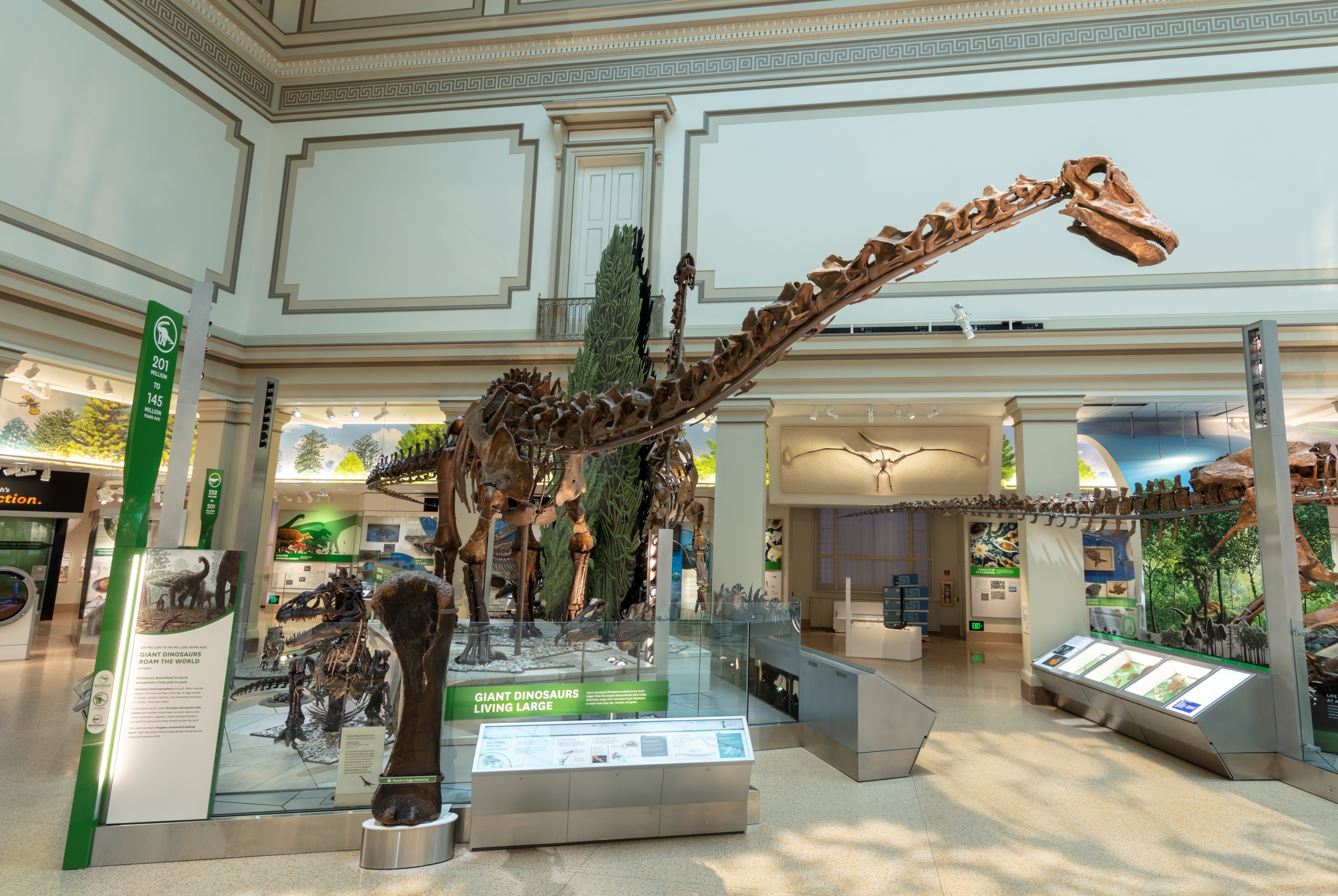
Dinosaurs are back in D.C., and they’re not here just to stand around and look pretty.
The Smithsonian National Museum of Natural History’s dinosaur and fossil hall reopens Saturday with a new name—the David H. Koch Hall of Fossils–Deep Time—and an ambitious new ethos to go with it.
“Fossils are our planet’s memory,” said Kirk Johnson, the Sant Director of the museum and a paleontologist by trade, at a preview event for the new hall on Tuesday. “Our planet has written its history in rocks and bones.”
To elicit that history, the museum’s curators have transformed the century-old Hall of Fossils over five years of renovations. What was once a dimly lit set of rooms is now one light-filled, 31,000-square-foot exhibition space packed with interactive exhibits, touchable objects and 700 fossil specimens that span 3.7 billion years of history. All of the dinosaurs have been re-mounted and re-posed.
The hall’s centerpiece is a 66 million year-old T. rex skeleton that’s been positioned to look like it’s ripping the head off a hapless Triceratops. The herbivore’s ribs are cracked under the T. rex’s foot, pointed out Matt Carrano, the museum’s dinosauria curator. He called the pose “a high drama moment.”

If you look behind the Triceratops’s head, you’ll see that a ball has been wrenched out of its socket. Cute!
“In each case, we kind of had this conversation with the fossil about what it is and what it wants to do,” he said.
Thanks to Carrano’s love for the unexpected, carnivores don’t always get to be the center of attention. In one corner, a triumphant, spike-tailed Stegosaurus stands over a Ceratosaurus that’s gotten stuck on its back after a failed attack. “This is one of the only upside-down dinosaur mounts, probably ever,” said Kay Behrensmeyer, the curator of fossil vertebrates. To her, the Stegosaurus looks rather smug.
Nearby, a Allosaurus skeleton crouches over a nest of eggs. She’s a carnivore, sure, but she’s also “a powerful mother,” as Behrensmeyer put it. The positioning allowed curators to show off the museum’s collection of eggshells and baby bones, too.
Behrensmeyer has been with the museum for 38 years, and she called the reopening of the Hall of Fossils the pinnacle of her career. She wore silver dinosaur earrings to celebrate the occasion—a Triceratops in her right lobe and a Diplodocus in her left.
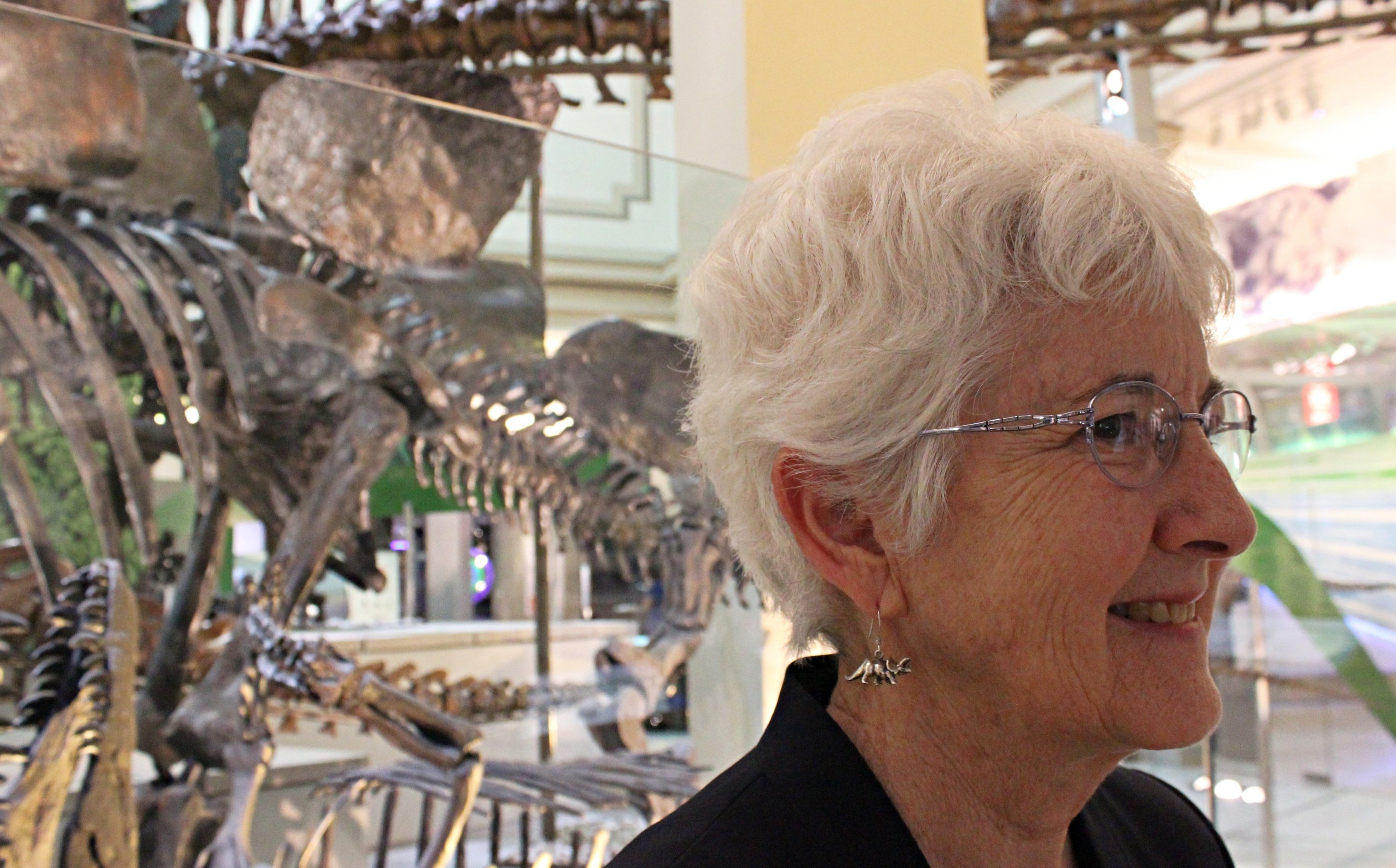
“I had two Diplodocuses, but one fell out,” she clarified. “Now I have to have one from each time period, which is fine.”
The Smithsonian touts its Hall of Fossils as the most-visited hall inside the most-visited science education facility in the world. It attracts more than 5 million visitors each year, most of whom are out-of-town tourists.
However, the exhibition rewards return visitors. There’s a smaller dinosaur positioned to be scratching its face that might escape notice on first visit, and dioramas of historic scenes with tiny details that each deserve a few minutes of nose-to-the-glass perusal. There are bones to touch, videos to watch, and digital dinos to feed.
I fed a dinosaur a pile of raw meat at the Natural History Museum’s new Hall of Fossils today. What’d you do with your Tuesday? pic.twitter.com/CiQ1aOL65U
— Mikaela Lefrak (@MikaelaLefrak) June 4, 2019
When the Hall of Fossils first opened in 1911, it became known by the nickname “the hall of extinct monsters.” In its new iteration, its inhabitants are no longer monsters from a foreign world. Rather, they’re shown to be part of a continuum of animal life on Earth.
“They came out of deep time, and they have more and more stories to tell us,” Behrensmeyer said. “And there are so many fossils still out there. They have to be discovered by the next generation.”
This story originally appeared at WAMU.