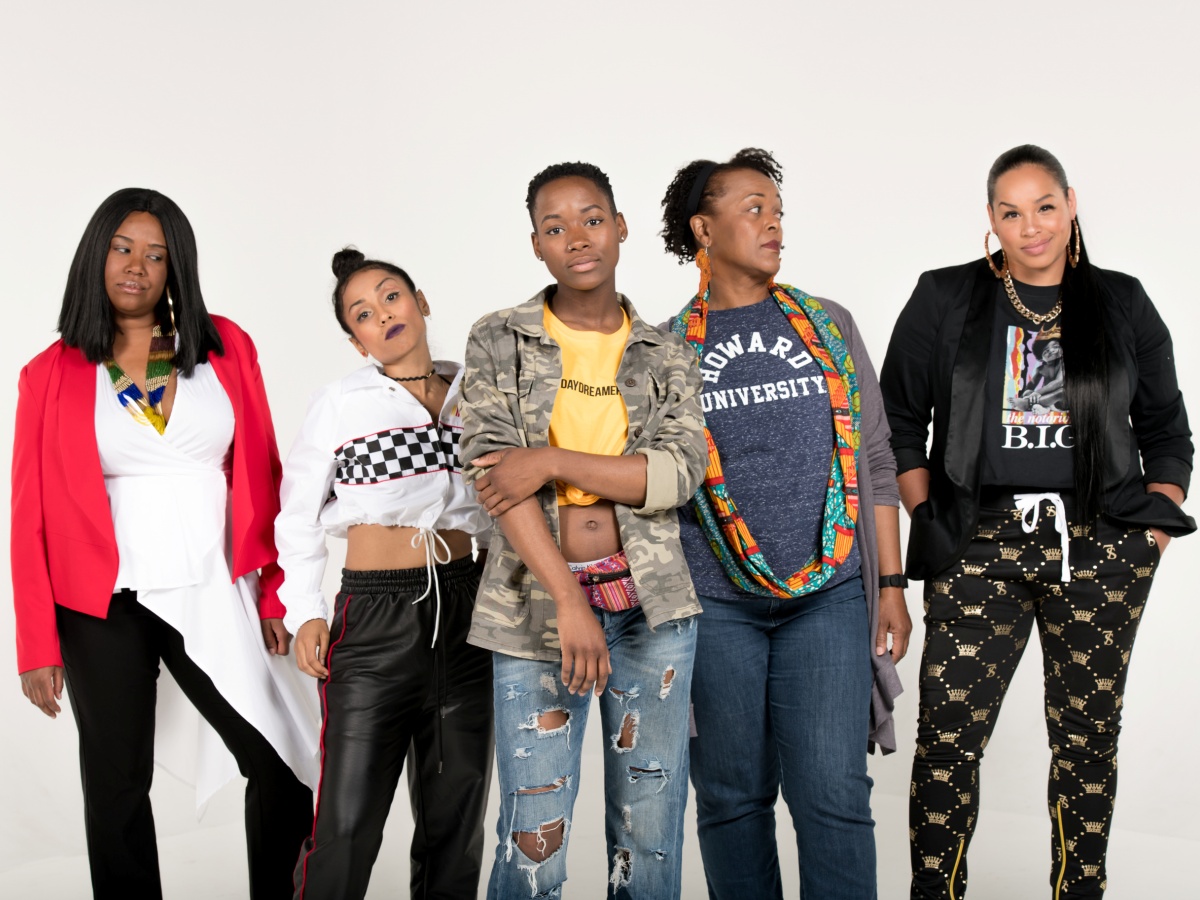
While the forthcoming play HERstory: Love Forever, Hip Hop acts as a love letter to hip-hop, playwright Goldie Patrick also uses it to question whether the male-dominated genre is dead.
“I unconditionally love hip-hop,” says Patrick, 36, who also directs the play. “I also recognize that I have had traumatic experiences in my relationships with hip-hop and I continue to ask myself, ‘Is it worth it and why am I there?’ And I think I ask those questions now because I recognize that because of my age, I don’t want to be here just to say that I didn’t leave.”
In the play, showing at the Kennedy Center on Friday and Saturday, hip-hop is personified as a woman on her deathbed named H.E.R. while five women surround her and explore the misogyny, objectification, and misrepresentation that they say have become mainstays in hip-hop. That leads them to debate whether they should take H.E.R. off life support.
The 90-minute play features an all-woman ensemble, and explores the characters’ perspectives on and experiences with hip-hop, including their memories of pioneering female rappers Moni Love, Queen Latifah, Roxanne Shanté, and others. It covers the culture and music from the 1970’s to now: Expect to hear tunes from The Sugarhill Gang, Rob Base and DJ E-Z Rock, Notorious B.I.G., and others.
The name H.E.R. is a nod to Common’s 1994 hit “I Used to Love H.E.R.”—the play centers on women and girls who used to love hip-hop, or still do.
For Patrick, H.E.R.’s critical condition in the hospital represents the critical state of hip-hop.
“We, the makers of hip-hop, the consumers of hip-hop were also the influencers of hip-hop,” Patrick says. “[Now] the ‘we’ isn’t a community of people with morals and values on authenticity. Instead the ‘we’ is determined really by a corporate algorithm that dictates what we will buy.”
Patrick based the play’s current iteration on unpublished interviews she conducted this year with artist Toni Blackman, breakdancing icon Ana “Rokafella” Garcia and others, as well as on her own experiences with misogyny as an aspiring rapper at Howard University.
When she was 17, Patrick remembers she and her boyfriend at the time performed in a high-school rappers’ showcase at the school, but when they were scheduled to face off against a popular male group, the guys, saying they didn’t want to lose to the couple, sabotaged them by stealing their tape. Patrick also recalls that people spread rumors that she was gay because she liked rapping and avoided tight clothes.
“By the time I came to Howard, I refused to rap because I didn’t want the rumors to follow me,” says Patrick, who graduated from the university’s theater arts department in 2004.
On campus, male rappers she thought were her friends spewed misogynistic lyrics about women, using their platform to disrespect and lie about women they claimed to have bedded, she says.
In 2001, Patrick responded by founding Females Representing Every Side of Hip-Hop Inc., a theater company and nonprofit based out of the Anacostia Arts Center. It started out as a social group she formed on campus after feeling like there was no outlet for women in hip-hop.
Patrick started writing the first version of the play—a monologue—in 2004, at a time when the Mount Rainier resident wondered whether hip-hop was dead because there weren’t that many female emcees left.
Lisa “Left Eye” Lopes from TLC had just died in a plane crash in 2002, Lil’ Kim was incarcerated, Missy Elliott was a year away from taking a hiatus, and Lauryn Hill had disappeared from the music scene altogether.
“It was silent and I was struggling in the silence,” Patrick says. “Part of that first version of [the play] is I wrote this letter to Lauryn Hill begging her to come back … telling her, ‘I understand that I may not know why you’re not here, but we can’t live without you.’”
Then while Patrick was reworking her play, Nas released a song in 2006 called “Hip-Hop Is Dead.” In the song, Nas personifies hip-hop as a woman with the chorus, “Hip hop just died this mornin’ and she’s dead, she’s dead.” It left Patrick questioning whether it’s easier for men to dispose of hip-hop when it’s represented as a woman.
“When we talk about the hip-hop narrative being centered on a male experience or a male perspective, and … hip-hop’s referred to as a woman from Nas in this moment when he’s saying she’s dead,” Patrick says. “How do we not make black women disposable? How do we make this so valuable that we want to fight for it?”
As her play evolved from a monologue to a production, it told the story of six women, their relationship with hip-hop, and how and why they felt disenfranchised by the music.
HERstory debuted in 2004 at the D.C. Arts Center in Adams Morgan as part of the D.C. Hip-Hop Theater Festival and returned in 2006 before an independently produced version launched there in 2007.
Now updated for 2019, the play also touches on issues of cultural appropriation through discussions about white rappers Iggy Azalea and Bhad Bhabie, known as the “Cash Me Outside” girl. Contemporary artists like Cardi B. also get shout outs in the play.
At the Kennedy Center this weekend, local lady DJs Cleveland Browne and Miss H.E.R. (natch) will get the party started by opening the play with tunes from Lauryn Hill, Missy Elliott, Nicki Minaj, Salt-N-Pepa and more.
“When you come into the theater you’re coming to a party, you’re coming to the club,” Patrick says. “This is ours. It must reflect us.”
HERstory: Love Forever, Hip Hop plays at the Kennedy Center Friday and Saturday, 7:30 p.m. Tickets $25-$35.