 Mikaela Lefrak
In June 1989, at the height of the AIDS crisis, staff members at the Corcoran Gallery of Art were preparing to open an exhibition of nearly 150 black-and-white photographs by Robert Mapplethorpe. The photographer had died of AIDS that spring at the age of 42, and the exhibition, Robert Mapplethorpe: The Perfect Moment, was supposed to be a retrospective of his work.
The images were striking: Many of them featured black bodies and white bodies intertwined in homoerotic poses. Some depicted sexually violent acts. Through Mapplethorpe’s lens, these bodies somehow appeared as both static sculptures and living presences.
But the public never got to see them. On June 13, 1989, two weeks before the retrospective was scheduled to open, the Corcoran canceled it. It was a decision that would change the course of the institution’s future. (The Corcoran was dissolved in 2014 after years of financial struggles.)
The intricacies of that fateful decision are now on display in a new exhibition, 6.13.89, at the Corcoran, which is now part of George Washington University’s Corcoran School of Art and Design. Graduate students pored through thousands of documents from the gallery’s archives to tell the story of the Mapplethorpe show’s conception, controversy and cancellation, as well as the community outcry that followed.
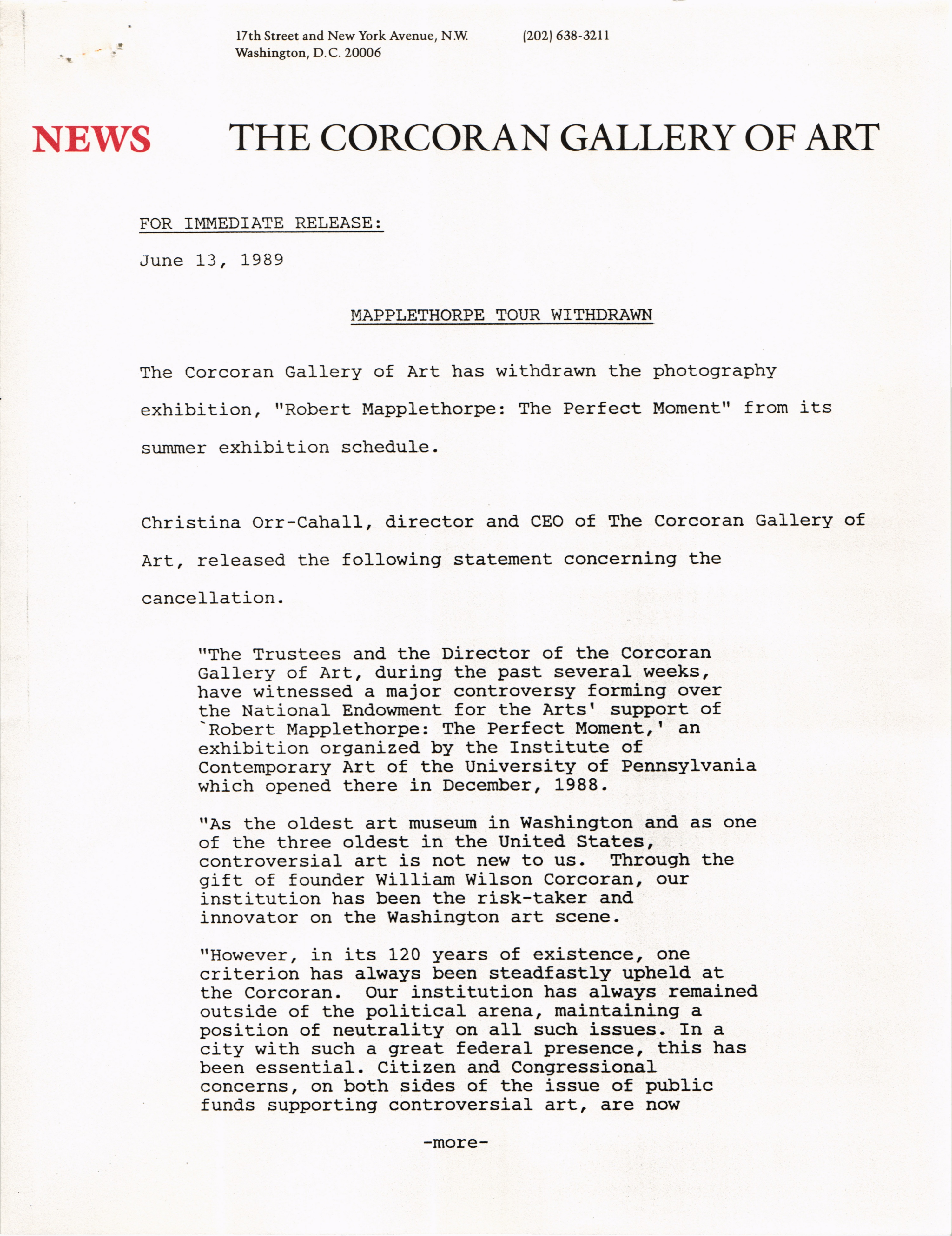
A 1989 news release explaining the decision to cancel the Mapplethorpe retrospective.Corcoran Gallery of Art
“The goal with the exhibition isn’t to castigate any single person’s decision at all, but rather to talk about what happens when institutions are pulled in different directions,” said Sanjit Sethi, the director of the Corcoran School. “What happens when their values separate from the values of the community?”
The 1989 Mapplethorpe exhibition had been partially financed by a $30,000 grant from the National Endowment for the Arts (NEA). About a month before it was set to open, conservative members of Congress caught wind of the subject matter being funded by federal dollars.
“We realize that the interpretation of art is a subjective evaluation, but there is a very clear and unambiguous line that exists between what can be classified as art and what must be called morally reprehensible trash,” read a June 8, 1989, letter to the NEA that was signed by around two dozen members of the House of Representatives. The letter went on to call the exhibition “a horrible abuse of tax dollars” and threatened to reduce NEA funding.
Four days later, the Corcoran’s Board of Trustees met with its director, Christina Orr-Cahall, and made the decision to cancel. Minutes from that fateful meeting are on display alongside a handwritten menu of the food that was served (which included macarons and “oriental rice”).
The decision was met with instant rebuke from artists, gay rights advocates and Corcoran staff members. Protestors projected Mapplethorpe’s photos onto the exterior of the Corcoran on the day the show was scheduled to open. The New York Times reported that the crowd numbered around 700 people.
Sethi said that he got some questions about why the school was “dredging up” the controversy again. The Corcoran is technically no longer a museum, and George Washington University leadership and Corcoran professors are still navigating their new relationship.
“There’s no way for the Corcoran, in any incarnation, to move forward without marking what occurred 30 years ago,” Sethi said he responded.
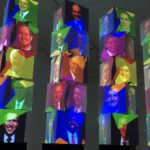
In February, the Corcoran invited projectionist Robin Bell to exhibit his work, much of which took issue with the Trump administration. The show, OPEN, echoed the work of the activists who projected Mapplethorpe’s images onto the Corcoran.
Last Saturday, on the same day as D.C.’s Pride Parade, Sethi put the final touches on 6.13.19. with Madeline Henkin and Arthur Foster, graduate students and the exhibition’s co-curators.
“It felt like a fitting task to do,” he said. “It’s really important for us, from a pedagogical and community standpoint, to excavate one of the biggest ghosts of our past.”
6.13.89 opens at the Corcoran at 500 17th Street NW on Saturday and runs through October 6.
This story originally appeared at WAMU.