Martin Austermuhle
Update: The D.C. Council’s final version of the Budget Support Act, which passed 12-1, included an amendment that prevents Events D.C. from spending any money in fiscal years 2019 or 2020 to buy the RFK champus from the federal government or otherwise attempt to lure the NFL to D.C.
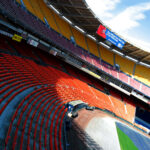
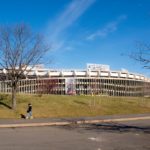
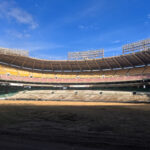
Original: D.C. Mayor Muriel Bowser has made her position clear: she’d like to see the Washington football team return to the city, where they could play in a new stadium on the site of RFK, the location of some of the team’s greatest days.
But the D.C. Council may have other ideas.
A provision of a budget bill the Council will take up on Tuesday would prohibit Events D.C., the city’s sports and convention authority, from spending any money over the next two years to purchase the RFK campus from the federal government or to “induce a National Football League team to locate in the District.”
Last year, Bowser teamed up with congressional Republicans in supporting a bill that would have extended the city’s lease over the RFK campus and allowed commercial development on the site. The bill was seen as a means to attract the team back into D.C., where they played until departing for FedEx Field in Prince George’s County in 1997.
As part of that effort, Events D.C. spent $150,000 lobbying Congress in support of any measure that would give the city more control over the 190-acre campus, according to a report from the Washington City Paper.
Separately, earlier this year, D.C. Del. Eleanor Holmes Norton introduced a bill in the House of Representatives that would require the federal government to sell the RFK campus to the city at fair market value.
But the council’s provision isn’t so much about the team’s name or concerns that the city may be left on the hook for helping pay for a new stadium; it’s more of an extension of the tug-of-war that has played out in recent weeks over how Events D.C. spends the money it takes in from hotel and restaurant taxes.
Last month, the Council tried to take $60 million of excess funds out of Events D.C.’s reserves, in part to repair the city’s aging stock of public housing. (The amount was eventually decreased to $49 million). But Chief Financial Officer Jeffrey DeWitt—a member of Events D.C.’s board—objected, saying any extra money the authority has must go to pay off the debt the city accrued in building the Washington Convention Center.
“If you, and that means Events D.C., don’t have money for anything including for the general fund of the government, then you’re not going make money available for things that you don’t have in your budget like attracting a football team,” said Council Chairman Phil Mendelson in an interview on Monday.
An email to Events D.C. seeking comment went unreturned.
Mendelson said he is also planning on calling a hearing in the fall to more broadly explore the money taken in and spent by Events D.C., which manages the Convention Center, Nationals Park, and the new Sports and Entertainment Arena that opened in Southeast D.C. last year. Last week, it opened new turf playing fields on the site of a former parking lot next to the stadium.
He said he wants to know how Events D.C. spends the excess revenue it takes in, and pledged to reassert the council’s power of the purse over some of that money.
“If there’s too much, we absolutely have to have control of that money,” he said.
Mendelson also worked another provision into the budget bill to prevent any movement on RFK. He’s proposing withholding building permits for any project on the stadium’s campus (as well as Franklin Park) if Bowser does not submit a report to the Zoning Commission that is required for the implementation of a new law regulating short-term rentals on home-sharing platforms like Airbnb and VRBO. Bowser called the bill, which passed last November, too restrictive.
“The move by the council chairman prioritizes stopping Airbnb over improvements at our parks,” says Bowser spokeswoman LaToya Foster, referring to the city’s plan to help rehabilitate Franklin Park in downtown D.C.
In related news, The Washington Post is reporting that Mendelson has found a way to claim $47 million to be split between fixing public housing and improving the city’s 911 dispatch system. While Mendelson largely refused to discuss details about the plan on Monday, the proposed budget bill also includes a separate source of money for public housing: half of Events D.C.’s excess reserves as of the end of the current fiscal year, which ends in September.
This story originally appeared on WAMU.