There’s no one right answer to the Rorschach inkblot test. What you behold is what you see, and almost certainly different from what someone else sees. In an odd experiment melding perception and expression, D.C.’s Rorschach Theatre, named for that psychological test of yore, has invited local playwrights and filmmakers to create brand-new works based on their impressions of a single piece of artwork.
In this case, that artwork is Leo Villareal’s “Multiverse,” the immersive hallway beneath the National Gallery of Art with electric diodes and other circuitry that light up as you walk past. The artist has said that while the lights at first might appear to be random, the longer one looks at it, a pattern begins to take shape—similar to the Rorschach inkblot test.
After a walkthrough of “Multiverse” last Saturday, Rorschach co-artistic director Jenny McConnell Frederick gave the playwrights and filmmakers their mission: Write a short play or film treatment inspired by “Multiverse.” And have it ready by Sunday.
“Last night we read hot-off-the-presses plays and made some tweaks and changes, and tonight is the first time the actors come together to read the pieces,” McConnell Frederick says Monday at a rehearsal space inside the Atlas Performing Arts Center on H Street. “They’ll spend the week rehearsing them, then on Saturday we debut them all—and close them all.”
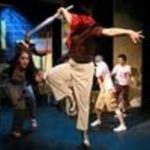
This unique theatrical event is called KLECKSOGRAPHY (a word meaning the interpretation of inkblots), which will have three performances this weekend. Audiences will behold a show of short plays and two-minute films conceived, designed, and executed in less than a week—all inspired by “Multiverse.”
KLECKSOGRAPHY, hosted by Rorschach, is a collaborative effort with fellow District theater companies Theater Alliance, Solos Nua, Longacre Lea, Flying V Theatre, and We Happy Few, all of whose directors and actors will be contributing to the show. Rorschach has staged such interpretative events since 2010, with previous themes including forgotten Washington stories and urban legends. This will be the first time that other theater companies have contributed works and personnel to the event.
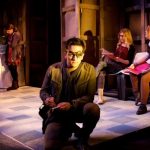
Jared Strange, a playwright pursuing a Ph.D in theater and performance at the University of Maryland, will debut Three Histories of the Future as his contribution to KLECKSOGRAPHY. The short play involves three people using a “discount time travel experience” that goes not precisely according to plan.
“They get a little stuck together quite literally [and] their problems start to meld together,” says Strange, whose earlier work, The Emperor’s Big, Fat, Naked Revolution, played at the 2017 DC Source Festival.
Although Strange’s play takes the futuristic look and feel of “Multiverse” to heart in his new play, he says he was most struck by the quotidian activities he observed in that hallway beneath the National Gallery as people strolled through the immersive piece.
“You see people on their phones and security guards telling them what to do or what not to do,” he says. “And I was struck by how just ordinary it is that we could be in this mystical, incredible space—we could be in time travel with faster-than-light speed—but people would still be doing their regular everyday stuff.”
Accordingly, Three Histories of the Future envisages such an alternate universe where the problems of everyday life get mixed up quite literally with the time travel of its three characters. (To save time in writing, Strange gave the characters the same names as each actor.)
Jjana Valentiner, who is directing Strange’s play, says she and the playwright “mined” the skills of their small cast to bring it to fruition in such a short time.
“You have to be at the top of your game to be able to go in and have 10 minutes to make an impression on an audience,” Valentiner says. “It’s a fun challenge.”
Kylos Brannon, a professor at American University and a participant in the show, agrees that brevity is critical to the storytelling of these short pieces.
“These are appetizers, not full meals, and should be free to be incomplete, or only a taste for an audience,” he says.
Brannon’s work is one of six films of two minutes or less that round out the nascent narrative told by KLECKSOGRAPHY. Brannon is mentoring the current and former AU students whose other movies will debut Saturday evening. (American University holds the license to WAMU, DCist’s parent company). Banner also went in a high-concept direction for his “Multiverse”-inspired project.
“I’ve been crafting a short script that’s a little like a poem, in which I will use found footage to illustrate how [human and] light are the same but different, and vary across alternate identities and infinite possible universes,” Brannon teases of his film.
Valentiner, the director of Strange’s Three Histories of the Future, says Saturday evening’s event will expose audiences to the depth of the D.C. theater community’s talent pool, especially at the smaller scale of the repertory companies contributing to KLECKSOGRAPHY.
“In the larger theater spaces, it can be very visually spectacular, but the smaller theaters I think have the ability to take greater risk because that’s the bread and butter of what they’re doing every day,” she says.
KLECKSOGRAPHY runs at the Atlas Performing Arts Center Saturday, with shows at 5 p.m., 7 p.m., and 9 p.m., $15-$20.
This story has been updated with the correct spelling for Kyle Brannon’s name.