What if Metro’s Red Line took passengers all the way to Mount Pleasant, or if the 50 and 52 routes up and down 14th Street NW were subways rather than buses?
This could have been part of D.C.’s public transportation system, instead of the 117 miles of tracks and 91 stations that Metro currently uses to carry its daily riders.
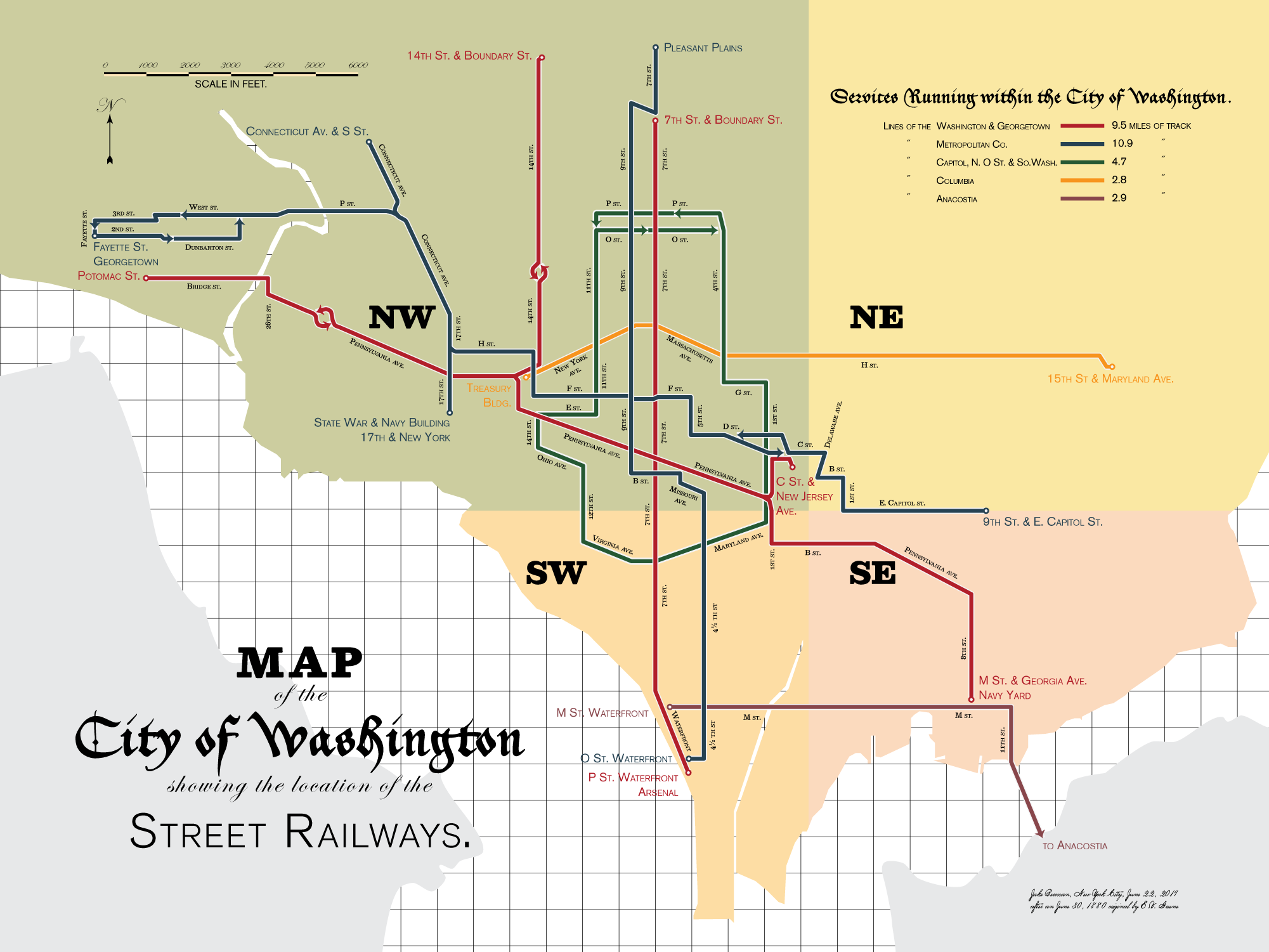
These colorful maps from New York City-based artist Jake Berman show the District’s forgotten streetcars and subway plans. “I want the person who’s looking at them to imagine what could have been or what used to be,” says Berman, who has poured hours of work into recreating America’s lost transit maps.
Long before Metro opened its doors in 1976, Washington had an extensive network of streetcars, Berman explains. But in 1944, during World War II, increasing traffic in the District prompted the city’s engineers to draw up a plan to move the downtown segments of the system underground. The proposed system didn’t extend nearly as far into D.C.’s suburbs as Metro’s commuter rail does, but, as Berman notes, it served a much greater number of stops in the city’s downtown.

The 1944 design never materialized—as cars became more popular, the plan was abandoned in favor of building highways.
“The federal government had decidedly turned towards highway construction,” says Berman. “It wasn’t until the 1960s and 1970s that subways and other massive transit came back into vogue.” In 1969, Metro began construction on its rail system.
Berman says it takes several weeks just to gather the information he needs to recreate the maps. He acquired the long-forgotten plans for the 1944 subway from the District Department of Transportation.
“It requires a lot of archival research,” he says. “The D.C. subway plan from 1944 had basically been sitting in the archives for decades.”
If officials had implemented the plan, the District would probably have grown in a radically different way, Berman says. “There’s a very different future that might have resulted if they had just taken the pre-war system and put it underground through downtown,” Berman says. “You would have had a subway station right outside of the White House.”