 Monna Kashfi
Sanctuary DMV, a local all-volunteer immigration advocacy collective, has been conducting bystander intervention trainings in the D.C. region for the past two years. But after President Donald Trump announced a wide-sweeping ICE operation last week that would have targeted 2,000 families with individuals who have received deportation orders, the turnout at Sanctuary DMV’s training session last Saturday for their rapid response network was the largest organizers have seen to date: 200 people.
“People were really galvanized by Trump’s tweet about mass raids starting across the country,” says Brandon Wu, an organizer with Sanctuary DMV. “We organized that training on 48 hours’ notice just with the idea that people were really on high alert because of that tweet and because of subsequent intel that ICE was going to target D.C.”
Trump announced the cancellation of the raids just hours before they were scheduled to be carried out on June 23, delaying them by two weeks to give Congress an opportunity to pass border security legislation. Just hours after Trump’s tweet calling off the raids, at least two undocumented immigrants were arrested by ICE agents in D.C.
Sanctuary DMV operates an immigration emergency hotline where anyone can report ICE activity across the greater D.C. region. And trained volunteers from the rapid response network are then deployed to film the enforcement activity as bystanders and provide support to the family members who are left behind.
Volunteers also follow up with ICE to provide deportation defense support to the undocumented immigrants who are detained and to get information about the case to the detainee’s family and the public. Creating accountability for the ICE agents on the scene, and for the agency as a whole, is the primary function of bystanders “bearing witness” in these situations, Wu says.
It’s important for bystanders to know their roles and responsibilities—and when to curb their efforts, Wu says. “The most important thing is that we’re not asking folks to intervene in any way or interfere in any way,” says Wu. “Any blowback from that kind of action would fall on the people that ICE is targeting rather than the volunteers.”
Legal experts say that bystander intervention with law enforcement, whether it be ICE agents or the local police, is a fine line that must be navigated carefully. The law does not provide bystanders who intervene in these situations the same protections provided by “Good Samaritan” laws that typically protect people who intervene on the scene of an accident or other medical emergencies.
“The smartest move is to observe and keep your emotions in check,” says Thomas Simeone, an attorney based in the District. “Avoid going after the cops in any way. Physically getting involved can open yourself up to up to six months in jail.”
For many Sanctuary DMV volunteers, the most important takeaway from the bystander training is to behave responsibly so that their presence doesn’t do more harm than good for an already vulnerable community.
“Any risk I am taking is not on the same level as an undocumented person coming out in the community and asking for help in a public and open way,” says Jennifer Amuzie, a volunteer with Sanctuary DMV. “Respecting that is really important.”
As the new deadline for the raids looms, Sanctuary DMV is planning an additional rapid response training session on Tuesday, July 2. The group also trains volunteers to accompany immigrants to routine ICE check-ins and immigration court appointments.
“This community is always under siege,” Amuzie says. “There are people who think the danger has passed, but this is a community that is always in danger.”
In the aftermath of the president’s announcement about ramped up raids, Mayor Muriel Bowser took to social media to reassert that D.C. is a sanctuary city and said she is “committed to protecting the rights of all our immigrant families in the face of these disturbing threats.” D.C. police also tweeted that “MPD will not enforce civil immigration laws, which only create a strong divide between the police and community members.” But the District also is filled with more than two dozen federal law enforcement agencies, many of which do.
And surrounding jurisdictions have also been grappling with what can often be confusing federal policies regarding criminal and removal warrants. At least three undocumented immigrants have been placed in deportation proceedings after recent encounters with local police in Prince George’s County, the Washington Post reports, even though county officials vowed not to cooperate with ICE in 2017.
For Amuzie, the opportunity to volunteer with Sanctuary DMV presented itself when she was looking for a tangible response to national immigration policy. An estimated 25,000 undocumented immigrants live in the Greater Washington area, according to a 2016 Pew Research Center study.
“We’re looking out for our neighbors in the same way you do when you spend your Saturday morning at a soup kitchen,” Amuzie says of her efforts and those of her fellow volunteers.
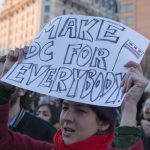
Others have turned to protests and rallies. On Wednesday, a few dozen people demonstrated in Northern Virginia near a U.S. Citizenship and Immigration Services Field Office in Fairfax County.
The march was organized by La ColectiVA, a Latinx-led collaborative based in Virginia that partnered with Sanctuary DMV for the event.
Organizer Danny Cendejas says the goal was to “inform our community about their rights, inform our community about their resources, and hotlines that are available, and make sure that we can, as a community, push back” against the raids.
Sanctuary DMV will also hold a rally on Saturday to protest the ICE raids and show support for D.C.’s immigrant communities. It will start at 4:30 p.m. at Columbia Heights Civic Plaza and hundreds of people have indicated that they plan to participate.
Reporting contributed by Julie Chang.