Jacob Fenston
D.C. got a month’s worth of rain in one hour on Monday morning, rivaling the record for all-time rainiest hour. Then it kept on raining. The torrential downpours overwhelmed D.C.’s sewer system, and water quality monitoring shows the results: some of the highest bacteria levels in local waterways so far this summer.
Since May, volunteers have been testing water for E. coli every week at 22 sites along the Potomac River, Anacostia River and Rock Creek. Most weeks, some sites have low enough bacteria levels that they are considered safe to swim in, under EPA standards.
This week, only one site (the Tidal Basin) could be considered safe for swimming. Four sites had bacteria levels so high they were basically off the charts.
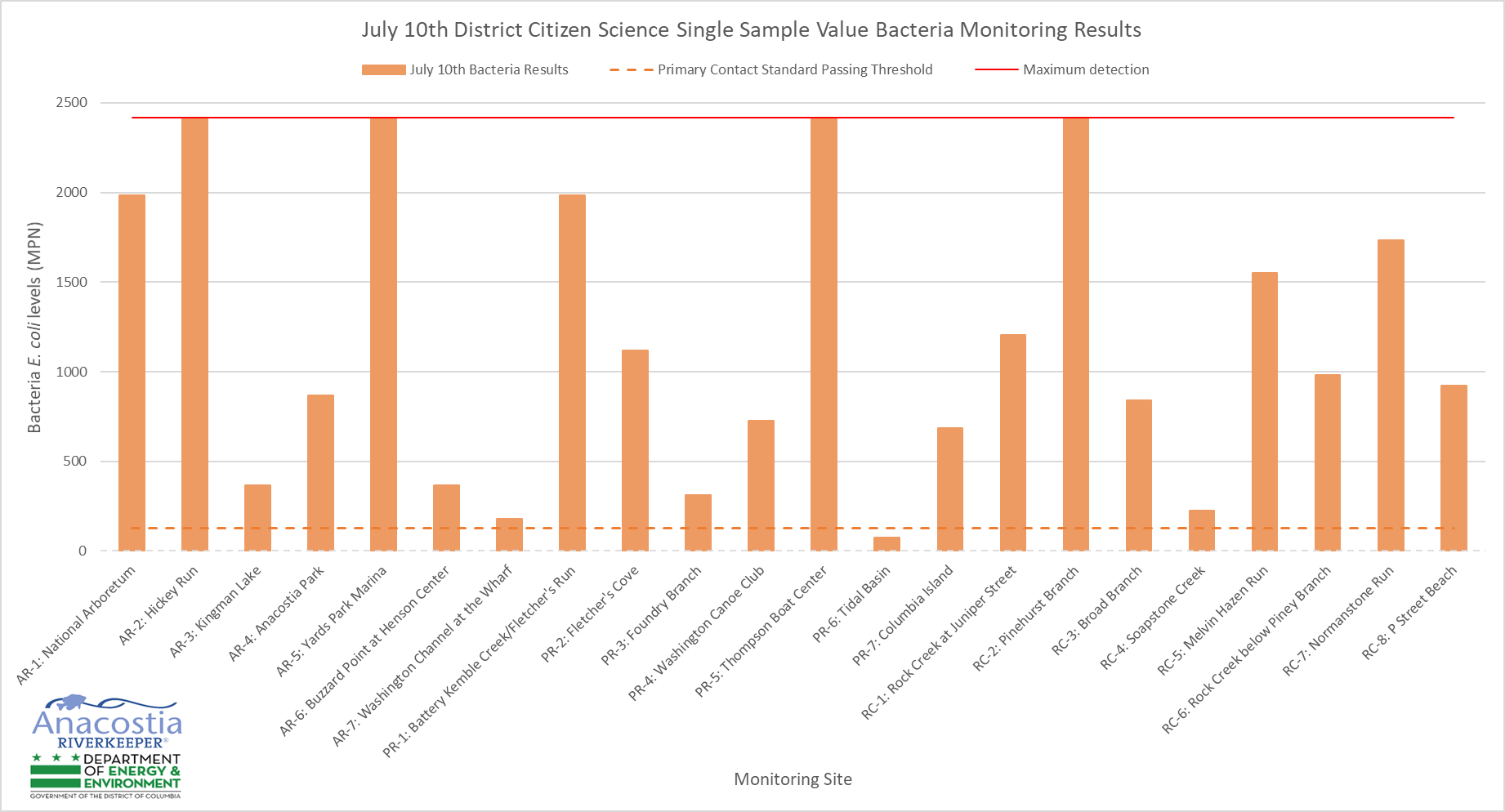
This is not the week to jump off the dock at Thompson Boat Center!
The most polluted sites tested on July 10 were Hickey Run (an Anacostia tributary in the National Arboretum), Yards Park (on the Anacostia), Thompson Boat Center (on the Potomac), and Pinehurst Branch (a Rock Creek tributary). All four had E. coli levels greater than the maximum level tested for — 2419.6 MPN / 100mL. That’s six times the EPA standard for safe swimming.
Things could have been a lot worse.
Last year, DC Water opened the first portion of a $2.6 billion tunnel system to prevent sewage overflows into the Anacostia. That tunnel kept 170 million gallons of sewage combined with stormwater out of the river on Monday. Still, 50 million gallons of combined sewage did overflow into the water, contributing to the spike in bacteria levels.
It’s not just sewage that contaminates the water. Even at sites upstream of the combined sewer outfalls, the bacteria levels were high.
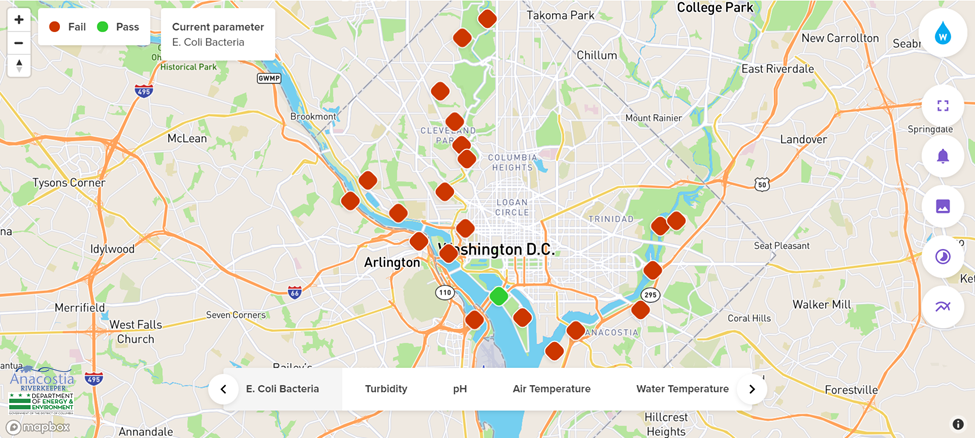
Sites marked with red failed E. coli testing, indicating it’s unsafe to swim in the area. Note the one green diamond, at the Tidal Basin.
“There’s a lot of potential sources for the bacterial contamination of the water,” says Trey Sherard, with Anacostia Riverkeeper, one of the nonprofits conducting the weekly water quality monitoring. “E. coli, which is what we test for, as a proxy for things that might make us sick, is only found in the guts of warm-blooded animals. So if there’s E. coli in the water then there has been some type of fecal contamination.”
Other sources of bacteria include waste from pets and wildlife washing off of roadways and sidewalks.
Sherard recommends waiting at least 72 hours after a storm before coming in contact with water in the Anacostia. The river’s slow-moving waters take a long time to flush out pollution.
The most recent water testing results can be found online, or in the Swim Guide app.
Swimming, however, is illegal in all D.C. waterways, except during permitted events.
This story first appeared on WAMU.