Jacob Fenston
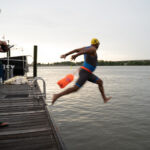
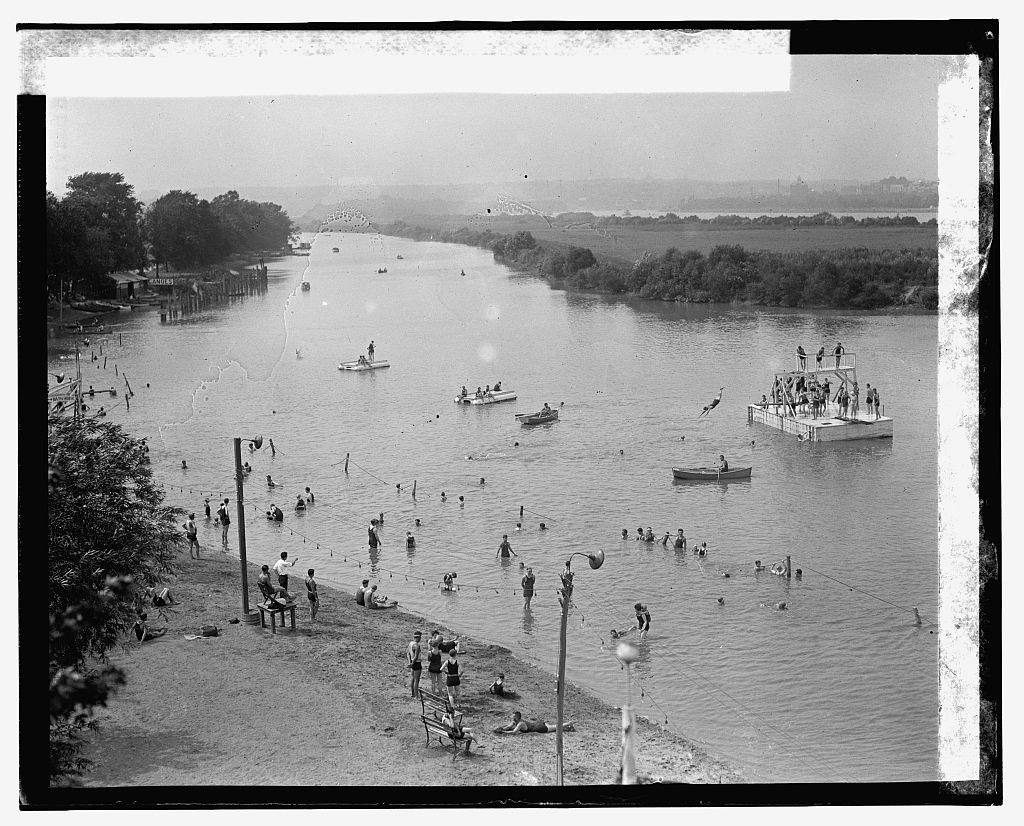
A century ago, a hot summer day in D.C. would mean thousands of people crowding the banks of the Tidal Basin, the Potomac River, Anacostia River and Rock Creek to cool off. Now, environmental advocates say the waters are, in some places at least, once again clean enough to swim in. They are calling on city officials to lift the longtime ban on swimming.
“This this is one of the only cities in the United States that it’s illegal to swim because of raw sewage in the waterways,” said Potomac Riverkeeper Dean Naujoks.
“D.C. has made a lot of progress,” he said. “It’s time to lift the swim ban.”
The Potomac Riverkeeper Network has launched a campaign to get D.C. to end the ban on swimming, and has a petition urging Mayor Muriel Bowser to commit to doing so.
The first swim ban on the Potomac was instituted in 1932. At the time, there was no sewage treatment in the region; raw sewage from hundreds of thousands of residents was dumped directly into the rivers.
Pollution from sewage continued even after treatment plants were built. But in the past few years, major sewer upgrades have helped clean up the water. DC Water’s Clean Rivers Project has kept billions of gallons of sewage out of the Anacostia River — preventing more than 80% of sewage overflows since 2018. The next phase of the project on the Anacostia will go online next year, preventing 98% of overflows. Similar projects are in the works for the Potomac River: a sewer upgrade in Alexandria is scheduled for completion in 2025, and one in D.C. is slated for 2030.
“Lyndon Johnson said that this river was a national disgrace, but he also said that this river should serve as a model,” said Naujoks, referring to remarks President Johnson made in 1965, calling for action to clean up the nation’s waters.
Naujoks spoke at an event at The Wharf, marking the 50th anniversary of the Clean Water Act, which has been responsible for spurring the cleanup of D.C.’s rivers as well as waterways around the country.
So where might swimming be possible, if District officials lift the ban?
D.C. Delegate Eleanor Holmes Norton has requested that the Army Corps of Engineers conduct a feasibility study on public swimming options in the Potomac and Anacostia, including cost estimates for all the feasible options.
“The Potomac River, once the destination of untreated wastewater, agricultural runoff, and industrial pollution, is once again a thriving aquatic ecosystem,” said Norton, speaking at the event.
Water quality data collected by a coalition of environmental groups over the past three years shows that numerous spots on the Potomac and Anacostia usually have levels of bacteria low enough that it’s safe to swim.
Five locations passed water quality standards for bacteria more than 80% of the time. Washington Channel (where The Wharf is located) passed 98% of time; the Tidal Basin passed 97%; Buzzard Point (on the Anacostia) passed 85%; Kingman Island (on the Anacostia) passed 83%; and Thompson Boat Center (on the Potomac) passed 82%.

The cleanest locations were generally in areas with high water flow, so bacteria is quickly diluted, and in areas distant from outfalls were sewage overflows during storms. Rock Creek, though scenic, had consistently high bacteria levels.
A 2019 study of swimming feasibility on the Anacostia River identified nine possible sites, from Yards Park, at the southern end of the river, to Kenilworth Park, upstream near the Maryland border. Authors examined the pros and cons of each site and considered various options for getting people in the water, from beaches to floating swim platforms.
Historically, the Tidal Basin was a popular spot for swimming, starting soon after its construction in the 1880s. However, Congress banned swimming there in 1925, in part due to rising pollution levels, and in part due to racism. In a segregated city, Black swimmers were pushing to have equal facilities built on the side of the Tidal Basin where they swam; rather than allowing that, Congress closed the white beach and demolished the white bath houses.
There was also a beach on the Virginia side of the Potomac, called Arlington Beach, located near what is now the Pentagon. The beach had not only swimming areas and floating diving platforms, but also bath houses, canoes, a roller coaster, and other attractions.

D.C. officials have been generally supportive, if noncommittal, of lifting the swim ban. In recent years, the ban has been relaxed, so now permitted events are allowed on both the Potomac and Anacostia.
Nicole Goines, a spokesperson for the District Department of Energy and Environment, said in an email that “DOEE’s goal is to allow swimming in District waters.”
Goines said the department was encouraged by recent data showing the water is often safe for swimming. “To remove the swimming ban, DOEE is taking steps to update our regulations and water quality standards to be consistent with the EPA’s most recent science and recommended standards. This, combined with developing new monitoring and analytical tools, will allow the District to alert the public when the waters are unsafe for contact recreation, not unlike beach advisories that are used in coastal communities.”
Naujoks and others credited the Clean Water Act, passed in October, 1972 with bipartisan support in Congress, for improvements in water quality in D.C.
“It’s 50 years of tremendous progress that we have made,” said Radhika Fox, who leads the Office of Water at the U.S. Environmental Protection Agency, and who also spoke at the event.
But while progress has been made, it has been on a much slower timeframe than the law originally called for.
The Clean Water Act set a 1983 deadline to make waters once again swimmable and fishable, after decades of unregulated pollution from sewage and industry. After 50 years, half of the nation’s waterways are still considered impaired, according to a recent report.
“A big piece of that is the need for investment,” said Fox. “It’s the need for us to actually prioritize our water resources.”
She pointed to the recent infrastructure law passed by Congress, which includes record funding for improving sewage and stormwater infrastructure as well as drinking water infrastructure.
“We are going to be investing $50 billion over the next five years in water bodies like this all around the country,” says Fox.
One wonders, do swimming beaches count as water infrastructure?