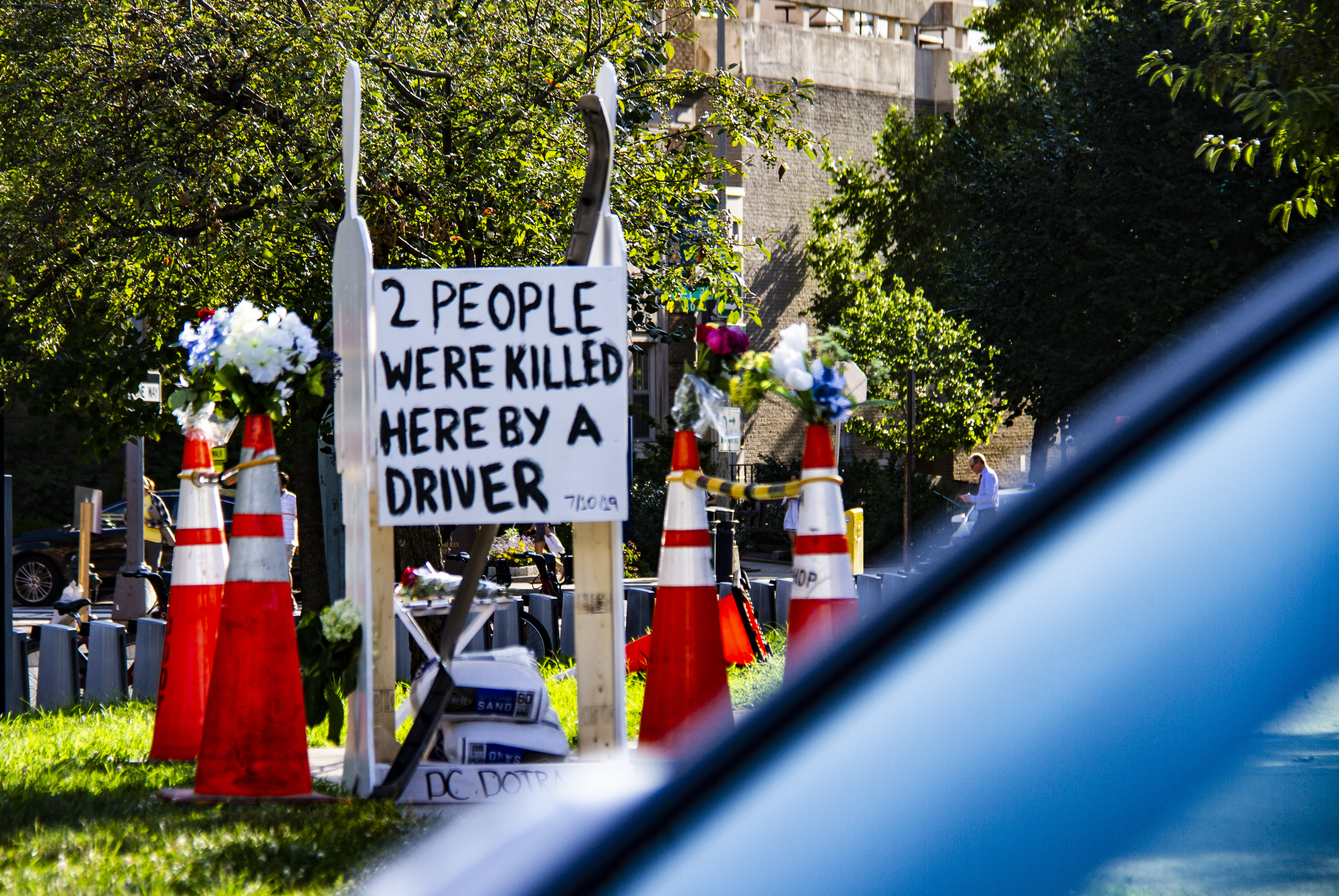

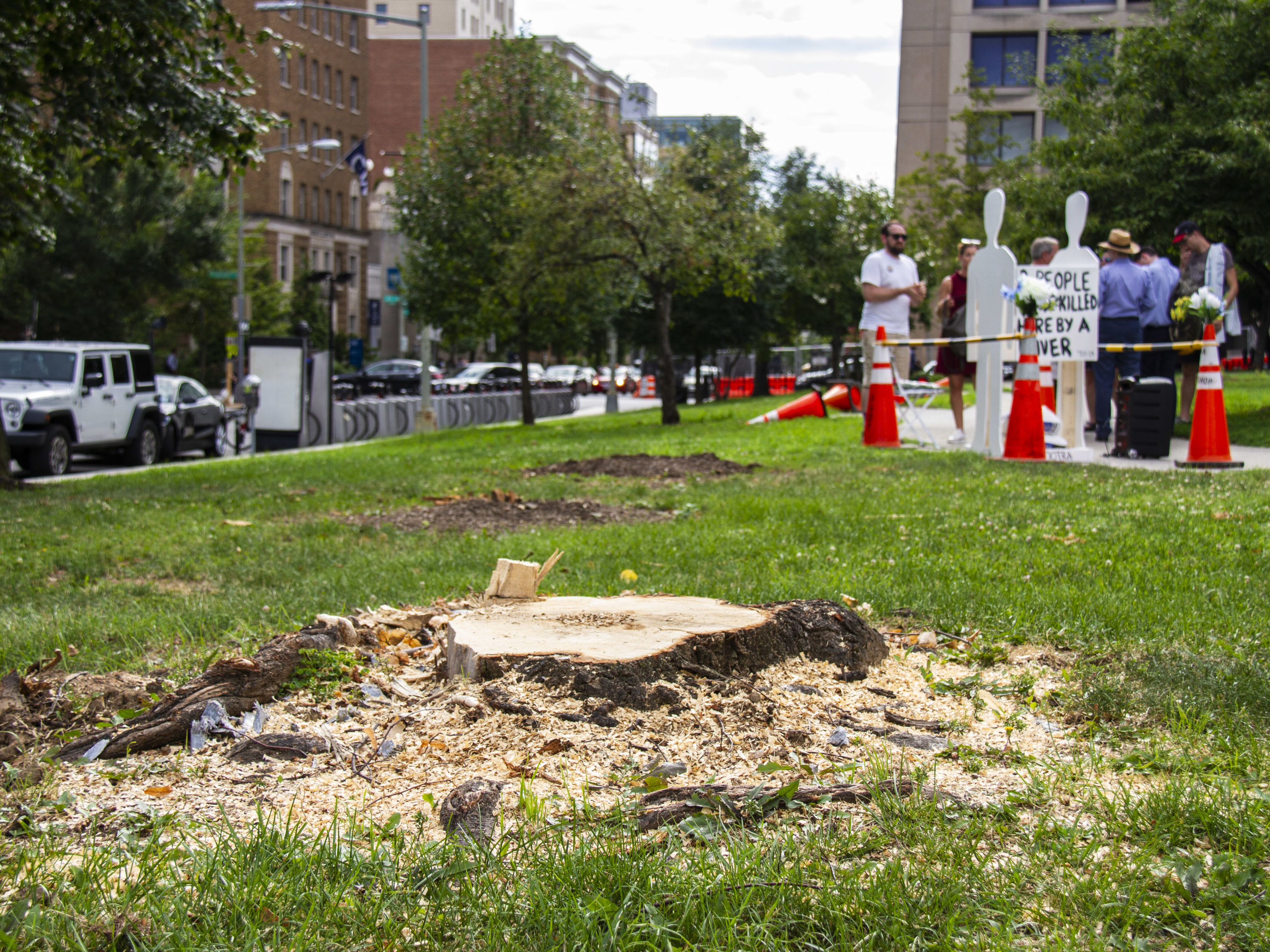
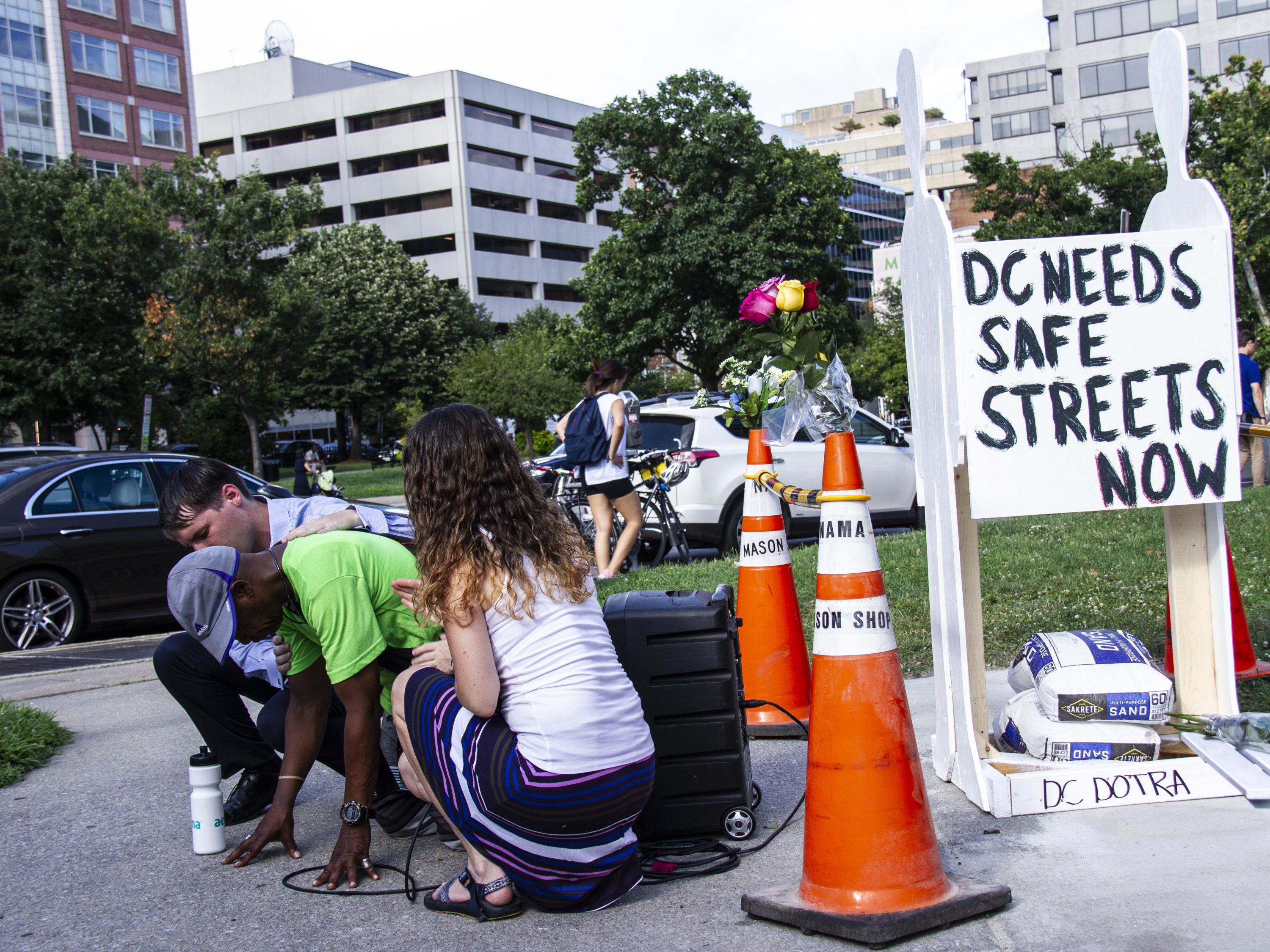
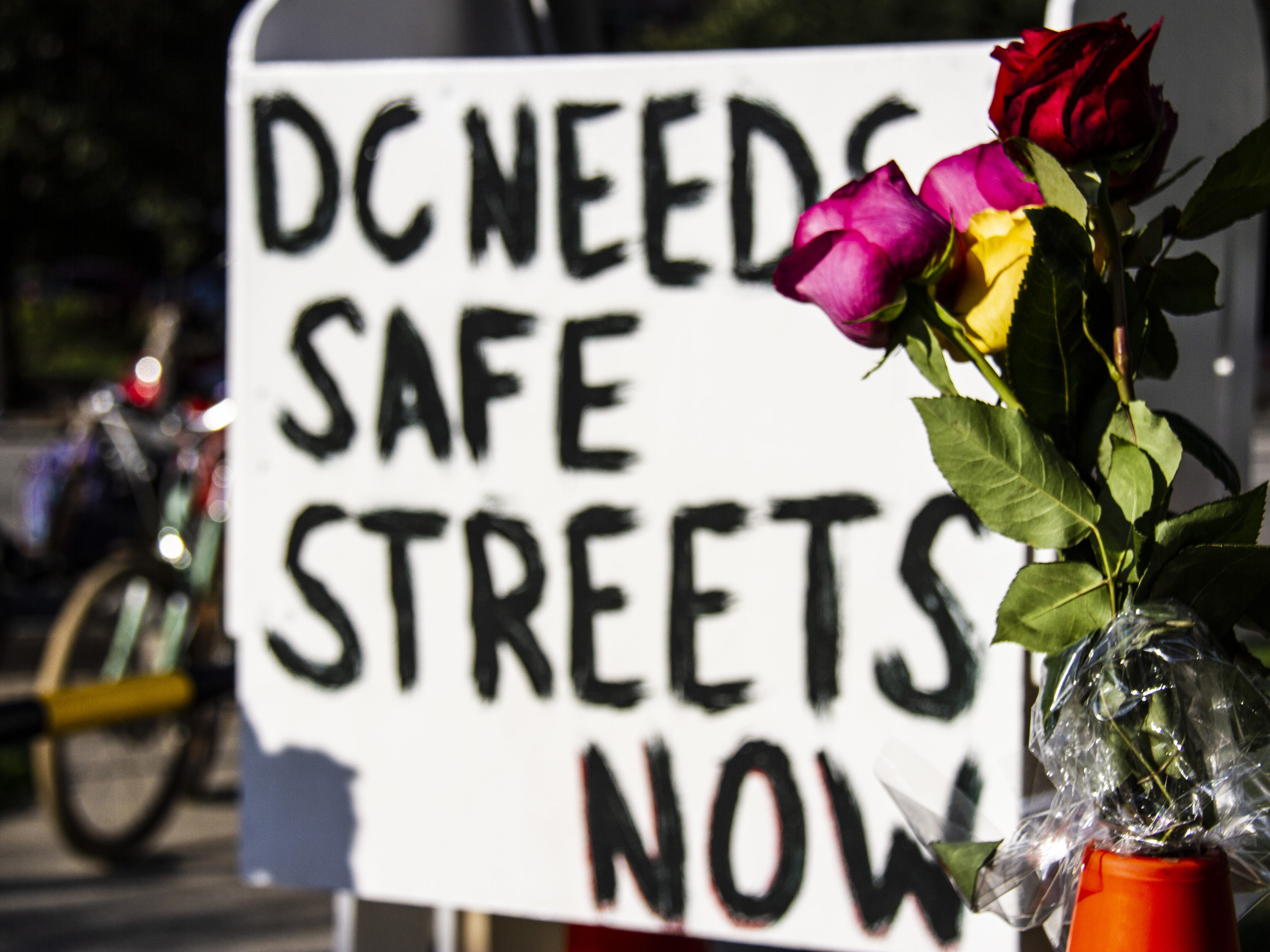
By Thursday evening, the only signs left of last week’s deadly crash in a park near Foggy Bottom were a tree stump covered in fresh sawdust and, a few feet away, two bare spots in the grass where benches used to be.
As rush-hour traffic thickened on Pennsylvania Avenue, people started trickling in for the vigil with beads of sweat running down their foreheads. It was still upwards of 90 degrees downtown.
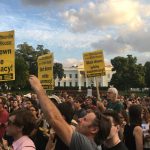
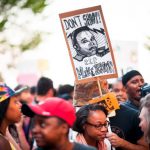
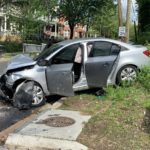
By 5:30 p.m, around 50 people were gathered at James Monroe Park. They came to honor the lives of the two people who were killed there last week when an SUV driver barreled into the park at around 11:30 p.m. on July 10th.
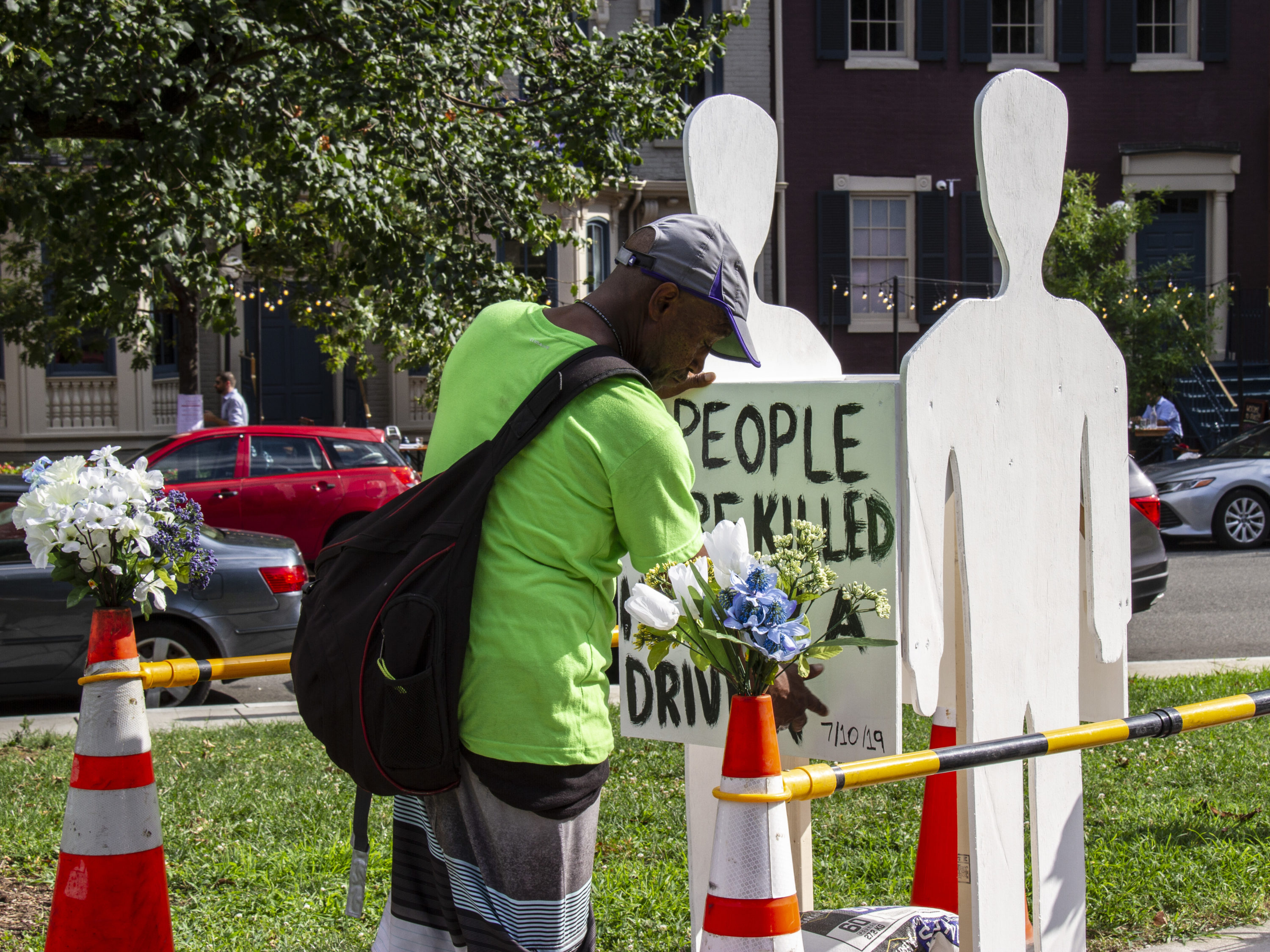
Robert Gregory was one of the first people to arrive.
“I knew the guy,” he said, fighting back tears. “He was always walking around with that speaker—he was always playing music. I was surprised he was here because he usually sleeps at the subway down there on Connecticut Avenue.”
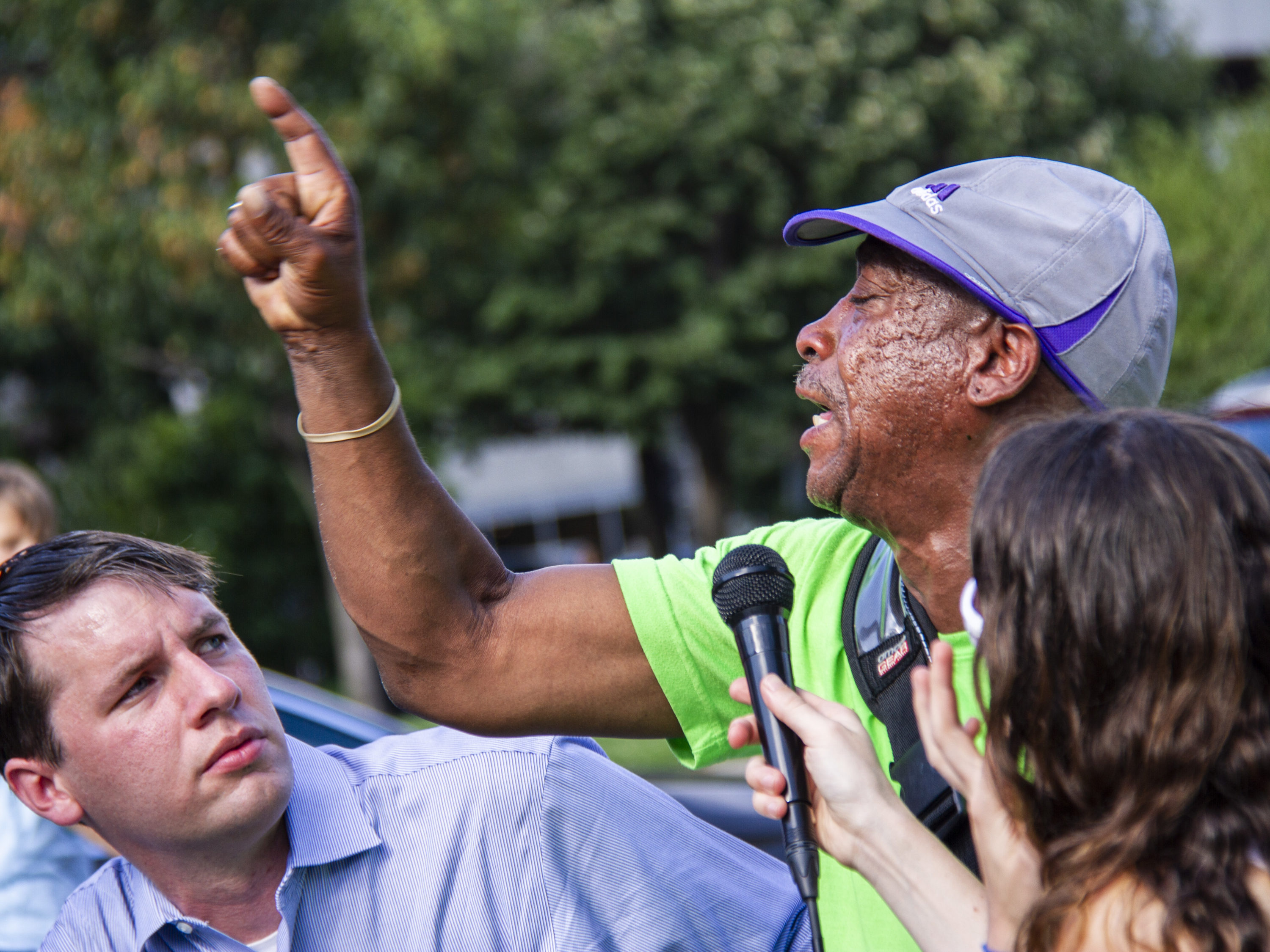
Gregory, who is homeless, said he’s spent many nights sleeping on the same benches where the two people were struck and killed. He broke down several times on Thursday evening, unable to stay on his feet as he addressed the small crowd in the sweltering heat.
More than a week after the crash, many details around the incident remain murky.
The U.S. Park Police, which is in charge of the investigation, has not disclosed the identities of the crash victims. A spokesperson for Park Police said on Thursday that their names would not be released to the public until families had been notified.
“I’ve been in contact with the detective and they’re still trying to make notification of next of kin,” said Sergeant Eduardo Delgado, a spokesperson for the U.S. Park Police.
Delgado could not confirm that the victims were homeless, either. Still, many community members say they were, and that they were killed while sleeping on the park benches.
What caused the crash is also unclear. Last week, police said that speed may have been involved, and that the driver, who was injured in the crash, was tested for substances. But Delgado said he did not know the results of the toxicology report.
The lack of transparency around the crash investigation has left many community members frustrated.
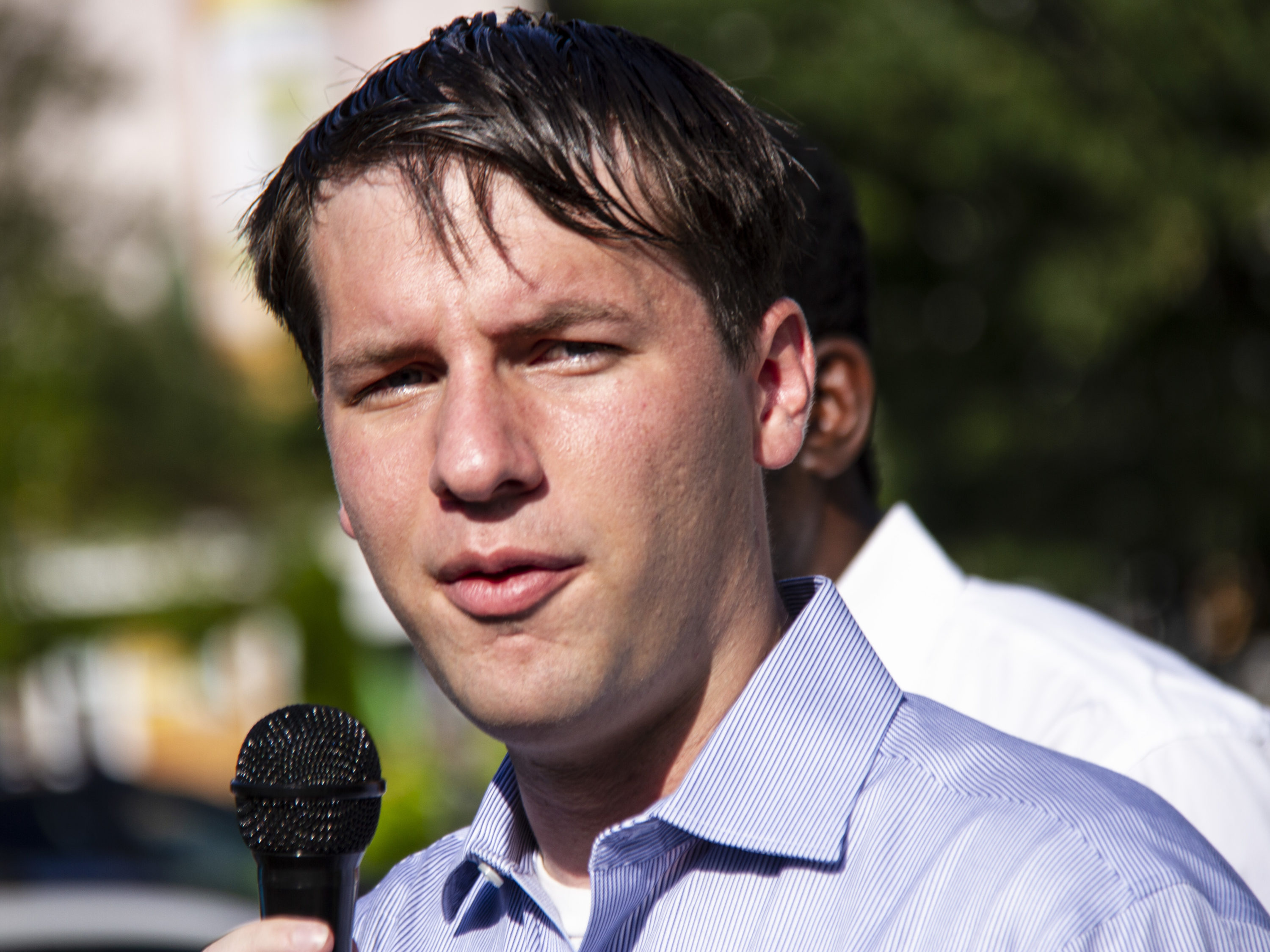
“There is no reason to withhold this sort of information,” said Patrick Kennedy, a commissioner for ANC 2A and candidate for D.C. Council. “We can’t get information on the driver, we can’t get information on the disposition of the charges. People want to know what happens in their community because they want to know that they have a reason to feel safe here.”
Kennedy said that park police tends to be less forthcoming with information than the Metropolitan Police Department.
“I understand that they’re doing their due diligence, but for our community’s sake we need to know,” said Kennedy, who spoke at the vigil on Thursday. “It is part of a cultural problem there. They are not accountable to the residents of the District of Columbia the way the Metropolitan Police Department is.”
As of Friday morning, the U.S. Attorney’s Office for the District of Columbia had not brought any charges against the driver. The prosecutor’s office did not return several requests for more information on the case from DCist.
The memorial on Thursday drew many transit advocates. Many of them said that the site of the crash, just a few blocks from the World Bank on Pennsylvania Avenue, has long been known as a dangerous area for pedestrians and cyclists.
“It’s actually a really inhospitable place,” said Greg Billing, executive director for the Washington Area Bicyclist Association. “Just walking across the street is like, eight lanes of traffic—it’s really terrifying. It really doesn’t work for anybody.”
Back in July 2017, the DDOT completed a study “to improve east-west travel for cyclists, pedestrians, and buses” along Pennsylvania Avenue NW between 17th Street and Washington Circle. A report on existing conditions identified 21st Street NW and Pennsylvania Avenue, near where the crash occurred, as a high-risk intersection for pedestrians.
But improvements to Pennsylvania Avenue are not slated to begin until 2023, according to Billing. He said that DDOT has good plans, but that the agency has been reluctant to implement temporary safety measures.
“We shouldn’t leave this street, which is basically a loaded gun, out in the community for years while we develop new plans,” he said.
Several people wore red to the vigil to symbolize that they had been victims of traffic crashes.
Rudy Riet, who rode his bike to the vigil on Thursday evening, said he has lost two close friends in traffic crashes—one this year, and another six years ago. “I feel a true gut punch,” said Riet, who lives in Dupont Circle and works for Jump bicycles. “Coming down to see this—it’s something that I have to do just out of respect for those who have lost loved ones.”
Last week marked the 13th and 14th traffic fatalities in the District since the start of 2019, according to advocates. Earlier this year, the cycling community was rattled by the death of longtime bike advocate Dave Salovesh, who was was killed by the driver of a stolen van.
In 2018, the District saw a significant uptick in pedestrian, bike, and scooter fatalities despite efforts by officials to put an end to traffic fatalities.
As the vigil winded down, Robert Gregory walked around the park, staring at the benches that were still standing.
“I’m angry with myself because God spared me and took them,” he said. “Because it should have been me. They always say people die so that you can live—and maybe that’s what happened.”