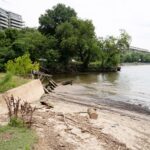
While some folks anticipate being able to swim in D.C.’s rivers in the near future, don’t expect being able to (safely) jump into Rock Creek anytime soon.
In Anacostia Riverkeeper’s most recent weekly water quality test, none of the sites measured in Rock Creek passed. And this past week is not unique in that regard—sites in Rock Creek fail bacteria level tests almost every week.
That makes Rock Creek stand out among the tested bodies of water, and not in a good way. The most recent week’s test shows a passing level of bacteria in five out of six sites on the Potomac River, and four out of seven sites on the Anacostia River. That means these sites are swimmable (if it were legal to swim in D.C.), passing the Environmental Protection Agency and the District’s standards for primary contact.
(If you’re confused about what exactly constitutes Rock Creek in this case, it’s referring to the body of water that flows from upper Montgomery County, through D.C., into the Potomac River. But the findings from this report are based solely on data from sites in the District, where the creek crosses the border in Chevy Chase. This part of the Rock Creek watershed, located in D.C., is 16.8 square miles in area.)
Rock Creek is dealing with a host of conditions that prevent it from reaching “swimmable” levels. According to Swim Guide, a database of water quality in beaches across the world, one of Rock Creek’s sites, Soapstone Creek, has five stormwater outfalls emptying into it. And another site, Rock Creek below Piney Branch, is located underneath a combined sewage overflow discharge into the water.
To combat this, DC Water has a few strategies in place. Its “Green Infrastructure Plan” is intended to build targeted sewer separation and other forms of green infrastructure (such as permeable pavement) by 2030.
This comes after the utility scrapped a proposal for an underground tunnel in Rock Creek in favor of these new plans. A tunnel would have allowed sewage and stormwater overflow to drain away from the body of water, creating an environment that has much lower levels of bacteria.
We’ve seen this process in action through DC Water’s new tunnel, which has already prevented the spread of bacteria in the Anacostia River by keeping combined sewage overflow out of the body of water. The new tunnel captured 5 billion gallons of sewage over its first eight months of use, according to WAMU. DC Water has plans to start building a similar tunnel for the Potomac River in 2023, slated for completion by 2030. But even without a tunnel, the Potomac River doesn’t have terribly high levels of bacteria. (People are already swimming in the Potomac over on the Maryland side, where it’s legal.)
Trey Sherard, outreach coordinator and staff biologist at Anacostia Riverkeeper tells DCist, “the Potomac is also receiving everything coming out of Rock Creek,” but because the Potomac is larger, bacteria gets diluted.
That’s another major difference between Rock Creek and the other two rivers. As Sherard explains, “with it being much smaller, [anything increasing the presence of bacteria] can jump the levels really significantly, really quickly,” when compared to the effects in the Potomac or Anacostia.
This District-wide data on bacteria levels is largely available because of a grant from the D.C. Department of Energy and Environment. In June of last year, DDOE awarded Anacostia Riverkeeper a grant to create a volunteer-based group that would monitor bacteria levels in the District’s bodies of water.
The roughly $140,000 grant has allowed the non-profit to train around 120 volunteers from all wards of the city to measure bacteria levels at 22 different sites, according to Robbie O’Donnell, project coordinator at Anacostia Riverkeeper. Previously, he says, the monitoring they conducted in eight sites just on the Anacostia River was mostly self-funded, with some financial assistance from Patagonia and the Maryland Sea Grant (in conjunction with Gallaudet University).
But what makes this study unique is the accessibility of their reports. Every week, data is disseminated across Facebook, Twitter, and their own website. And the app, Swim Guide, automatically provides access to the water quality levels of the bodies of water near you.
When the project concludes for the year in September, O’Donnell says they’ll have a full 20 weeks of data. They plan to compile all of it the following month and have it available for the public and city officials to read.
In the meantime, O’Donnell says they’ve been working with Audubon Naturalist Society to improve the quality of water in Rock Creek. Volunteers with the organization have been recording the quality of three tributaries in D.C. since the mid-1990’s—one on Pinehurst Branch near Beach Dr. NW, one on Melvin Hazen Run, and one on Normanstone Run. Additionally, Anacostia Riverkeeper has been working with Rock Creek Conservancy, a non-profit in the area, to measure the creek’s water quality.
“We eventually want to get to a swimmable D.C.,” O’Donnell explains. “That’s our main goal as riverkeepers.”
This story has been updated to clarify that the Rock Creek watershed in D.C. is 16.8 square miles in area and to include the role of Rock Creek Conservancy.