 Mikaela Lefrak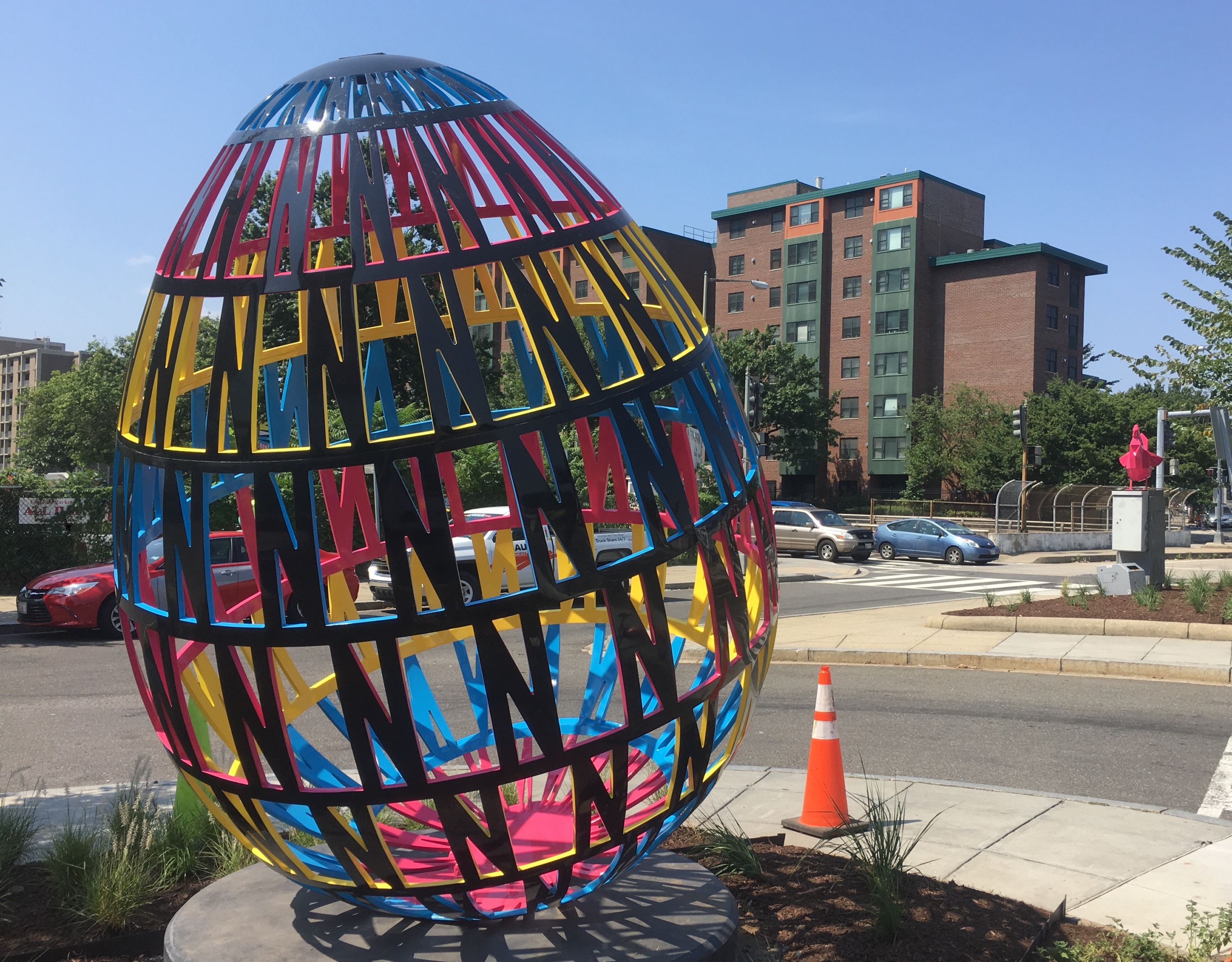
“It’s a question as old as philosophy itself: Which came first, the chicken or the egg? In NoMa, it turns out, they arrived simultaneously.”
Thus starts the NoMa Business Improvement District’s press release for its newest public art project, “The Chicken and the Egg.” The sculptures sit on small, triangle-shaped plots of land owned by the National Park Service. The sculptures are at the ever-busy intersection of North Capitol Street, New York Avenue, and N Street NE.
The two-part artwork looks pretty much like the name suggests: On one corner, a four-foot-tall, hot pink chicken is perched atop a utility box. (Note: It’s an actual utility box, not art.) The lonesome bird looks across the street at a nearly nine-foot-tall egg made of cyan, magenta, and yellow aluminum Ns—that’s N for N Street.
The press release continues: The whimsical statues are the first in the NoMa BID’s Gateways series, which aims to turn some intersections in the neighborhood into “signature streetscape moments.” The North Capitol Street-H Street NW intersection and the New York Avenue-Florida Avenue NE intersection are future targets.
“The Chicken and the Egg” is meant to harken back to the history of the neighborhood, when the nearby-ish Union Market was a wholesale foods market with live poultry sellers. The egg’s colors—cyan, magenta, yellow, and black, a.k.a. CMYK—are an homage to the area’s history as a printing center in the early 20th century. The U.S. Government Publishing Office is still located nearby.

Insert your favorite chicken-egg joke here.Mikaela Lefrak / WAMU
The sculptures were designed by southern California-based designer Harry Mark of the design firm RSM. The project cost $180,000.
NoMa, an acronym for “North of Massachusetts Avenue,” has been the site of rapid gentrification over the past two decades. Pre-Y2K, it was known for its warehouses spaces and vacant land and storefronts. Now it has an REI, a Harris Teeter, and numerous glossy apartment and office buildings. Every May, street artists from around the world paint murals all around the neighborhood as part of the POW! WOW! mural festival.
“The transformation of the neighborhood has been ongoing and iterative,” BID president Robin-Eve Jasper told WAMU. “What’s the genesis of these transformations? What came first, the chicken or the egg? [The statues] are kind of a little wry comment on that.”
Some of the BID’s beautification efforts have not gone over entirely smoothly. Take the M Street NE underpass near the REI: People experiencing homelessness regularly camp out there, but they were cleared away by the city in January 2018 to make way for construction on a BID-funded art installation called Rain. It featured 4,000 LED light rods hung from the underpass’s ceiling.
Jasper holds that the BID’s public art projects are meant to honor the area’s history and enrich all residents’ experiences. “The neighborhood does have a rich history,” she said, “and this is part of how we’re trying to bring it out—with a little bit of whimsy.”
If you want to celebrate or cluck at the new art in person, the BID is hosting a ribbon-cutting on Thursday at 6 p.m.
This story originally appeared on WAMU.