 Rachel Sadon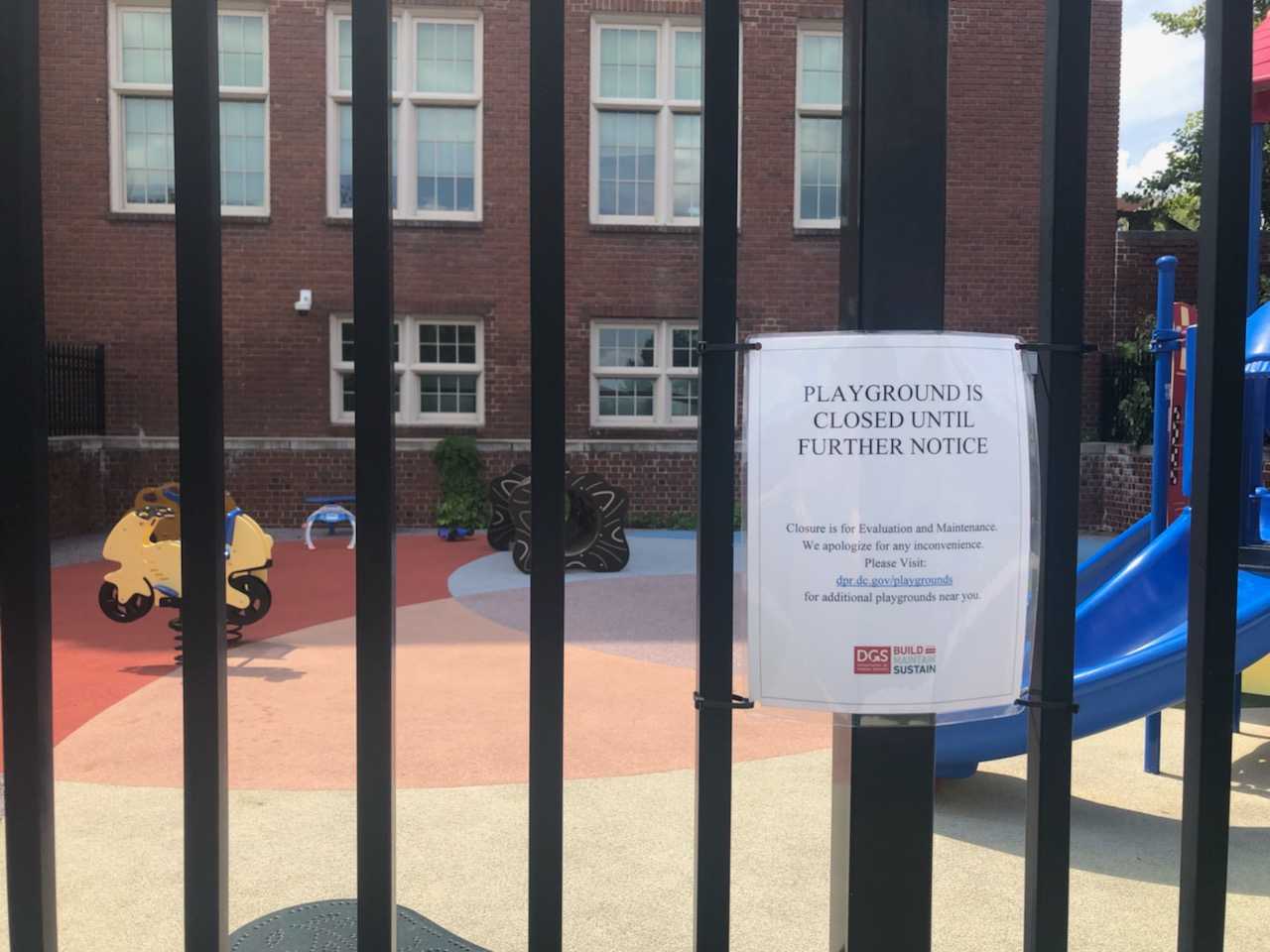
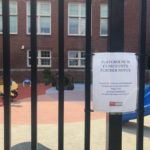
The D.C. government has closed three playgrounds after testing showed elevated levels of lead. The closures went into effect at Aiton Elementary School, Cardozo Education Campus, and Thomson Elementary School on Friday.
It’s not entirely clear what caused the elevated lead levels, or when the three playgrounds will reopen. The closures are the first of their kind, because D.C. has never tested these kind of playground surfaces for lead before. The city is also in the midst of testing every playground in its portfolio made of similar materials by January 2020 amid concerns from a vocal group of parents.
The surfaces in question are made from “pour-in-place” rubber—an often colorful, bouncy material usually made with a base of recycled tire shreds and a top layer of poured rubber. An interagency group studying artificial turf and playgrounds in the District lists it as one of two preferred materials for playgrounds in a May memo outlining recreational surfaces that it considers suitable (the other being engineered wood fiber and wood carpet).
For about two years, advocates with DC Safe Healthy Playing Fields have been calling for an end to its use and and the installation of new synthetic turf fields, citing issues including temperature, toxicity, and hardness. At playgrounds, the group said they were concerned about what children might be exposed to, particularly when the top layer cracks or wears down.
“It’s such a non-uniform material,” says Amanda Farber, a member of DC Safe Healthy Playing Fields. “It’s not regulated and it’s not uniform, so you could have bits of the tire crumb that have high lead and bits that don’t—you just don’t know. There’s no way to source it.”
So earlier this year, Safe Healthy Playing Fields, a national coalition, worked with an outside lab, Michigan’s Ecology Center, to test a number of playground sites for the presence of lead, starting with Janney Elementary. (In other cities, issues around lead on playgrounds have centered around soil contamination and paint on equipment.)
“At first, we just did it for our own curiosity,” Farber says. “Like okay, what’s in some of this material that’s literally getting everywhere all over these playgrounds, that the kids are having very close, constant exposure to?”
The results came back, finding high lead levels at Janney. The Ecology Center sent the material to a second independent lab to confirm the results and alerted the city in May.
The D.C. Department of General Services, which manages city-owned properties, says it hired an independent lab to test the playground within 24 hours of receiving notice of the Janney Elementary test results, but that its own testing yielded results below the safety threshold of 400 parts per million set by the Environmental Protection Agency (the U.S. Consumer Product Safety Commission has a 90 ppm standard for children’s products). Young children are particularly vulnerable to lead poisoning, which can affect physical and mental development.
A month later, the Ecology Center followed up with results from Janney and another two other playgrounds—Takoma Education Campus and Truesdell Education Campus—that all showed “lead concentrations in pieces of material as high as 4,000 ppm” (two samples clocked in above 7,000 ppm).
DGS again contracted with an outside firm, Soil and Land Use Technology, Inc. (Salut), to conduct testing at Takoma and Truesdell. At both locations, Salut reported low levels of lead, which the firm said were more likely to have come from external sources rather than the surface materials, and recommended removing debris around the playground. “Both the lead in bulk rinsate (wash water) and on the surfaces of the PIP playgrounds are in a matrix that potentially can be easily removed through regular maintenance and cleaning,” the industrial hygienist concluded.
But that same consultant has recommended that the city close one playground at Aiton Elementary School, one playground at Cardozo Education Campus, and the top floor playground at Thomson Elementary School after preliminary test results returned elevated levels of lead, DGS announced last week. The agency said that “further evaluation will be performed to understand the source of the lead and appropriate remediation.”
It’s not clear on what timeline that will occur or what additional steps might taken. Currently, signage has been posted and the area is cordoned off with safety tape at those locations. The Aiton playground was already slated for replacement, according to DGS, and that work is “ongoing.” But officials couldn’t immediately say what kind of material the surface will be replaced with.
The agency says that it will complete testing of all 257 individual pour-in-place playgrounds that it oversees by January of 2020 (it started first with the 82 D.C. public schools that have one or more such playgrounds). The work is being completed “out of concern for the safety and wellbeing of all residents,” DGS spokesperson Keith Anderson said in an emailed statement to DCist, and the results will be shared online.
The city’s year-old Interagency Working Group on Artificial Turf and Playgrounds has largely issued guidelines around artificial turf so far, but it is also considering thresholds for pour-in-place playgrounds.
This story has been updated to correct the name of one of the schools provided by DGS, Cardozo Education Campus.