 Rachel Sadon
Tens of thousands of wooden squares—inscribed with expressions of loss, sorrow, memory, hope—are making their way from the District to Burning Man, and they aren’t just metaphorically heavy. The collection weighs nearly a ton.
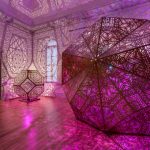
The tablets are en route to Black Rock City from the Renwick Gallery, which hosted an immersive exhibit about the festival last year. The centerpiece of No Spectators: The Art of Burning Man was an elaborate, absorbing room by artist David Best that seemed to glow from within the heart of the museum’s Grand Salon. While the larger exhibition closed in January of 2019, the work, called Temple, remains up through January 5, 2020.
The ornamented room is an allusion to the immense temples that Best has been building and burning at Burning Man since 2000. The first one he built became a memorial after the sudden death of a friend, and they’ve served as a meditation on loss ever since.
Like its desert brethren, the Renwick structure is meant to be a sacred space for visitors. “There’s not a hell of a lot of places for people to reflect on loss,” Best explained in a video about the piece. “It’s a place where someone can go to be forgiven or to seek forgiveness or to seek solitude from grief.”
On the playa, Best’s temples become a canvas for festival-goers; they’re covered in writing and tributes to loved ones by the time they are set ablaze in one of Burning Man’s two hallmark burns. The experience is often described by attendees as deeply emotional, even redemptive.
At the Renwick, though, the temple had to be “flame retardant to high heaven,” says curator Nora Atkinson (that unintentional irony is courtesy of government building codes). And concerned that it would be covered in writing long before the show’s end date, the Renwick and Best decided to offer visitors the opportunity to instead write on wooden placards, with the intention of eventually burning them.
“I didn’t want it to be just an art installation. I wanted it to have an ephemeral life,” Atkinson says.
People have left so many messages that curators have to had to repeatedly reorder more wooden placards. Periodically, they’ve culled the collection on display to make room for more.
In the meantime, they have been sitting in storage (the Renwick had to get an extra site to house all the boxes), while trying to figure out exactly how to burn somewhere in the neighborhood of 123,000 tablets.
Enter D.C.’s Burning Man community.
Since 2015, local burners have held an annual vigil on the National Mall called Catharsis. (You might remember it from the controversy over the large sculpture of a nude woman they planned to install near the Washington Monument.) Artist Michael Verdon designed the temples that were installed on America’s front lawn for those events.
Now, he and a large team of volunteers are at work on a chapel for Burning Man that will be alighted in the early morning hours of September 1. And at its base will be a series of pews filled with the tablets from the Renwick.
“It feels like we are taking the stories of 100,000 people who wrote down their thoughts and feelings. We’re taking those, as intended, and burning them in what I would call a sacred fire ceremony,” Verdon says. “We are honoring each and every one of those people.”
Before putting most of them on a shipping container headed for Burning Man, the team sifted through a couple of the boxes and found messages in at least 14 languages, according to Verdon. In total, he says the tablets and their containers weigh around 1,600 pounds. But it is what’s written on them that imbues them with such meaning.
“Some of the things that people write vary from signing someone’s name or saying that they’ll miss dad, to both sides taken up, like heart wrenching. People really got deep,” he says. “There’s some kind of trust that is being given, I feel, with these stories. And so making sure that they have a final resting that is suitable to people is important to me.”
That resting place—called the Chapel of Chimes—will be partially built using elements from several of the Catharsis temples (they couldn’t be burned in their entirety after the National Park Service tightened restrictions.) And Verdon says it’s a particular honor to be building using fragments from Best’s work, given that he started the modern tradition of igniting temples.
But it wasn’t always a guarantee that the Renwick placards would make it to the desert.
“We had been very careful in all of our phrasing with the public never to completely commit that all of these would be burned, because we were concerned that it might end up having to be a symbolic burn. We wanted to make something happen, but we weren’t sure we could actually do all of it,” Atkinson says. “But, you know, the Burning Man community is remarkably resourceful.”
Since she began planning the exhibition, the curator has gone to the festival every year (“I’m now, I think, an official burner,” Atkinson says), and she’s thrilled that the original intention of the work is being fulfilled.
“I think it’s important to all of the people who were involved in writing these, that their dreams go where they’re planned. It’s a very cool thing that it actually can meld with the real temple tradition out in the desert in that way.”
This story has been updated to correct the date of the burning ceremony.