 Lori McCue
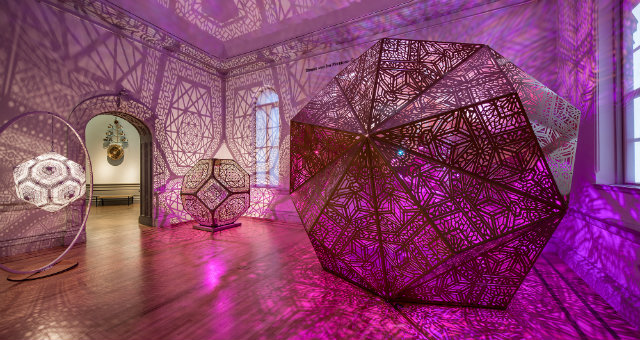 “HYBYCOZO” at the Renwick Gallery (Photo by Ron Blunt courtesy of the Renwick Gallery)
Ever since the Renwick Gallery used thousands of bugs, ethereal rainbow nets, and giant birds nests to make museums Instagrammable in 2015, the museum has specialized in artwork you just have to see. As of this week, you don’t even have to go in person to see their latest exhibit.
No Spectators: The Art of Burning Man is now available in virtual reality, the result of a partnership between the Smithsonian American Art Museum, the Renwick’s partner museum, and Intel. The exhibit is one of many virtual worlds available on Sansar, the VR experience created by Linden Labs, perhaps best known for the online game Second Life.
“We’ve been brainstorming [about] what can we do to make the museum accessible and available to people who may never get a chance to get on a plane and go to D.C. and see it in person,” said Sara Snyder, SAAM’s chief of external affairs and digital strategy.
Since No Spectators’ opening on March 30, more than 380,000 people have visited the Renwick Gallery to check out a variety of art (mutant bicycles! paper arches! rainbow mushrooms!) inspired by the annual Burning Man festival in Nevada’s Black Rock Desert. The exhibit’s popularity is one reason to make it the museum’s first VR experience, Snyder says, but it really came down to timing. “If we had the ability to do this years ago, we would have done it with WONDER too, she said. (SAAM did create a virtual WONDER experience, but it’s no Oculus Rift.)
Digitizing the exhibit used much of the same process used in creating video games. Sansar’s team took two weeks to photograph and scan the museum’s space and items with 3D mapping, Snyder says, and a few additional weeks to render the museum virtually.
Access to the VR exhibit is still somewhat limited: The Sansar technology is available for use on a desktop—only a Windows 7 PC or newer—or via a VR headset (can we come play with it?). Once you download the software and create your avatar, you can explore the first floor of the No Spectators exhibit, which includes the 18-foot-tall “Truth Is Beauty” sculpture, the “Tin Pan Dragon,” and “Capitol Theater,” the vehicle-turned-movie theater.
The experience also hides some Easter eggs for those who do their museum-going virtually. The exhibit’s six outdoor pieces scattered across downtown D.C.—a giant bear made of pennies among them— are included in Sansar’s version. Instead of being positioned near a Metro station or on a traffic island, however, the pieces in virtual world appear in a vast desert, much like they might at the Burning Man festival itself.
And don’t assume you’ll be wandering the museum alone: Snyder says No Spectators’ curator, Nora Atkinson, often drops in and offers virtual tours of the exhibit. “They’re able to hear her and ask her questions in real time,” Snyder said. You’ll also be able to interact with others visiting virtually, which means a date at the Renwick with someone living across the world isn’t out of the question.
While the physical No Spectators exhibit closes in January, the VR experience will be available permanently—and the plan is to eventually release it on other platforms, including Steam. In the next few weeks, Snyder says, SAAM is digitizing the second floor of the museum, which includes No Spectators’ very elaborate paper temple for Sansar. After that, her dream is to digitize the entire Smithsonian collection. Along the way, Snyder wants to experiment with more ways to create VR art experiences.
“We want to get a lot of feedback and more ideas about what people would like to see more of,” she said.
No Spectators: The Art of Burning Man is on view at the Renwick Gallery until January 21. The virtual reality exhibit is available here.