Takoma often gets confused for its Maryland neighbor, Takoma Park, and while some residents are understandably annoyed by this, there’s at least a good historical reason for it. In addition to a shared founding, the two Takomas share some cultural similarities (plus, a Metro station and town center) and even jointly celebrated their 50th, 75th, and 100th anniversaries. Here are ten things you probably didn’t know about the neighborhood:
1. Takoma, D.C. and Takoma, Md. used to be the same thing
Both Takomas were initially part of a single development founded by Benjamin Franklin Gilbert in 1883, then known as Takoma Park. The neighborhood was going to be named “Brightwood” after the train station that anchored the development, but Gilbert wasn’t fond of the name, so when a fellow guest (and soon-to-be Takoma Park resident) at the D.C. hotel that he was staying at suggested the name “Takoma,” Gilbert happily obliged. He tacked on “Park” and changed the name of the station to “Takoma.”
According to a promotional pamphlet for the development, the name comes from an indigenous word meaning “lifted up” or “near heaven.” And indeed, the new development was 350 feet higher in elevation than D.C. (It was spelled with a ‘k’ to distinguish it from Tacoma, Wash.)
Gilbert didn’t pay too much attention to jurisdictional lines when he was planning the new community, and even saw the multiple jurisdictions as a political advantage, so some of the new development ended up in parts of D.C., Montgomery County, and Prince George’s County. The development is often thought of as Washington’s first true suburb, and much of Gilbert’s marketing focused on the short, 10-minute express train commute into the city on the Baltimore and Ohio Railroad, which began been ferrying people and goods in the early 19th century as the first steam-powered railway in the U.S. There were 15 trains a day between Washington and Takoma Park and Gilbert really emphasized that fact. He pitched the development as an opportunity to reap the natural beauty and environmental benefits that you’d often associate with a more rural setting, while still being close to the city.
By 1886, the community had 150 residents and by 1890, the Maryland portion of the community became an incorporated town under the state of Maryland. This new designation didn’t mean much until the early twentieth century when the D.C. and Maryland portions of the development began to develop unique civic and political identities. In fact, it wasn’t until 1924 that the Citizen’s Association of Takoma Park, D.C. was established.

2. The guy that founded Takoma was a teetotaler
Gilbert’s first business venture was a restaurant called the Temperance Dining Room in downtown D.C, and anti-alcohol stance also spilled into his new Takoma Park development, with every deed issued for the development including a clause that prohibited the manufacture or sale of “spirituous liquors.”
This might have motivated the Seventh-day Adventist church, whose members also avoided alcohol consumption (as well as coffee and tea) on religious grounds, to establish their world headquarters in the Maryland portion of the community in 1904. Although the church eventually moved its headquarters to Silver Spring in 1989, their influence is still present in the neighborhood with its many vegetarian restaurants and Sunday farmers’ market (as opposed to being held on Saturday.)
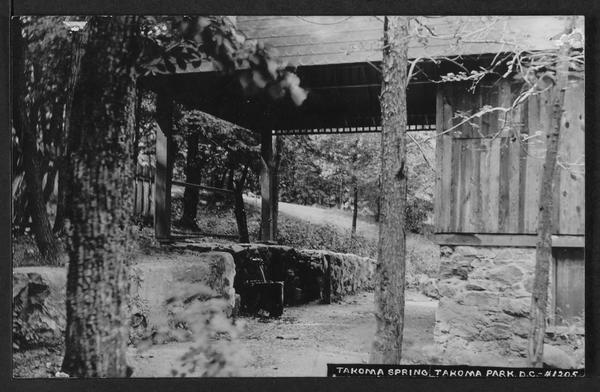
3. Takoma used to have a lot of natural springs
Abundant natural springs helped attracted Gilbert, and other developers before him, to the area.
Gilbert made sure to highlight the feature in his advertisements. One ad put it very matter-of-factly, stating that “the water is simply pure” (original emphasis), going on to say that although the water hasn’t been scientifically tested, many ill people “have been greatly benefitted from its use.”
At one point, the spring water was even being bottled and sold by the Takoma Park Springs Company as far north as New York.
There were two main springs that provided residents with drinking water—Little Spring and Takoma Spring (sometimes known as Big Spring). According to a 1999 article in the Takoma Voice, there are traces of Little Spring visible near Spring Place off Chestnut St., and Takoma spring was approximately located near the corner of Poplar and Elm Ave. in Takoma Park, Maryland.

4. One of the original Takoma Park development homes is still there
The Cady-Lee home, which was built in 1887 by insurance and real estate salesman Henry Cady and his wife, Lucinda, was designed by the same architect behind Vice President Mike Pence’s current residence, the Admiralty House.
The three-story Cady-Lee home, which has 22 rooms, was one of the grandest and most elaborate houses built in the Takoma Park development at the time. It stayed under the ownership of the Cady family until 1975 after the death of Mary Cady Lee, Henry and Lucinda Cady’s daughter.
Cady Lee had struggled to maintain the home in her late years, converting some of it into apartments for her and a few of her relatives. Around the same time, developers were pushing to modernize Takoma and trying to tear down some of neighborhood’s older structures. After Cady Lee’s passing, the owner of a nearby apartment building tried to expand onto the property, but community members stepped up and lobbied for historic designation for the home. Their efforts were successful because in that same year the home earned a spot on the National Register of Historic Places.
Now, the home has been fully restored and functions as an office space for the Forum for Youth Investment, which purchased the building and moved in its staff in 2002.
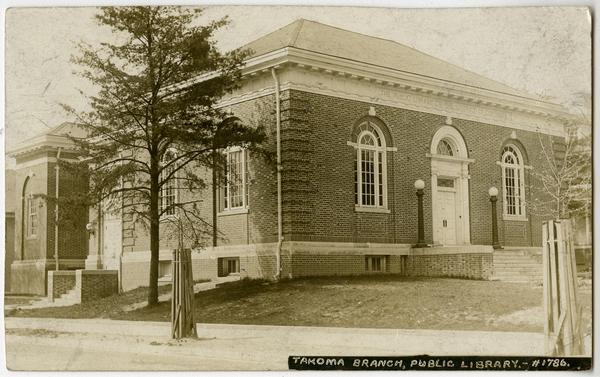
5. The Takoma Park Library was funded by Andrew Carnegie, and it was D.C.’s first neighborhood library
Carnegie committed to funding the construction of D.C.’s first central library (now, the Apple Carnegie Library) after a chance encounter with a member of the D.C. Library Board. At the new library’s dedication in Mount Vernon Square, Carnegie put forth another $350,000 toward the construction of a series of neighborhood libraries, so long as the city could identify potential sites and take care of their maintenance. Takoma Park won a bid for one of those library locations, along with Mount Pleasant and Southeast.
But the city had to get Congress’ approval before it could accept Carnegie’s funding, and it took two failed attempts before that happened. The first was a bill in 1904 that laid the groundwork for the DC Public Library System, authorizing the construction of a number libraries across the city over time. It passed the House but was killed in the Senate. The city made another attempt in 1906, but that one passed in the Senate but died in the House. It wasn’t until 1910 that a bill allowing the city to accept the donation and approving the construction of the library was successfully passed.
By Nov. 17, 1911, the new library opened its doors, becoming the first neighborhood branch of the DC Public Library system. Prior to it’s opening Takoma Park had a privately run, community-funded library. (By the way, the library closed late last month for a fourth month-long renovation.)
6. The neighborhood’s listserv is among the oldest in D.C.
The listserv, which is focused on both Takoma and Takoma Park, is more than 20 years old. It was a result of the efforts of handful of residents in response to a period of increased crime in the area. They pitched in for the cost of the software needed to run the listserv and a resident hosted it on his personal server when it launched in 1997. In 2003, another resident, Sharon Villines, took over ownership on the list and moved it over to YahooGroups instead. More than 15 years later, she still serves as a co-moderator. The listserv currently stands at 3,052 members, and for 2019 has been averaging roughly 476 messages per month.

7. Takoma (Maryland) has a low-power radio station
The FCC opened applications for new low-power FM radio stations in 2013. Former NPR All Things Considered director Marika Partridge and the community non-profit Historic Takoma applied, and by early 2016 they had a green light to get the station up and running.
Takoma Radio went live on July 16, 2016, and while the station is physically located in Takoma Park, station manager Olivia Ellis Randolph says that it’s mission is to cater to residents of both Takoma and Takoma Park. The station doesn’t closely track listenership, but Ellis Randolph, who also lives in Takoma, says that donations come in equally from people in both Takomas.
As a low-power station, its signal stretches to about a 2.5-mile radius—reaching about 250,000 people.
8. There was almost a freeway that would’ve decimated much of the neighborhood
D.C. is not always treated as a state when it comes to federal affairs, but that wasn’t the case in the 50’s and 60’s when the newly passed Federal Aid Highway Act made the District eligible for highway funds in way that was similar to states. With the newly available money, planners sought to build an enormous network of highways to alleviate D.C.’s growing traffic problems. Original proposals passed through multiple wealthy, white neighborhoods that successfully pushed back and got the plans rerouted.
Epic, decades-long fights ensued. This 6,000-word Washington Post story does the full story justice. But one of the most high-profile battles centered on the route for the North-Central freeway, which would have cut through Takoma and a number of poorer, black neighborhoods to the south, through Northeast (there were 17 different versions, every one of which required displacing people from their homes.)
Residents from the potentially impacted areas banded together in opposition to the freeway, with future Takoma Park mayor Sammie Abbott and activist Reginald Booker leading the charge. Their advocacy efforts highlighted how the freeway would displace black Washingtonians with the campaign slogan “White men’s roads through black men’s bedrooms.”
But Booker told the Post that if white homeowners hadn’t joined the cause, they likely would have been defeated. “The whole theory was to appeal to homeowners, no matter what race they were,” Booker said. “Our movement was unique. It was blacks and whites in a common effort, an integrated group, working in their own interests. That was the significant thing. It was an issue that united people.”
After immense pressure and growing public outrage, the freeway was scrapped. Rather than the proposed 38 miles of highway in the city proper, the District only built 10.
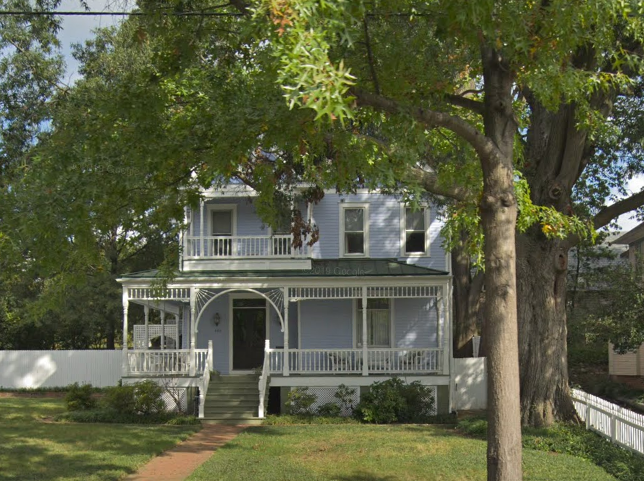
9. The D.C. portion of Takoma is one of the city’s 37 historic districts
The neighborhood earned a historic designation in 1983, largely for its status as the first suburb of D.C. and founder Gilbert’s vision for the development, which was emblematic of a larger, national development trend of people wanting to live in more idyllic, rural areas but still maintain convenient access to the city. Takoma’s architectural aesthetic also played a part, especially because of its 19th century wooden Stick (homes characterized by their highly angular and asymmetric aesthetic) and Shingle (homes with shingles on the walls and roof) style homes and other notable architectural styles. The designation spans 160 buildings in the neighborhood, including the Cady-Lee home.
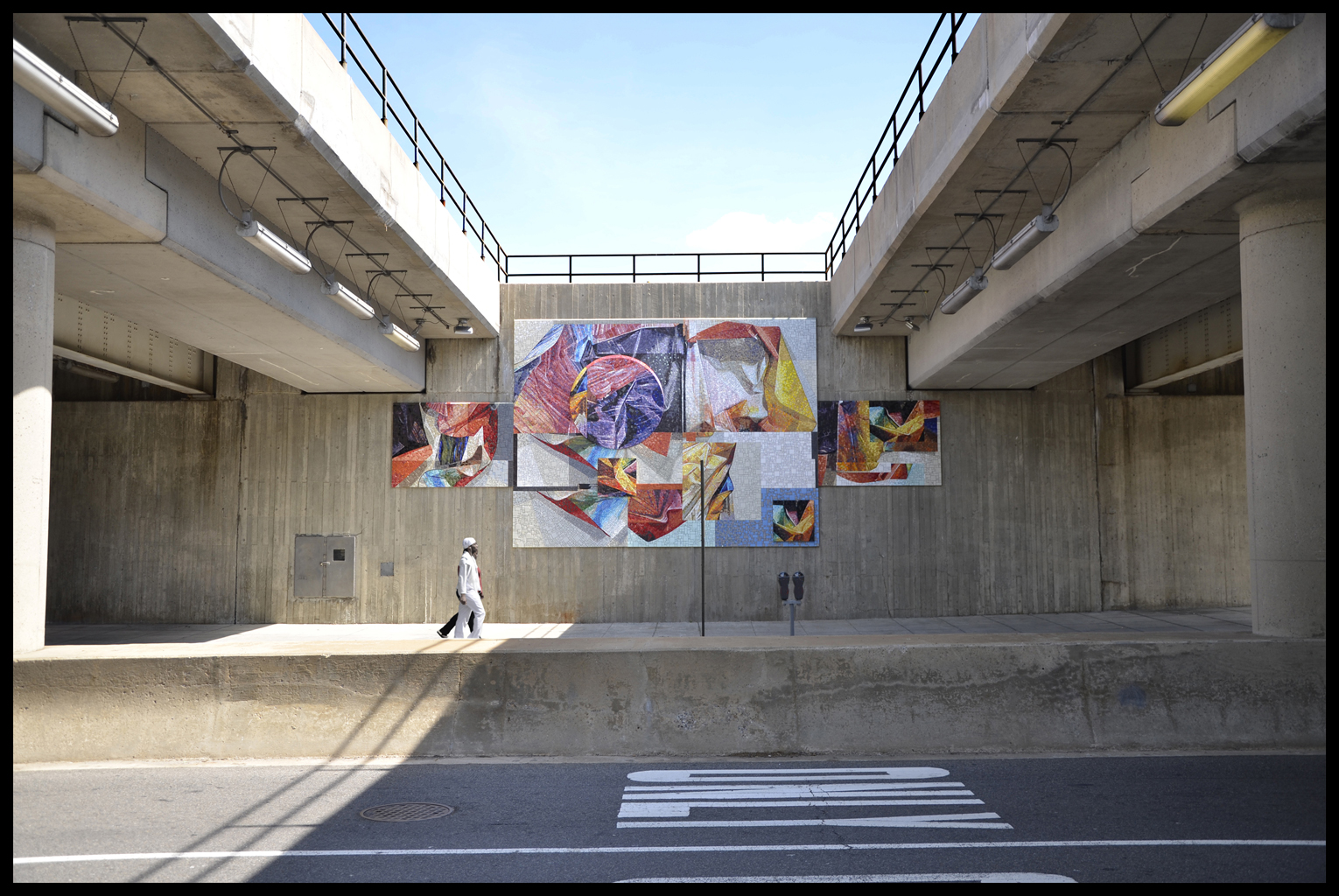
10. The Metro station’s mural is by renowned artist Sam Gilliam
Sam Gilliam’s expressive work can be found in the collections of more than one Smithsonian museum, but Takoma residents need only to walk to the Metro to find one of his pieces: “From a Model to a Rainbow.” The 400-square-foot, 2,000-pound panel hangs on a wall along the underpass on Cedar St.
The mural, which was unveiled in June 2011, is the result of a joint commission from the D.C. Commission on the Arts and Humanities and the Metro Art in Transit program.
Gilliam, who lives in Northwest D.C., is a core member of the Washington Color School, a collective of abstract painters creating artwork in D.C. in the 50’s and 60’s. At 85 years old, he is still making art and his work has been experiencing a renaissance in recent years.
Want more?
Ten Facts You May Not Know About Chinatown
Ten Facts You May Not Know About Spring Valley
Ten Facts You May Not Know About Navy Yard
10 Facts You May Not Know About Brookland
Ten Facts You May Not Know About Anacostia
Ten Facts You May Not Know About Dupont Circle
Ten Facts You May Not Know About Petworth
Nine Facts You May Not Know About The Southwest Waterfront