Rachel Kurzius
It’s a big week for D.C. statehood advocates, culminating in the first House of Representatives hearing on the topic in more than a quarter-century.
Mayor Muriel Bowser is using her bully pulpit to prime people for Thursday’s hearing on the Washington, D.C. Admission Act, the legislation that would make the District the 51st state. While D.C. Delegate Eleanor Holmes Norton has introduced this measure every term since she began serving in Congress, it has record levels of support this time around. Norton has expressed confidence it will pass the House, though it is unlikely to get a vote in the Republican-held Senate. (In June, Senate Majority Leader Mitch McConnell called D.C. statehood “full-bore socialism.”)
Perhaps the most visible sign of the week’s slate of events is the more than 100 flags lining Pennsylvania Avenue NW. They’re American flags with a slight change—51 stars to show what the banner would look like if it included D.C.
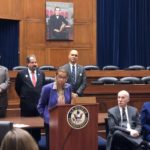
On Monday morning, Bowser hopped on a statehood-themed bus with officials and veterans (precisely 51 veterans, according to Bowser’s office) and rode down the flag-adorned avenue, landing at a statehood rally and press conference. A major thrust of the statehood movement includes highlighting the inequity of D.C.’s lack of full voting representation on Capitol Hill through D.C.’s veterans, who served in the armed forces even though they live in a place that doesn’t have a vote on whether or not the country goes to war.
While the reaction to flags appears largely positive, FOX 5 D.C.’s general manager, Patrick Paolini Jr. wrote on Twitter that the effort was “disrespectful,” writing that if Bowser wants to “advocate for statehood – fine. But disrespecting the flag is not a good look.” His tweet garnered zero retweets, six likes, and more than 40 replies, most of them in disagreement. As one person replied, “Disrespect is every time I pay federal taxes with no one to fully represent me in Congress, so thank you @MayorBowser!”
Monday’s parade and rally is part of what Bowser is calling “Statehood Week,” which also includes a party called “Mayor Bowser Presents the 51st Festivities: DC for Statehood” at the lot of the Anacostia Busboys and Poets location.
Bowser also released a commercial over the weekend featuring Antoinette Scott, a D.C. resident who was awarded the Purple Heart after her deployment to Iraq with the U.S. Army. The commercial is already airing in D.C., along with Kentucky and South Carolina.
South Carolina is among the states that the New Columbia Statehood Commission is targeting as part of its education campaign, which also includes interactive kiosks to teach tourists about D.C.’s efforts for representation. A new group that formed this year, 51 for 51, plans to spend seven figures pushing for statehood, though the campaign has declined to make its funding transparent.
Under H.R. 51, the bill that would grant D.C. statehood, D.C.’s eight wards would become a state that would begin with two senators and one House member. The Capitol, the monuments, and other sites would still be federal property.
At Thursday’s hearing, Bowser is among the witnesses invited by Democrats, alongside D.C. Council Chairman Phil Mendelson, D.C. Chief Financial Officer Jeffrey DeWitt, Congressional Research Service attorney Kenneth Thomas, and Kerwin Miller, a D.C. resident and veteran. Local activist groups are planning to pack the room in the Rayburn House Office Building where the hearing will be held.
Republicans want Ward 2 Councilmember Jack Evans as their witness, reports the Washington Post, to highlight the controversy around the longtime D.C. lawmaker, who would ostensibly become a state legislator if D.C. was granted statehood. GOPers on the House Oversight Committee have taken notice of Evans’ ethics woes, prompting Democrats on the committee to probe deeper into a Metro-conducted investigation into alleged wrongdoing.
One person who lobbied unsuccessfully to be the Republican witness was David Krucoff, a local real estate executive who founded an advocacy group called Douglass County, Maryland, an alternate idea for granting Washingtonians a voice in Congress by having the city retrocede into Maryland. The plan faces opposition in both D.C. and Maryland, though Krucoff often expresses frustration at the way in which officials and residents talk about statehood at what he deems is the expense of his alternate proposal. Because it didn’t discuss retrocession at length, a 2014 Senate hearing on statehood was “the most appalling piece of garbage hearing I’ve ever seen in my life,” Krucoff told DCist in 2017.
Statehood remains broadly popular in D.C.—a referendum in favor passed in 2016 with approximately 80 percent of the vote. While D.C. has a larger population than both Vermont and Wyoming, it has neither full voting representation in the House (Norton can vote in committee, but her role as delegate is more limited than a full-fledged representative), nor any representation in the Senate.
However, a nationwide poll released by Gallup over the summer shows that 64 percent of Americans outside of the District—the ones who already have representation on Capitol Hill—don’t think the District of Columbia should be a state.
This story has been updated to reflect that Krucoff tried unsuccessfully to be the Republican witness, and that GOPers are asking Evans to testify.