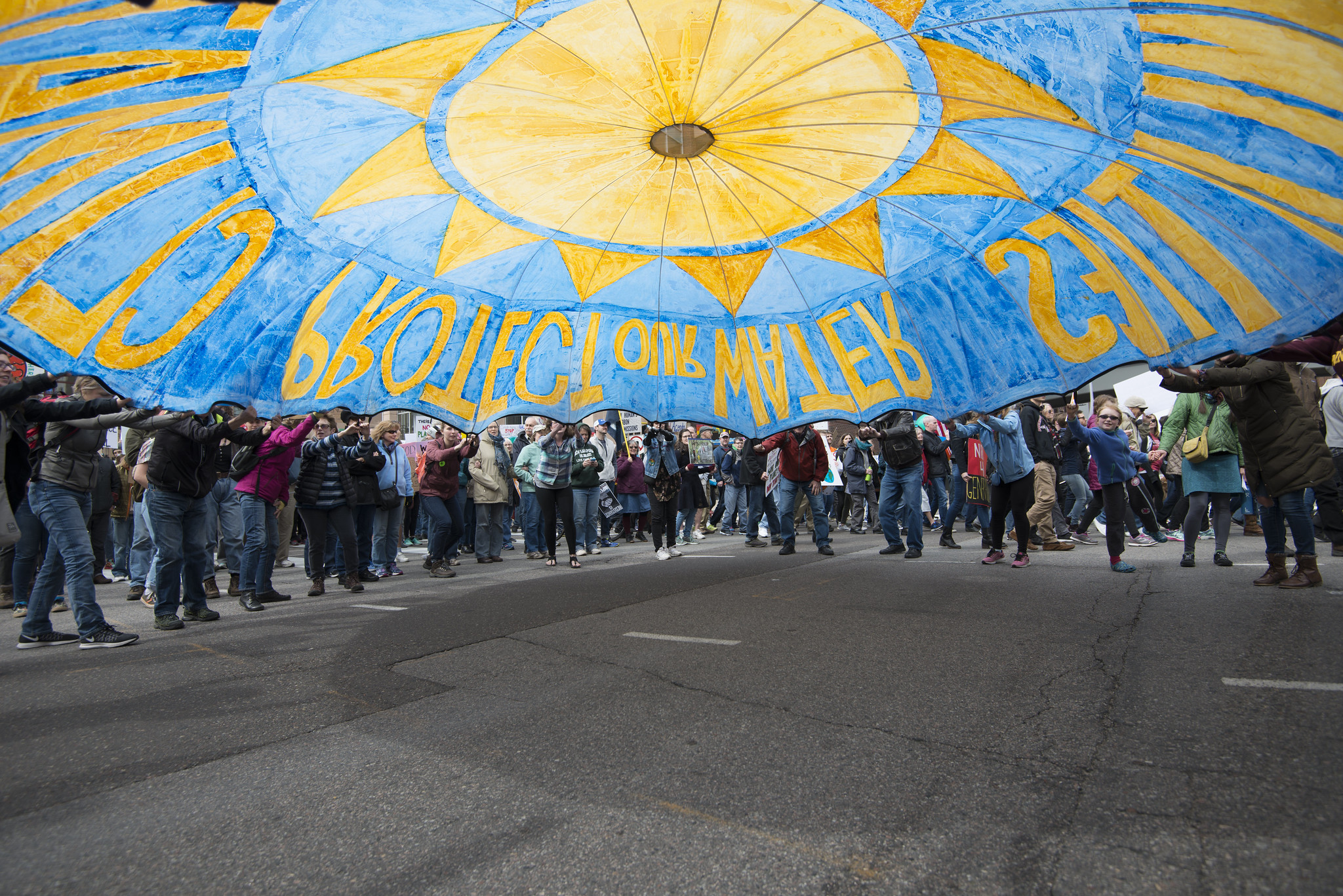
DCist is providing special coverage to climate issues this week as part of Covering Climate Now, a global collaboration of 250 news outlets designed to strengthen coverage of the climate story. Many of these stories originated as questions from our readers.
Combating climate change on an individual level can feel like a drop in the bucket.
Maybe your diet is primarily plant based. Or your lights are off whenever you don’t need them. Or your showers are shorter than a Ramones single. But the facts remain daunting: The planet is getting hotter, sea levels are getting higher, wildfire season is getting longer and biodiversity is getting narrower.
“I don’t own a car. I bought LEDs. Yay!” says Abby Lynch, a resident who’s been renting for nearly 10 years. She wrote to DCist asking what renters can do to minimize their impact. “But that doesn’t make a significant impact in a way that tackling all of the apartment stock in the city could or getting all of your homeowners to upgrade their homes.”
Ali Carter, another renter, also shared her concerns that the micro approach wasn’t adding up. “Those feel like such tiny little steps that we can take individually,” she says, “versus so much of the news and reporting on climate change seems to be, ‘Wow, this is a huge dire problem that’s going to totally change the whole planet.’”
She’s not wrong. But that doesn’t mean there’s nothing to be done. And just as climate change manifests in different ways from region to region, so do the ways that people can minimize their impact.
“We know that cities, historically, have been the problem and then the cause of the greatest amounts of greenhouse gases to cause global warming and climate change,” says Tommy Wells, the director of D.C.’s Department of Energy and Environment. “But we also know cities are the solution. The greatest traction and impact is within cities. And that’s where I learned from other residents and commuters and other carbon consumers what best practices are.”
Here’s a collection of tips for fighting climate change individually, with guidance from prominent local activists.
Plant a tree
“I believe trees are magic,” Wells says. “They do a lot besides purify air. They also cool the city. They are part of creating a biophilic city. The more trees and green you see, the better and healthier you feel when you’re walking in the city.”
Tree canopy coverage in D.C. has dropped from 50 percent to 38 percent since 1950. Wells recommends getting involved with Casey Trees, a nonprofit that aims to restore D.C.’s canopy by enlisting volunteers, elected officials and community groups to plant trees across all eight wards.
The District Department of Transportation’s Urban Forestry Division— responsible for nearly half of the trees planted in the District annually — also offers a program to adopt a street tree, as well as guidance for planting your own in an approved location.
No need to stop at trees. Whether you have a large yard or a small balcony, there are plenty of native plants that can benefit pollinators and other local wildlife.
Talk to your landlord about green alternatives and upgrades
Lynch told DCist that as a renter, she doesn’t know what big steps she can take to minimize her home’s environmental impact, since upgrades and green solutions are at the behest of her property owner. But renters like her can still have clout.
“As our electricity requirements go more and more towards 100 percent renewable electricity, it’s just going to become smarter and smarter to make the switch ahead of time,” says Denise Robbins, communications director for Climate Action Network. “Because the landlord can then say, ‘Oh, look at all these efficiency improvements that will keep your bills low. It’s an upsell for the house.’”
Renters can expedite these changes by using the framework of green leasing. It’s a custom rental agreement between a tenant and a landlord that could incentivize any number of sustainable practices — energy efficiency, water conservation, waste reduction — at reduced costs to both parties. Green Building Alliance offers a step-by-step guide to beginning this negotiation process with your landlord.
“We already know that we have more LEED certified buildings per capita than anywhere in the nation,” Wells says. “And that’s not because we require it. It’s because building owners wants tenants. More and more people are making choices based on their impact on the climate.”
Plan a community swap day
Appliances. School supplies. Slogan tees from the mid-2000s. You might have ‘em and don’t want ‘em, or you might want ‘em and don’t have ‘em.
“Let’s say you used to have a dog and you don’t have your dog anymore but you still have a dog bed, dog toys, other things,” Wells says. “Do a free swap for your apartment building where people bring things and it’s just a free exchange. [It’s] a great way to help lower people’s carbon footprints.”
Wells points out that the clothing industry is particularly carbon-intensive — whenever you can reuse, exchange or shop secondhand, do it. Check out SwapDC, Colony Club and Frugal Fashionista Clothing Swap Meetup for community swaps or our handy list of thrift stores. And if you’re doing home renovations, try Community Forklift for all manner of salvaged building materials and appliances.
Get to know DCSEU
It stands for District of Columbia Sustainable Energy Utility, and even if you’ve never heard of it, you’re already involved. Part of a nonprofit corporation, DCSEU has been a contractor to D.C. since 2011 — specializing in energy efficiency for electricity and natural gas, and the installation of solar energy.
“We are funded by ratepayers here in the city — the residential homeowners, commercial entities, churches, hospitals, universities, governmental institutions,” says Ted Trabue, managing director for DCSEU. “Everybody sees a little surcharge on their bill that’s collected by the respective utilities — Washington Gas, Pepco. And it’s remitted to the city, and then the city gives us an operating budget.”
In addition to tips and other resources (try taking their digital home walk through to find energy saving opportunities), DCSEU also offers rebates on energy efficient appliances. And in addition to publishing a guide to energy efficient lighting, the organization has helped discount LED lightbulbs at stores around the city.
A large portion of DCSEU’s budget is focused on low-income homeowners, including a program that covers the cost of solar panels (check here if you qualify).
“I would venture to say this is probably one of the largest low-income renewables programs on the eastern seaboard,” Trabue says.
Trabue says the calculable results of DCSEU’s work have been significant. “The city’s population has increased by about 13 percent over the last five years,” Trabue says. “The city’s energy consumption over that same period has come down by about three percent. I think we’ve had a large hand in that second statistic.”
Eat your veggies
It seems like every year, there’s a new study making the case for a simple way to curb climate change as an individual: Cut back on the meat. Just last month, a UN report indicated that high consumption of meat is contributing to a warming climate (another report complicates the picture a little bit, but it’s clear that it’s the case in the United States, where adopting a vegan, or even primarily vegan, diet would significantly lower greenhouse gas emissions.)
Buying your squash or spinach from a local farmer means that it wasn’t shipped by plane or 18-wheeler across the country to a grocery store, so its worth shopping locally and seasonally at the city’s many farmers markets. And you did remember your reusable tote, right?
These days, cutting back on meat doesn’t mean you’re missing out on the city’s entire restaurant scene, either. Vegan-friendly menus abound, from soul food at NuVegan Cafe locations in Park View and College Park, to fast-casual mediterranean burgers and fries at Shouk, to fine dining at Equinox downtown. Keep your eye on the H Street corridor. Fast-casual bowls, fancy small plates, and diner-style fare are turning it into a vegan destination.
Compost
There have long been neighborhood-level composting facilities to turn food scraps into nutrient-rich soil, but the city has also had a free, government-sponsored composting program since 2017. Participation is easy: Bring your coffee grounds, corncobs, flowers and what-have-yous to your ward’s farmers’ market during its on-season (three of the markets are year-round).
“We recommend rinsing plastic containers holding the food waste between uses and lining the bottom with shredded newspapers for odor control,” the Department of Public Works advises. “Another tip for controlling odors is to store food scraps in the freezer or refrigerator.”
For a map of market locations and more details about acceptable food items, click here.
If that’s too much effort, for a fee, Compost Cab will come pick your scraps up directly.
Have your say at stakeholder events
Earlier this year, the District government unveiled the Sustainable D.C. 2.0 Plan— an updated comprehensive strategy to make D.C. the most sustainable city in the U.S. But before any of that happened, city officials listened to the people with the most at stake: residents. Community members attended focus groups, public events and open houses and weighed in on what Sustainable D.C. 2.0 should look like.
Wells says the plan involved more outreach than the city had ever done before. “It’s just completely imperative that the residents, the people that live here, are involved in seeing their ideas, values and recommendations reflected in the plans that we do,” he says.
With the continued input of residents, the Sustainable D.C. 2.0 Plan will evolve and grow — and so will other District initiatives. DOEE’s Green Bank will soon hold public comment periods on the types of clean energy projects it funds. The District Department of Transportation will eventually host a listening session to shape transportation projects in the pipeline. And plans for a new Office of Urban Agriculture are underway, with input from community stakeholders about what that office should do in a city like Washington.
“We’re going to really try to make sure that they are promoting everything that they can to every neighborhood in D.C. […] to make sure that everybody, all the D.C. residents, are aware of the kinds of tools that they can use to get funding,” Robbins says about Green Bank and DOEE.
Stay in-the-know about community events through DOEE and D.C. Climate Coalition.
And don’t forget about federal lawmakers. Even without meaningful political power, there’s a long tradition of Washingtonians capitalizing on proximity. “We are so close to the White House, the Capitol,” Robbins says. “The best way for someone to amplify their impact is to talk to their legislators.”
Switch to LED bulbs
“The easiest thing for residents to do is go to some of our local retailers — Costco, Safeway, Ace Hardware — and buy LED bulbs for their home,” Trabue says.
LED bulbs use up to 85 percent less energy than standard incandescent bulbs. They’re also more energy efficient than halogen bulbs and compact fluorescents, and they last up to 25 years. Plus, they’re cheap — as low as 95 cents each.
The result? You’ll cut down your personal energy bill and the city’s carbon footprint. According to the EPA, if you replaced one incandescent bulb with an LED in every home in America, you would prevent almost 7 billion pounds of annual greenhouse gas emissions. And if you own a business in the District, you can apply for rebates for each LED bulb and light fixture you use.
Go carless
There are 5,610 dockless scooters operating in the District. And while it’s unclear whether the environmental benefits of going electric actually outweigh the carbon emissions from scooter production, one thing’s for sure: When it comes to transportation, the climate-friendly policy is as easy as ABC… Anything But Cars.
“If you’re going to take a short trip, a mile or two miles in the District, grabbing an electric microtransit vehicle has a smaller carbon footprint than using Uber or Lyft,” Wells says.
Just saying: There are 975 dockless bikes, 3,700 docked bikes, 400 mopeds, 11,500 D.C.-area bus stops and 91 Metro stations at your disposal.
Create a rain garden
Lynch says she’s noticed a push to reduce rain runoff around the District, particularly in Ward 1, where she lives. But her building’s structure doesn’t aid runoff reduction. “One of the things I’ve noticed is that with our big old flat roof, rainwater just drains straight into the alley,” she says.
That’s where rain gardens come in. They absorb stormwater runoff from impervious surfaces, such as roofs, and in turn provide an excellent source of groundwater. 10 rain gardens cropped up downtown earlier this year, which collectively have the capacity to absorb 43,000 gallons of rainwater each time there’s a storm.
Rain gardens are highly customizable to fit a variety of sites, and even minimize the need for pesticides, mowing, irrigation and fertilization. And thanks to D.C.’s landscaping rebate program, the returns aren’t just environmental.
Check out this how-to guide for building your own.
This story has been updated to accurately reflect how long DCSEU has been a contractor to D.C.