Natalie Delgadillo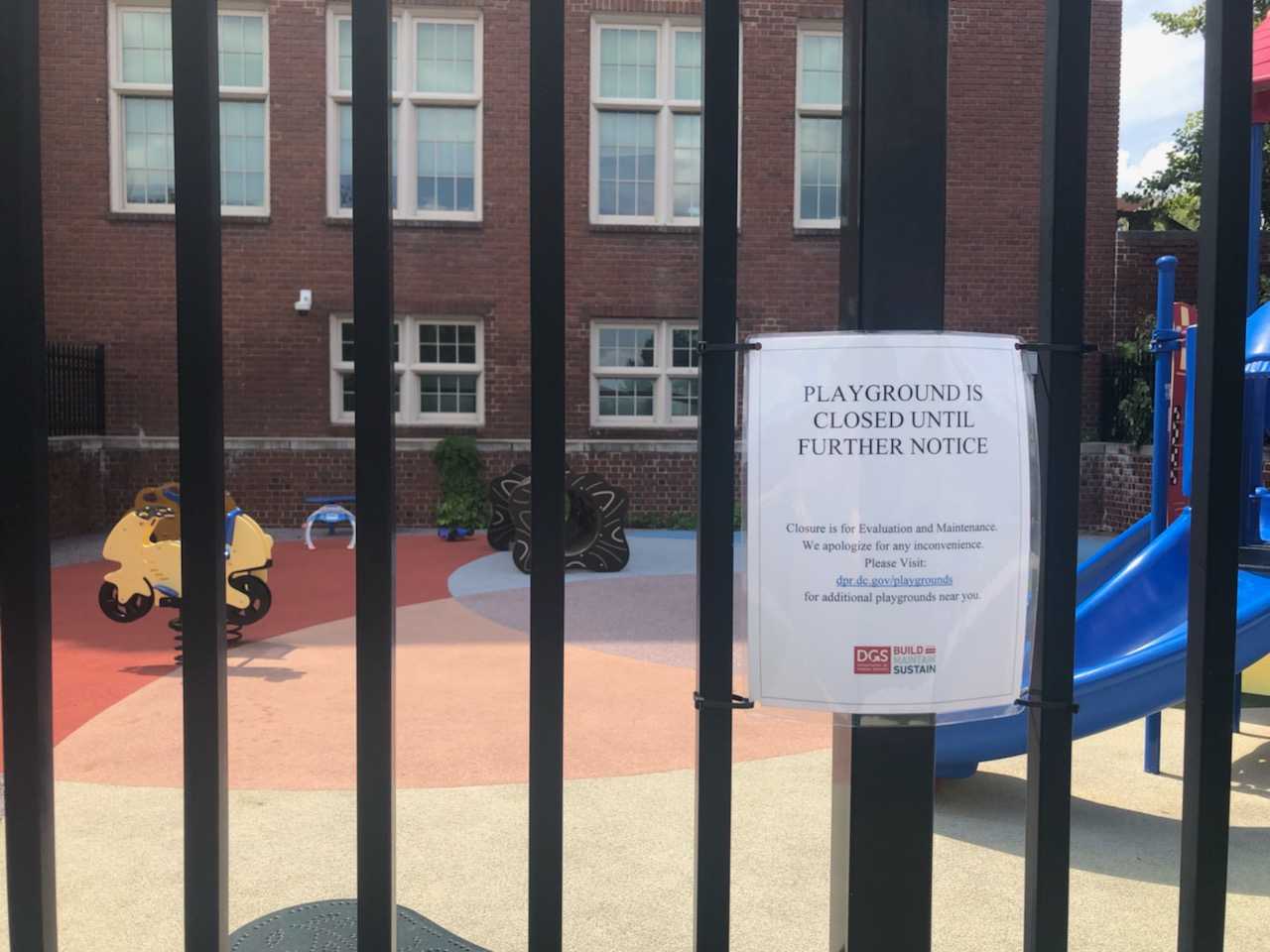
The D.C. government found and remediated elevated lead levels at 17 playgrounds across the District, the city announced to residents last Friday. The findings come after the Department of General Services closed three playgrounds in early August after testing revealed elevated levels of lead on those play surfaces.
The testing and closures followed years of advocacy from some parents and community members concerned about pour-in-place playgrounds, which are made of a bouncy material consists of recycled tires and a top layer of poured rubber. Advocacy organization DC Safe Healthy Playing Fields has been calling for an end to the use of PIP in the District’s playgrounds, and the use of crumb rubber in synthetic fields. They fear, in part, that the heterogeneous materials present in PIP fields, including tire fragments, may contain lead. Even small amounts of lead are hazardous to children, who can suffer permanent neurological and physical damage from lead exposure.
Earlier this year, the organization commissioned a third-party organization, the Michigan-based Ecology Center, to test samples from various elementary schools with pour-in-place rubber playgrounds, and found elevated lead levels at Janney Elementary. The Ecology Center sent those results to the city in May, and DGS conducted its own testing, which it said came back with lead levels below the threshold set by the Environmental Protection Agency (below 400 parts per million).
A month later, additional testing from the Ecology Center revealed lead levels as high as 4,000 ppm at Janney, as well as the Takoma Education Campus and the Truesdell Education Campus. DGS then contracted with Soil and Land Use Technology, Inc. to test PIP playground surfaces, and the agency reported low lead at Takoma and Truesdell. But at the same time, Salut recommended that playgrounds at Aiton Elementary School, Cardozo Education Campus, and Thomson Elementary School be closed after testing revealed high lead levels. (For a more thorough recounting, see our story about this at the time).
DGS said it would undertake lead testing at all 257 of its pour-in-place playgrounds by January 2020, starting with the ones at D.C. public schools. There are 87 public school sites with PIP playgrounds, per DGS, and testing and analysis has been completed at 79 of them.
Of the hundreds of surfaces tested at these 79 sites, Salut found “actionable” levels of lead (above 400 ppm) at 17 sites. The District has remediated all 17 sites with methods that included pressure washing and high-efficiency particulate air vacuuming of 14 of the 17 sites, per a letter DGS sent out to residents about the testing. For six sites, the city had to close down the playground for a longer period of time to complete additional remediation, including “stabilizing nearby paint flaking and covering or removing sections of material,” according to the letter.
The 17 schools that tested positive for elevated lead levels are as follows:
- Aiton Elementary School
- Bancroft Elementary School
- Cardozo Education Campus
- Dorothy I. Height Elementary School
- Eaton Elementary School
- H.D. Cooke Elementary School
- Janney Elementary School
- Langdon Education Campus
- Nalle Elementary School
- Oyster-Adams Bilingual School (Adams Campus)
- River Terrace Education Campus
- Roosevelt High School
- Shepherd Elementary School
- Thomas Elementary School
- Thomson Elementary School
- Truesdell Education Campus
- Turner Elementary School
Aiton, Cardozo, Janney, Thomas, Thomson, and Turner all had to be closed down for a longer period of time for more extensive remediation. The top layer of playgrounds at Turner and Cardozo were removed, and the playgrounds are open. At Thomson, crews placed artificial turf over the top layer of PIP material, sealing in the lead. That playground is also open. Aiton is open, too, as crews replaced the playground surfacing that tested high for lead. Conditions at Janney and Thomas are still being re-tested and confirmed.
Per Salut’s report, the agency identified various possible sources of lead contamination on the playgrounds, including lead paint chips drifting onto the field from nearby buildings, nearby lead-contaminated soil getting carried onto the field by wind, rain, and foot traffic (in the case of one school, construction activity nearby likely unearthed lead-contaminated soil), and—at five playgrounds at three schools—lead content actually mixed into the top layer of the PIP surfacing.
Evan Yeats is an Advisory Neighborhood Commissioner in Ward 4 who has two children attending one of the 17 elementary schools on this list. He says that he feels DGS and D.C. Public Schools have not been sufficiently transparent about the test results or what exactly the city is doing to remediate them. “There’s very little trust here. D.C. has a history of problems with lead exposure, lead in paint chips, and lead in the water,” Yeats says. “And the response that DGS and DCPS has engaged in doesn’t acknowledge the history in all of D.C.’s communities with regard to exposure to lead.”
Yeats also takes issue with the standard being used in the testing to determine what’s safe—400 ppm—“especially since the American Academy of Pediatrics says there is no safe level of lead exposure for children.” The U.S. Consumer Product Safety Commission uses a 90 ppm standard for any children’s products.
The D.C. Council Committee on Facilities and Procurement, chaired by At-large Councilmember Robert White, is going to hold a roundtable on the issue at 10 a.m. on October 3.
In January 2020, Salut expects to provide a full report of all testing, along with “further recommendations for remediation/corrective actions, suggestions for future PIP playground contractors, and effective maintenance schedules and procedures,” per Salut’s report on the 17 playgrounds. The company’s report is dated September 13, but the news didn’t become public until September 20.
In its letter to residents, DGS says that it will “implement improved routing maintenance” to clear play surfaces of debris from nearby buildings and soil that may contain lead, as well as “revise playground design and purchasing guidelines to more explicitly guard against lead contamination from various sources.”
Previously:
D.C. Closes Three Playgrounds After Tests Show High Lead Levels
This story has been updated with the accurate name for Evan Yeats and a more accurate description of DC Safe Healthy Playing Fields’ advocacy.