Rachel Kurzius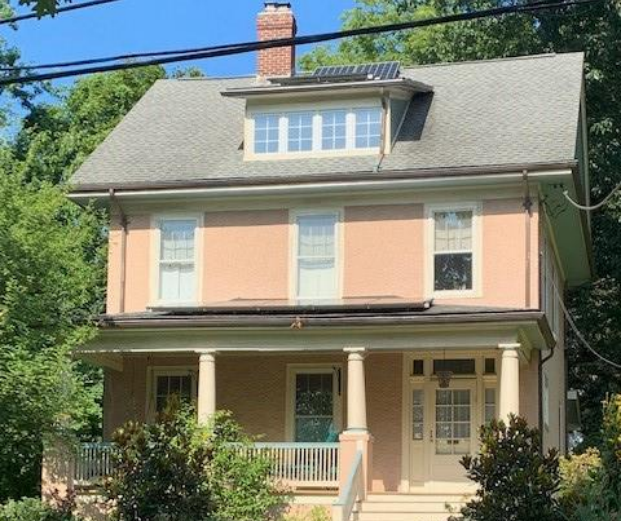
A decision by the D.C. Historic Preservation Review Board to deny a petition for front-facing solar panels in a historic district has been met with widespread exasperation, especially on (where else?) Twitter.
“Historic preservation is the enemy of progress,” “This is so infuriating,” and “How is this allowed to happen in 2019?” are just a small, but representative, sample of the responses.
Tommy Wells, the director of the District Department of Energy and the Environment, chimed in, too. “Disappointing,” he wrote on Twitter. “Waiting for the next generation of appointees…”
The vote comes as DOEE has been among the city agencies advocating for more residents to adopt solar energy, especially as the District works to transition to 100 percent renewable energy by 2032, in line with legislation passed unanimously by the D.C. Council last year. The response to this decision may influence the ongoing process of finalizing a new set of sustainability guidelines for historic properties.
While solar panels can save residents money on their electric bills, Steve Preister, the man whose bid for solar panels was rejected last week, says that he wasn’t particularly motivated by finances. He’s worried about climate change.
Already, the region has felt the impacts of climate change, and those consequences—unpredictable weather and hotter temperatures among them—are expected to intensify in the coming years.
“We’re running out of time here,” says Preister, a resident of Takoma whose home falls within the historic district of Takoma Park. He says that after the vote, he told the board, “You know, species are going extinct,” and he wishes he had added, “but at least I have a beautiful roof.”
As first detailed by Greater Greater Washington, Preister’s bid for solar panels on his main front roof has been years in the making. He already has dozens of solar panels in the back of his century-old home, which he has lived in for almost 35 years.
Last year, the board approved Preister’s application for solar panels on the porch roof and front dormer of his home, but rejected his bid for panels on the main front roof, citing their visibility from the street.
This year, he returned with another application for panels for his front-facing roof, but with a couple of changes: The panels would be situated a couple inches closer to the roof, for one, and he also came armed with unanimous approval from his Advisory Neighborhood Commission. And, in the intervening time, D.C. has begun implementation of its ambitious climate legislation, while requires that 10 percent of its renewable energy be from locally generated solar power.
Preister’s commissioner, Erin Palmer, says that the ANC is “reconceptualizing how solar panels are considered. As I understand it, the Historic Preservation Review Board considers them as alterations of the roof and talks about them like skylights. We are trying to reframe solar panels as something that is temporary and reversible.”
But the vast majority of the Historic Preservation Review Board wasn’t buying it. The board consists of nine residents appointed by the mayor, and they are trained in architecture, archeology, history, and other subjects. They review construction on buildings that are designated historic properties, among other duties. D.C. has more than 25,000 historic properties, according to the 2016 D.C. Historic Preservation Plan, and doing construction on them requires additional layers of approval from the board.
“We’re trying to push them into a different comfort level on solar panels,” says Palmer.
One board member, historian Andrew Aurbach, voted in favor of Preister’s application, arguing that the solar panels wouldn’t undermine how people understood the historic context of the home.
But he was the only one who voted yes. For some board members, the aesthetics of solar panels on front-facing roofs made them a no-go. “I applaud your greenness and your desire to save the planet,” said board member Chris Landis, a local architect, per GGW. “But I just have this vision of a row of houses with solar panels on the front of them and it just—it upsets me.”
Michelle Moore, the CEO of nonprofit solar organization Groundswell, says that, “Given the fight that we’re in for our future around climate change and the urgency of transforming our energy sources to be 100 percent renewable, it’s time to redefine beauty … To assert or insinuate that solar is ugly is to risk turning the historic aspects of Washington neighborhoods into a mausoleum.”
When reached by phone, Landis says that, “The board has a certain purview, which is just historic districts, and it really has to do with the architecture of a district … It doesn’t have to do with the environment or existential threats.”
Landis says that the board isn’t necessarily opposed to solar panels. “When there is a product that is developed that looks like slate and develops energy, I would imagine that those would probably be acceptable,” he says. “We’re not there yet, but we’re close.”
But even without those technological advances, the board and the Historic Preservation Office have approved most of the solar panel projects that’ve been put before them.
Preister’s case is only the second instance of denying an installation—all of the others have been approved, either in full or with some modifications, according to Steve Callcott, a deputy preservation officer at the Historic Preservation Office. The board has considered solar 14 times involving 11 properties over the past decade.
Most of the time, the Historic Preservation Office, which is staffed by city employees, can make determinations about applications without the board’s input, based on guidelines developed by previous decisions. The office has approved more than 1,400 solar installations from 2009-2019.
“In terms of the actual numbers, it’s not resulting in substantial restrictions on solar installations,” says Callcott, who adds that, over time, the board has become more flexible—allowing panels on the sides of historic homes, and permitting those that are a little visible from the street.
For instance, the board approved side panels on a home close to Preister’s in Takoma, overriding the staff recommendation, earlier this year. Members of the board argued that the home was on a high enough elevation and had enough tree cover that the solar panels wouldn’t be too visible.
But to Preister, having his solar panels visible from the street is an unabashedly good thing. “One of my motivators is that I want people to think” about the panels when they see them, he says. He adds that there may be a chilling effect from this vote. When going house-to-house to gain the approval of his neighborhood for the project (all 10 houses on the block, including his, were ultimately in favor), “four or five [homeowners] said, ‘I want to wait to see if you get it and if you do, I’m going to try this, too,” says Preister.
He adds that the sun shines brightest on his front-facing roof. “The front of my house is east, and that’s where all the beautiful sun is,” he says. “Other than the flat panels, I can’t take advantage of that.”
The board’s decision regarding Preister’s property comes as it is nearly done with a multiyear process of creating a Sustainability Guide for Older and Historic Buildings. Most of the document is about retrofitting, insulation, and other less visible elements of sustainable design, but there is a section about solar. In its current draft form, it reads, “Installation of [solar] systems needs to take into account the building’s structural capacity and architectural character, and may not be feasible or appropriate in all instances.”
According to Callcott, DOEE requested that the guidelines be as flexible as possible when it comes to solar installations. The updated guideline draft will come before the board in December, along with public testimony. “The board will decide whether they want to modify their policy or wholesale change the policy,” says Callcott.
In the entire document, the question of visible solar is likely to be the most controversial element.
Indeed, there has long been a perceived tension between preservation and sustainability efforts—previous fights have popped up over windows, for instance—but Moore, of Groundswell, believes that the two aren’t necessarily at odds. Historic preservation is “about challenging [cities] to do adaptive re-use of buildings, and using what you’ve got instead of tearing it down,” she says.
Callcott notes that’s one of the points the sustainability guideline is trying to make: “A lot of [older] buildings, particularly the ones that predate World War II, have better energy efficient qualities inherent in them than more recent construction … A lot of them were designed before there was mechanical heating and cooling, so inherent in their design are a lot of sustainable qualities. The issue with solar is that it’s a step beyond energy efficient and it’s getting into energy generation.”
Preister says he is now trying to connect with other historic districts, as well as different city agencies, to figure out if they can work together to shift the way the board considers solar panels: “The experience has turned me into a bit of an activist.”