Rachel Kurzius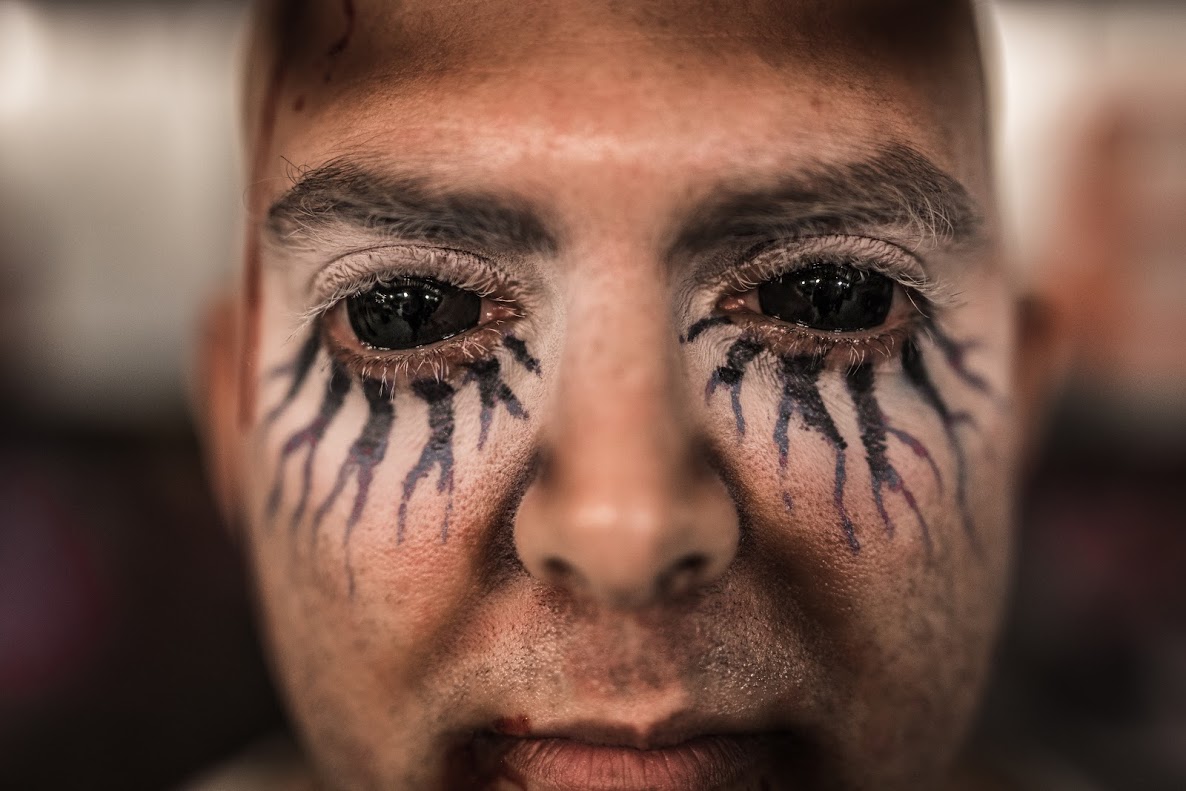
For those who decide to attend one of the area’s haunted attractions during the spooky season, it means a night of bone-trembling screams, gallons of fake blood, and an intense sense of relief when it’s all over.
But what about the people employed on these sinister stomping grounds?
“People think that it’s just fun and games out here scaring people, but it is a lot of work,” says Dave Harding, the designer and area manager for The Town at Markoff’s Haunted Forest in Poolesville, Md. “It does take a toll on you.”
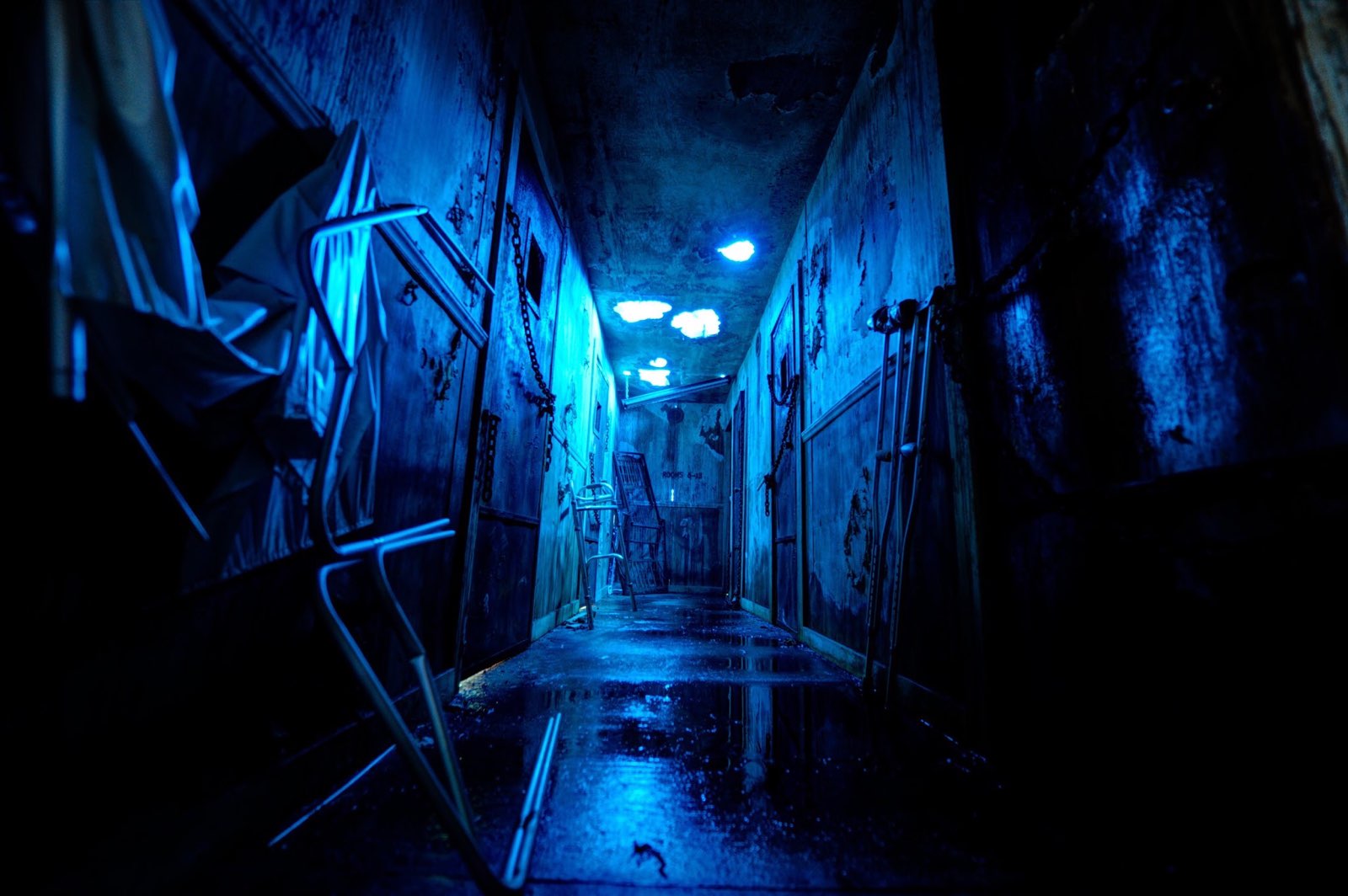
Offerings at Markoff’s Haunted Forest include two haunted trails and a simulacrum of an old town, which has a creepy asylum. “My staff are sitting there listening to those recorded screams every night, and I know it does wear on them,” says Harding, a longtime lover of Halloween. “I’ve got staff that have no voices left, no energy, at the end of a three-day weekend. I tell them, ‘I need you to go home, I need you to rest, I need you to drink some tea because I need you to come back here Friday to scare people.'”
Harding is employed full-time by Calleva, the outdoor education nonprofit where Markoff’s ticket revenue goes (his other job titles include head beekeeper and sailing instructor—”It depends on the day”). He’s part of a small group of Calleva year-round staffers who take part in mounting the haunted forest. By August, the team has 25-30 operational staff to oversee elements ranging from design to concessions to parking. Between all of the attractions, Harding says, they employ about 250 actors.
Arianna Dastvan is one of those actors. “I have been working with them for 14 years and I will never stop working here,” she says. Dastvan is a middle school teacher in Baltimore County who moonlights as a deranged clown at Markoff’s. “I’m a happy, bubbly teacher, and this weekend I will be transformed into something completely insane.”
Dastvan says that “scaring for five hours straight is exhausting when you’re on your game the whole time.” Without giving away too much about her scare, it involves her making repetitive motions, breathing shallow, and keeping her eyes wide open. (“I have the most toned arms at the end of the month,” she says with a laugh.)
Still, she thinks the perks make it all worthwhile. “I am very much a people-watcher and this is my prime time to people-watch, because not only am I watching them, but I’m scaring the crap out of them,” Dastvan says. “I love the psychological aspect of this job.”
She has been doing some version of her clown character for the entirety of her time at Markoff’s. That’s something that Harding encourages.
“We try to have somebody take that scene and make it theirs,” he says. “It takes a while to get into the groove and figure out what hiding spots work and what scares work.” Some actors might switch up their roles more frequently, but there’s one designation that is rigid. “The chainsaws are set,” he says of the of the actors who wield the roaring tools and chase patrons. “They’re like the elite group in the haunted forest—you have to work your way up there. If you’re comparing it to high school, those would be the jocks.”
Mike Lado, the creative director of Field of Screams Maryland out in Olney, says that “we allow people to roam around in their roles night to night for the first two weekends to get a feel for what they like the most. If there’s an actor who really gives themselves to a role, then that’s their role for the season. Other people who like to try different roles because they like to put on a different face—sometimes literally, sometimes figuratively.”
Lado says that manufacturing Field of Screams Maryland is a year-long process. “Once we’re done taking things down, we put our heads together and decide, what worked best? What didn’t work best?” he says. The key part about scaring visitors is developing sets. “It’s all about directing them without letting them know they’re being directed,” he explains. “You play into the science of what humans instinctually do in those situations and play off of that.”
He gives an example of a haunt from a few years back: Visitors need to walk through a Mad Max Thunderdome-esque cage, where they see a hulking man chained to a post. As they’re trying their best to avoid the grasp of the chained-up man, “you’d be so distracted that you wouldn’t notice this other guy running from the woods and jumping onto the dome,” Lado says. “Your instinct is to run, and now you’re running right into the guy with chains. There is no escape from that scare.”
Despite spending the whole year conceiving new, gory ways to terrify people, Lado doesn’t think the work takes a psychic toll. “For me, it’s an art form,” he says. “It’s never, ‘How deviant and dark and messed up can we be?’ It’s, ‘How many worlds can I create for people?’ It’s a fun experience in getting to work in a place where you’re creating those feelings in other people. It’s strangely rewarding.”
Running the two haunted trails, eerie factory, and more at Field of Screams requires a management team of 15 people running the trails each night, plus anywhere from 80 to more than 100 actors, per Lado. “There’s a misconception that there’s one creative doing everything,” he says. “It takes a really strong team to put together something this big.”
The sets have built-in cues to help actors with timing. For instance, a light will go on, and a series of actions ought to happen by the time the light goes off. But sometimes, visitors will start running, throwing off the timing.
Running won’t save them from a scare, though. Actors are able to improvise, and can use a network of behind-the-scenes access points to find the visitors. “You can run, but chances are, if you’re going to hide, there’s going to be someone waiting for you,” Lado says.
Aside from the run-versus-hide dichotomy, there’s another pair of reactions that govern people’s reactions to fear: fight or flight. Has an actor ever gotten punched? “That happens all the time,” says Harding. Despite constant warnings to visitors at Markoff’s not to touch the actors, “it’s part of the job and they understand that’s how a lot of people react. Some people will run, some people will choose to fight.”
Dastvan says she was punched during one of her first Octobers working at Markoff’s. “When I had braces and I was in high school, I was doing a very animatronic-type scare,” she explains.”There was less than a foot between me and the patrons, and when I did my jolting scare, only once I got punched in the mouth … That was the moment when I realized, ‘OK, I have to have more space.'” Still, she never considered giving up the gig.
Many of the scares at haunts do involve getting physically close to patrons, but Harding says that it doesn’t necessarily mean screaming in someone’s face.
“A lot of people think they have to be too loud and that’s not the case,” he says. “Sometimes, some of the best scares are the quiet ones. My favorite thing is to come up on somebody in the middle of the group and give them a whisper, and their freaking out scares the rest of the group. I love doing the quiet and concise scares.”
Indeed, it’s the variety of reactions that keeps things exciting.
“I don’t know of any other business where, when people are running away screaming and crying, it means you did your job well,” says Lado. “For us, it means we did a great job.”