DMV Color, a new exhibition featuring contemporary works of book art, highlights women of color connected to the local region, while also showcasing the D.C. area as fertile ground for the book arts.
With approximately 20 artists’ books, graphic novels, photobooks, and zines on display in National Museum of Women in the Arts’ fourth floor library, DMV Color includes both widely-known artists—such as Elizabeth Catlett and Loïs Mailou Jones—and lesser-known creators.
“The impetus was just feeling like we wanted to shine a spotlight on book arts in the DMV and shine a spotlight on the creative endeavors of women of color,” says Lynora Williams, director of the Betty Boyd Library & Research Center. “It’s somewhat understated the extent to which, for women of color, this is a very fertile area that sparks a lot of creative work, and it’s also an area that’s important for book arts.”
Williams notes that for book artists, the D.C. area has several programs and organizations to learn more and exhibit their work, including the Pyramid Atlantic Art Center in Hyattsville, and George Washington University’s Corcoran School of the Arts, which has in the past offered study in the area of book arts. Additionally, annual zinefests and the long-running Small Press Expo in Bethesda all support local artists.
NMWA has also promoted local book arts by hosting the DC Art Book Fair. The third annual event, held in July, brought together small presses, artists, and vendors selling independently published works, and was organized by the DC Art Book Collective.
The works featured in DMV Color address issues that include home, family life, dislocation, storytelling, spirituality, and immigration, with a common focus on expressions of cultural identity and heritage. My Cotton Book (2010) by Ibé Crawley, for example, explores the impact that cotton farming and processing had on generations of African Americans. Crawley approached the construction of the artist’s book as a “quilted story,” or a textual sculpture. The work includes a fascinatingly tactile mix of layers of cotton thread, colored bits of fabric, decorative paper, and tufts of matted cotton.
Crawley incorporates archival photos depicting the lives of enslaved and formerly enslaved peoples. In addition to showing the photo subjects laboring in fields, the photos also honor them as individuals and as family units. The work is both moving and deeply unsettling.
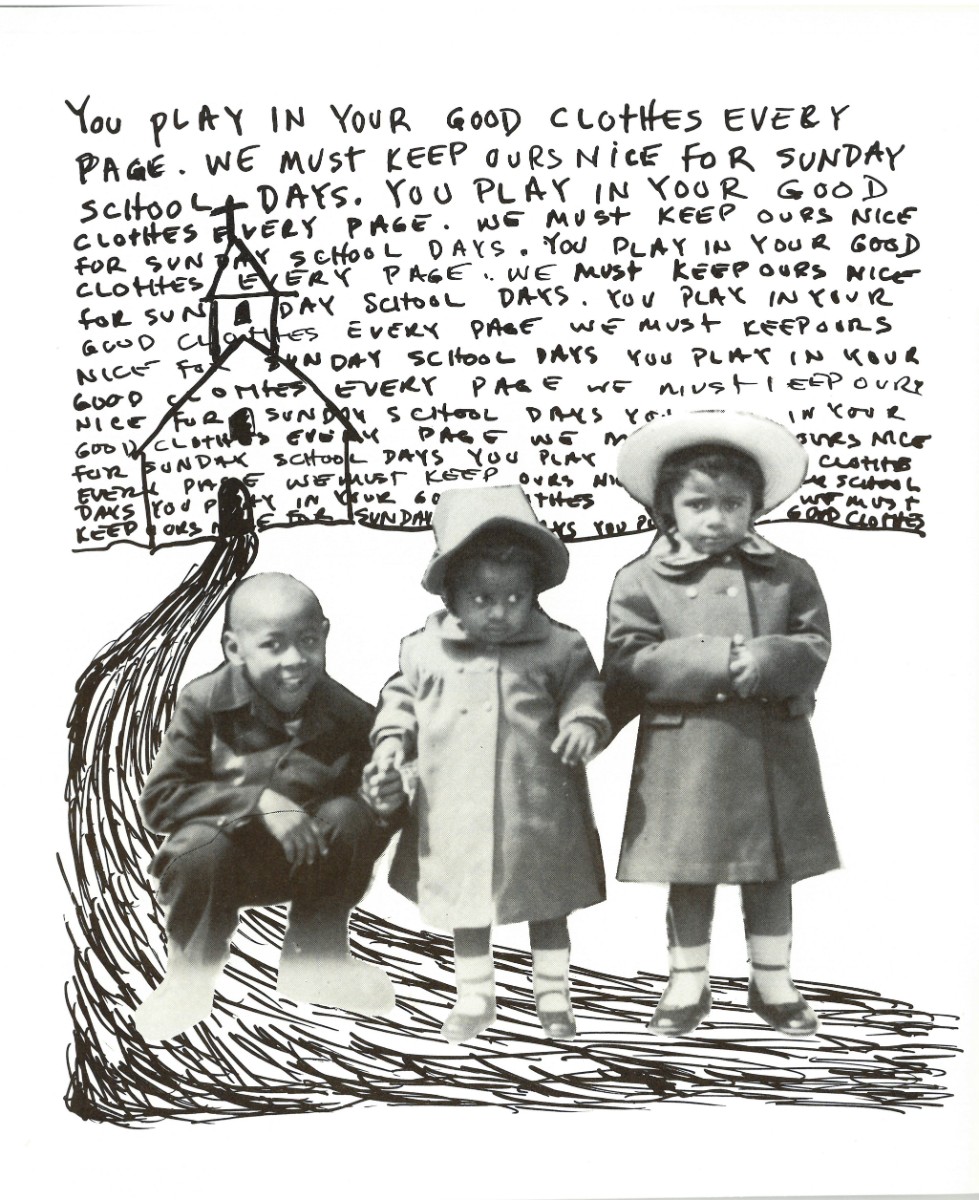
In Reading Dick and Jane with Me (1989), Clarissa T. Sligh overlays a reworked Dick and Jane reader with images of African American children, namely her siblings, herself, and their friends.
But what appears to be a collection of happy, youthful images in the first few pages has a much deeper meaning for the artist as she soon interrupts the classic story with her own. In 1956, when she was 15, Sligh was the lead plaintiff in the school desegregation case Clarissa Thompson et. al v. County School Board of Arlington County, which ultimately granted her the right to enroll at Washington-Lee High School (now Washington-Liberty). That personal history brings a darker context to the work.
Another piece about memory and history, Sabrina Barekzai’s delightful, slender zine, Afghan Superstitions, Vol. 2, 2016 incorporates stories, superstitions, and adages that Barekzai heard as a child from friends and family, while growing up in Northern Virginia in the 1980s.
Still another work examines D.C.’s present and future. In her photobook The D.C. I See—Art of a Vanishing City (2018), Carolyn Toye adeptly captures the beauty of D.C.’s buildings and places on the verge of disappearance. The book includes images taken from 2005-2018 that celebrate the architecture of former factories and warehouses, abandoned spaces, and neighborhoods that would soon be redeveloped. Toye’s work crosses quadrants, as she photographs spaces such as the former Wonder Bread Factory, Union Market, The Wharf, and Buzzard Point. She focuses on the small things: the cracks, colors, details, and the quirks that give the city its personality.
“I hope that my images of D.C.’s urban landscape offer the viewer a glimpse into the city’s classic architecture and ‘local’ landmarks and, by extension, into the lives of the Washingtonians who, like me, have lived, worked, played, and prayed within its walls,” Toye explains in the introduction to The D.C. I See.
In addition to offering opportunities for discovery, DMV Color hopes to start a dialogue across cultures. “I feel like this is a way for us, through this show, to talk to one another. A lot of times we don’t have those opportunities,” says Williams.
National Museum of Women in the Arts, Nov. 4–March 4. Monday–Friday, 10 a.m.–12 p.m. and 1–5 p.m. Admission is $10 for adults, $8 for visitors 65 and over and students, and free for NMWA members and youth 18 and under.