In a comprehensive new exhibition, the Hirshhorn Museum and Sculpture Garden traces the career of 20th century artist and provocateur Marcel Duchamp. Marcel Duchamp: The Barbara and Aaron Levine Collection features the recent gift of more than 50 works of art that have been promised to the museum by Washingtonians Barbara and Aaron Levine. (In an interview with the Washington Post, Hirshhorn board chairman Daniel Sallick called the acquisition “the art world equivalent of the Wizards getting LeBron James.”)
“This exhibition allows us to show almost a genesis story around modern art,” says Hirshhorn Director Melissa Chiu, who notes that many contemporary artists would name Duchamp as their most important artistic influence.
Duchamp’s influence is certainly a major point of the Hirshhorn exhibition. It features photographs of Duchamp with or by his friends and collaborators, including Man Ray, Hans Hofmann, Diane Arbus, Irving Penn, and Henri Cartier-Bresson. The first gallery in the exhibition includes Duchamp’s Andy Warhol screen test, filmed in 1966 and not part of the Levines gift. (In April 2020, the museum will open a companion exhibition featuring works of art by Duchamp’s collaborators as well as the numerous contemporary artists for whom Duchamp served as an inspiration.)
The current Hirshhorn exhibition, which opened Saturday, is a reverent display of work that was created with the utmost irreverence for institutions of fine art. For decades, Duchamp held onto his resentment towards such institutions after having his work rejected in two significant ways. The first rejection came in Paris in 1912.
As the story goes, Duchamp submitted his painting “Nude Descending a Staircase, No. 2” to the Salon des Indépendants. The painting was poorly received by other members of the salon, who represented Cubism, and felt the painting slanted too far towards Futurism—a rival artistic movement. They asked Duchamp’s brothers, also salon members, to have Duchamp replace his painting with a substitution. The 25-year-old Duchamp refused, took his painting home, and renounced his membership.
Comprised of layers of angular shapes, lines, ovals, and half-moon brushstrokes, the painting conveys downward descent, but not—as some viewers argued–the human form. When Duchamp took the work to be exhibited in New York in 1913, “Nude Descending a Staircase” was so widely ridiculed that even former President Theodore Roosevelt piled on, calling the work “repellent.”
The second rejection served to build Duchamp’s legend. He submitted “Fountain,” a white porcelain urinal scrawled with the pseudonym “R. Mutt” on the bottom, to the first annual exhibition of the Society of Independent Artists in New York in 1917. Although the exhibition was purported to be open to any artist who paid the fee, “Fountain” was hidden from the public behind a partition. As a result, Duchamp renounced his membership to this salon as well.

“Fountain,” which is included in the Hirshhorn exhibition by photograph, is one of the pieces for which he is best known, which he called readymades. In choosing a readymade object at a certain time and place, Duchamp argued, that decision in that moment is itself an artistic act. In the case of “Fountain,” for example, when the artist deemed the urinal art, so it was.
“An artist is able to choose a commercially-fabricated, every day, manufactured object and purely by that artist’s choice transform it into a work of art,” says senior curator Evelyn C. Hankins. “You displace utility, and instead you make art.”
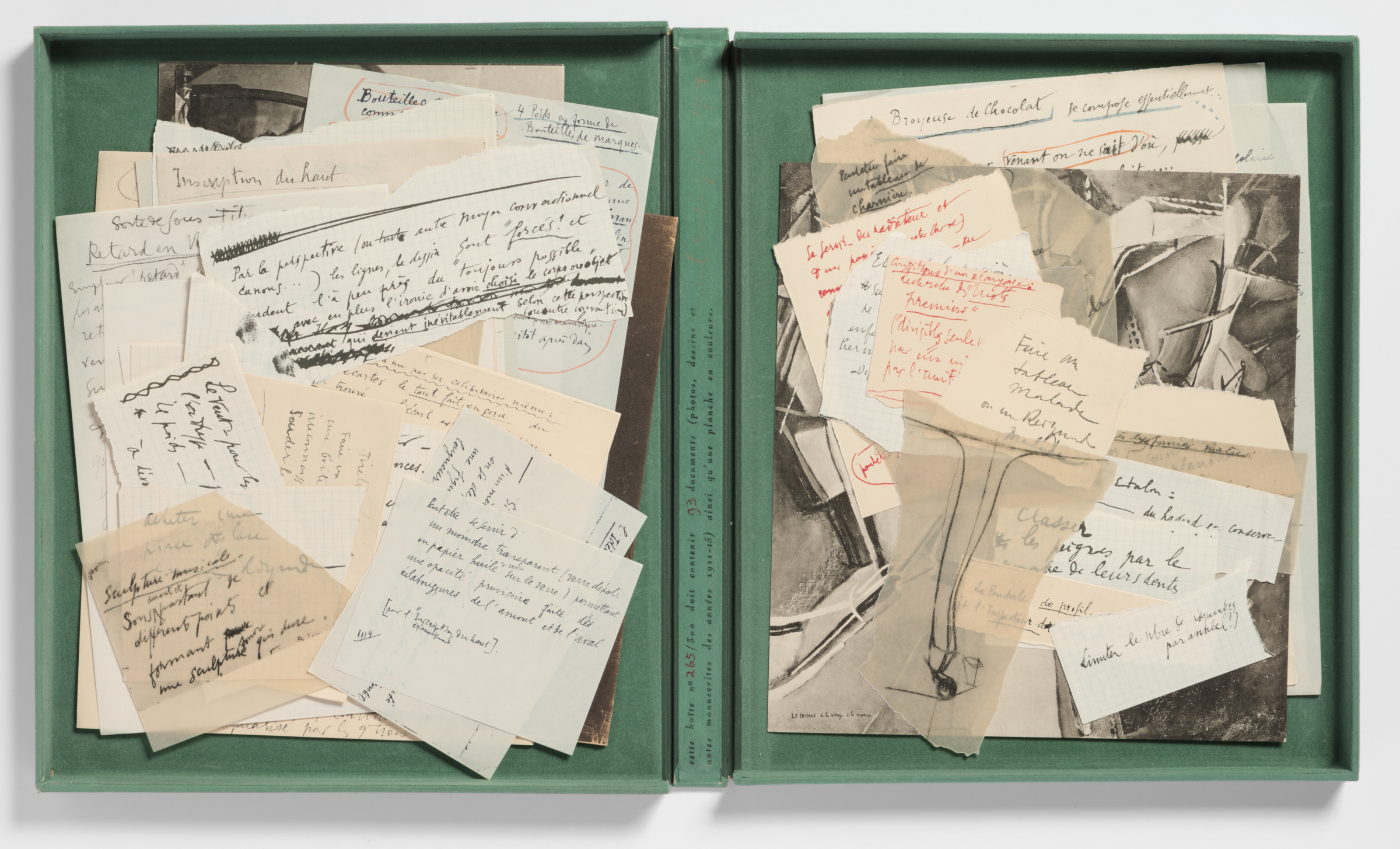
Duchamp also believed that the artistic process was itself a work of art. This is apparent in one of the pieces on display at the Hirshhorn, 1934’s “The Bride Stripped Bare by Her Bachelors, Even (The Green Box),” which contains 94 facsimiles of notes, drawings, and photographs in a green cardboard box. These pieces are the carefully reconstructed records of his process towards creating the artwork of the same name, which is also known as “The Large Glass.”
“The Large Glass” is a freestanding piece, mainly two panes of glass that incorporate painted abstractions of characters: There’s a bride on the top pane of glass, and nine figures known as the “Bachelor Machine” on the bottom pane. It explores such themes as physics, mechanics, engineering, sexuality, and alchemy. Duchamp worked on “The Large Glass” between 1912 and 1923, when he declared the work “definitely unfinished.” A large-scale reproduction of the work is on view, but it’s his process, laid out in “The Green Box,” that is the main feature.
Duchamp created 300 versions of “The Green Box.” He used collotype, a photomechanical flat printing process, to reproduce the images, and created zinc templates to replicate the exact tear shapes of the collected scraps of paper that were his notes on “The Large Glass.” “The Green Box” is both original and reproduction; created by the artist and fabricated, produced, and reprinted by collaborators. “Duchamp is challenging ideas of originality, authenticity, and where the artist’s hand is,” says Hankins.
Duchamp also argued that it’s the viewer who completes a work of art. By viewing the work and handling the objects in “The Green Box,” Duchamp intended for the viewer to participate in the act of creation. “Each time the box is opened and the viewer shuffles through [the pieces], narratives are created by their own choices,” says Hankins.
While visitors can’t handle “The Green Box” and other items on display at the Hirshhorn, they can participate in one of Duchamp’s greatest passions. “Because of his love of chess, and with the idea that the viewer completes the work, we put chess tables out so that people could play during museum hours,” says Hankins. In this way, visitors become part of the exhibition.
Duchamp was so passionate about chess that when he left New York (and the art world) in frustration in 1918, he headed to Buenos Aires, where he stayed for nine months, focusing on his chess playing. In 1923, when he returned to Paris he played chess professionally there for a while as well. He eventually returned to art in earnest. In the mid 1930s, he started building his own retrospective.
He created 68 small-scale reproductions of his major works for his collection of greatest hits, titled “From or by Marcel Duchamp or Rrose Sélavy (The Box in a Valise).” Duchamp included works such as “Nude Descending a Staircase,” a miniature “Fountain,” a compact version of “The Bride Stripped Bare,” and a postcard-sized “L.H.O.O.Q,” his mustachioed “Mona Lisa.” This is one of the most delightful works in the Hirshhorn exhibition, and the museum includes a short unboxing video.
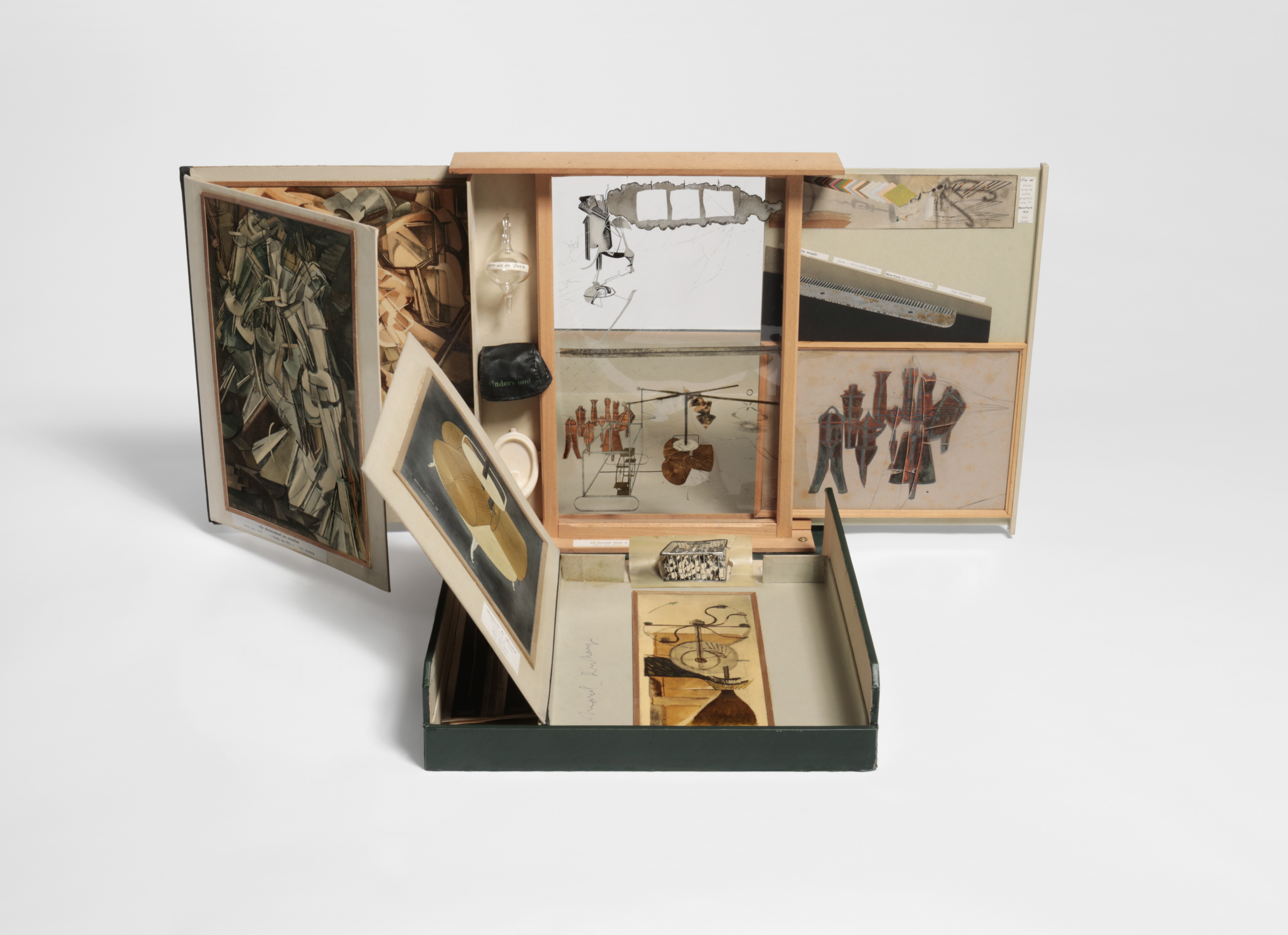
It took Duchamp six years and plenty of help from friends to complete the series. To make his teeny replicas, he used production methods including photography, hand-colored photo proofs, papier-mâché, casting molds, and printing. “I think often, because of Duchamp’s ideas about the readymade, we think of him as being averse to craft, but he was always very interested in things being well-made,” says Hankins.
By creating his own portable museum, as Duchamp called “The Box in a Valise,” he controlled his presentation (without interference from a jury or curator), and he removed the barriers between his work and himself, and himself and the viewer of his work.
“A really incredible part of Duchamp’s contribution to art [is] this idea that the viewer is as important to the creation of meaning as the artist himself,” says Hankins. “That was an incredibly radical idea.”
Marcel Duchamp: The Barbara and Aaron Levine Collection is on view at the Hirshhorn Museum until Oct. 15, 2020.
There’s No Paywall Here
DCist is supported by a community of members … readers just like you. So if you love the local news and stories you find here, don’t let it disappear!