Rachel Kurzius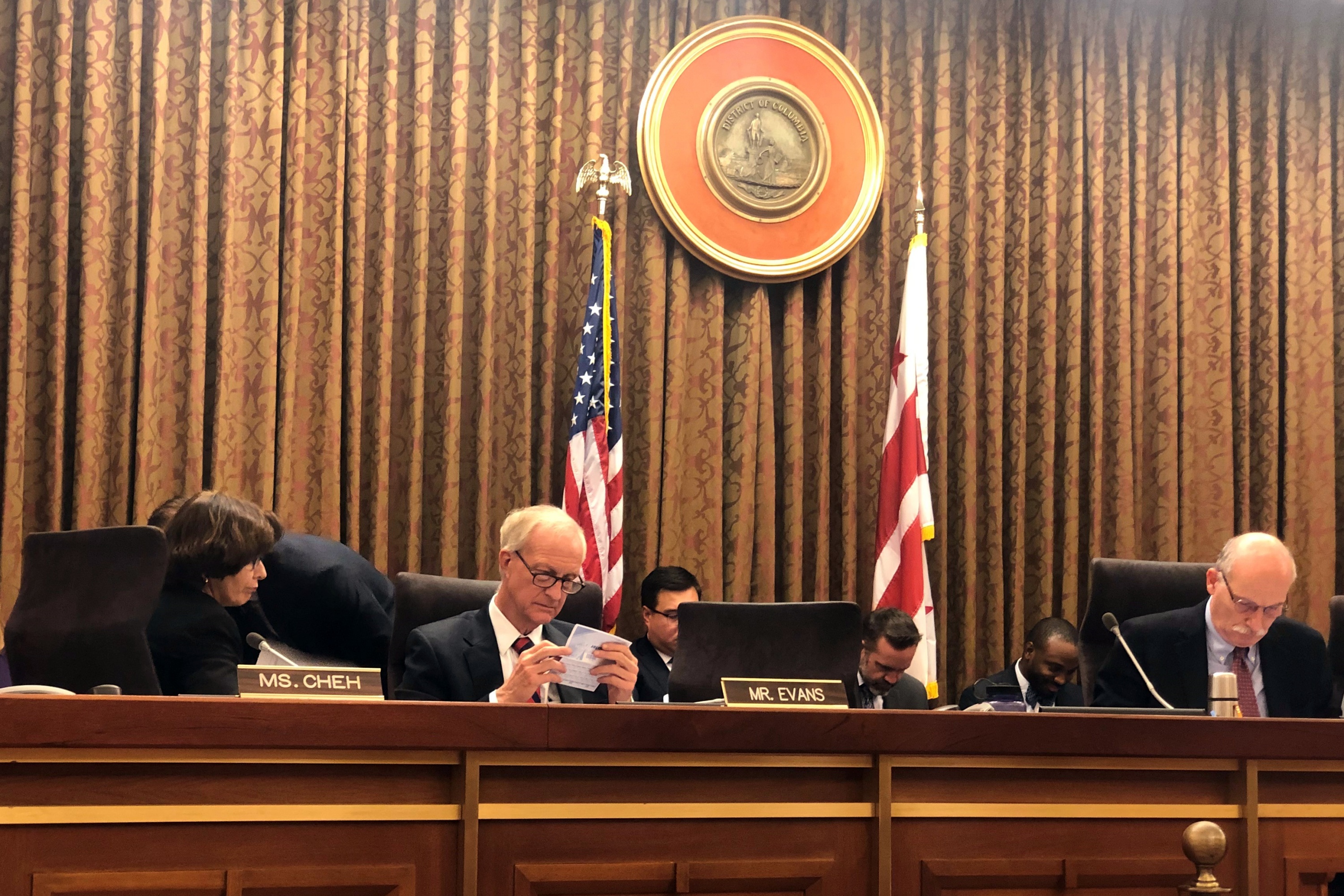
Update, 1/29/20: Boy oh boy have there been updates since this guide was published! Chief among them, Evans resigned from the D.C. Council, effective January 17. He stepped down shortly before a scheduled vote to expel him over the conflict of interest investigation detailed below—and after all 12 of his colleagues had voted to recommend booting him off the legislative body back in December. His resignation prompted the D.C. Board of Elections to schedule a special election on June 16 to finish Evans’ term, two weeks after the crowded primary that had long been scheduled because the Ward 2 seat is on the ballot in 2020.
Just 10 days after Evans stepped down from the council, he filed to run in both elections: the early June primary, and the special election to fill the seat he vacated to avoid expulsion. While nothing in D.C. law bars him from entering the race, his former colleagues on the council are not pleased.
In light of these latest turns, it’s worth revisiting all of the investigations into Jack Evans.
Original:
Jack Evans is a longtime fixture of D.C. politics—he’s served as the Ward 2 councilmember for nearly three decades, and had multiple stints as the chairman of the Metro Board of Directors. He’s seen as one of the council’s most business-friendly members, and he’s held a second job for much of his time in office. (Which is allowed, according to council rules, so long as any potential conflicts of interest are disclosed.)
But for more than a year, he’s become a fixture of local headlines, and not the good kind. The short of it? He faces accusations that he used his public roles for private gain, trying to parlay his government experience into payment from companies and influencing policy on behalf of his clients. At this point, the majority of his D.C. Council colleagues are calling on him to step down. There’s a recall effort underway, and, for the first time in a long time, he’s facing competition for his seat in the June primary.
How did we get here? The various investigations are hard to track (some of them are entirely shrouded in secrecy) and, as we already know, Evans’ Wikipedia page isn’t exactly a reliable source.
So, we hereby present a guide to all the investigations into Evans.
BOARD OF ETHICS AND GOVERNMENT ACCOUNTABILITY, PART 1
Reason for Investigation: D.C.’s ethics board was looking into Evans’ relationship with a digital sign company (see our first explainer, from last December, for more). At question was whether payments Evans received and then returned from Digi Media had anything to do with legislation he proposed that would have uniquely benefited the company. (The bill never made it to a vote.)
Timeline: The Board of Ethics and Government Accountability’s investigation began in January 2018, according to the Washington Post. At the time, D.C. Council Chairman Phil Mendelson pointed to the investigation as the reason he wasn’t convening a committee to look into Evans’ potential conflicts of interest. Then, the BEGA probe was suspended a few months before the end of 2018. The Post noted that while BEGA officials didn’t give a reason for the suspension, “in other cases they have stepped aside in deference to law enforcement investigations.”
Conclusion: Seemingly still suspended.
Evans’ Response: Evans has maintained that he returned the money to Digi Media, and so it doesn’t constitute a conflict of interest.
FEDERAL INQUIRY
Reason for Investigation: As the suspension of the BEGA investigation seemed to indicate, federal law enforcement was looking into Evans’ dealings with Digi. This became clear in February, when a federal grand jury subpoenaed records related to Evans and Digi Media.
Timeline: We don’t know precisely when the federal probe began or what, exactly, it encompasses. But there are some clues. In early March, D.C. councilmembers and other government officials received subpoenas demanding they keep all of their communications with Evans. That memo provided more insight into where investigators were looking because it also sought documents related to companies like Pepco, Excelon, Eagle Bank, Eastbanc, Colonial Parking, Willco Construction, and more. In March, Mendelson cited the investigation as part of why the council wasn’t embarking on its own investigation at the time: “Other issues that are swirling are issues that are being investigated by the U.S. Attorney … and if we were to try to enter that field right now, they would push us back,” he said. The FBI capped off a particularly bad week for Evans in June by conducting a raid on his Georgetown home. That’s the last public peep from the probe.
Conclusion: This is presumably still ongoing, though the U.S. attorney’s office might not necessarily announce it has closed the investigation (especially if it doesn’t lead to indictments).
Evans’ Response: Evans has said that he spoke with U.S. attorneys for an interview this year, and has called on his D.C. Council colleagues to wait until this probe is completed before proposing any punishment (they have not heeded this request). As for the FBI raid, “What an impression that has made,” he said in early July, adding that the boxes agents carried out were largely empty.
METRO ETHICS COMMITTEE INQUIRY
Reason for Investigation: At the beginning of March, the Post published emails sent from Evans’ council office to potential employers, in which he touted his experience at the Metro board and the council to get hired in the private sector.
Timeline: The Metro board announced its ethics officer was reviewing the matter within days of the publication of the emails in the Post. The board hired law firm Schulte Roth & Zabel to look into the allegations. While the Metro ethics board was looking at the law firm’s findings in an early May meeting to determine whether Evans had violated the code of conduct, no one was taking minutes. In late May, Evans announced he was stepping down as chair of the board when his term ended, though maintained he would stay on the board. At the same time, Metro board member Clarence Crawford said that the ethics committee’s probe into Evans was “resolved” and “closed,” though he wouldn’t say whether there was any connection between Evans’ choice and the results of the investigation. By June, Evans was insisting to his D.C. Council colleagues and the public that “the ethics committee at Metro found no violation of any ethics rules on my part.” That was not true: Metro’s general counsel showing that the committee concluded Evans did violate Metro’s ethics code—he lobbied for Metro to look into LAZ Parking, the company that manages Metro’s parking, without disclosing that he had a $50,000 consulting contract with Colonial Parking. He was ordered to fix his disclosure forms and told not to run for reelection as board chair. (Metro has since changed the way it conducts ethics investigations.) It later came out that Evans reportedly berated Metro employees to prevent the release of the ethics investigation’s conclusions.
Conclusion: The Post published the 20-page internal memo from Schulte Roth & Zabel that outlined Evans’ alleged violations, which states the investigation found “a pattern of conduct in which Evans attempted to and did help his friends and clients and served their interests, rather than the interests of WMATA. Evans did not disclose his consulting and personal relationships, and he did not recuse himself from any WMATA-related transactions, discussions, or issues.” The memo from Metro prompted calls for the D.C. Council to launch its own investigation into Evans. D.C.’s other principal voting board member, Corbett Price, resigned in August, after allegations that he aided Evans in trying to keep the results of the investigation quiet.
Evans’ Response: Evans announced his forthcoming resignation from the board that same day the report was released, June 20. H
D.C. COUNCIL INVESTIGATION
Reason for Investigation: Following the release of the Metro memo and the FBI raid the following morning, Mendelson announced he would be appointing an ad hoc committee to investigate Evans, and would vote to remove him as the powerful chairman of the Finance Committee.
Timeline: While the release of emails from Evans’ office in March prompted Metro to launch an investigation, Mendelson took a different tack: He opted to have the council vote to reprimand Evans (a form of discipline comprised of a statement of disapproval). In March, the council reprimanded Evans and took away some of the finance committee’s oversight responsibilities. But the publication of that damning Metro report in June prompted the call for more consequences. Over Evans’ protestations that the Metro report was sloppy and his colleagues didn’t have all the facts, the D.C. Council voted in July to disband the Finance Committee, stripping Evans of his chairmanship, and to hire law firm O’Melveny & Myers to investigate any real or perceived conflicts of interest for Evans from 2014 to the present day. Evans was still allowed to vote on other committees. The firm worked over the summer and fell behind schedule when key witnesses refused to talk, but readied a report for early November. By October, Mendelson had appointed the ad hoc committee that would examine the report and recommend discipline to the full council within 90 days of the report’s delivery. The committee consisted of all 12 of the D.C. councilmembers who aren’t Evans, chaired by Ward 3 Councilmember Mary Cheh. The 97-page report came out in November, and found that Evans violated the council’s ethics rules at least 11 times. “Mr. Evans has obliterated the public trust, and that would speak as well for the trust from his colleagues,” Mendelson said the day of its release. “I think the report is damning. When you think about it, there’s no good news in it.” Cheh said that, even if his missteps were unintentional, that meant they came from a place of “willful blindness” By the end of that day, the majority of his colleagues were publicly calling on Evans to resign. On November 19, the ad hoc committee will have the opportunity to interview investigators from O’Melveny & Myers in what is expected to be an open hearing. On December 3, Evans will speak before the ad hoc committee, which needs to bring its recommendations forth by early February. Evans opted not to speak before the ad hoc committee on December 3. Instead, during that day’s meeting of the committee, all 12 of his colleagues voted to recommend removing him from office.
Conclusion: The ad hoc committee will vote on punishment that could include kicking Evans out of office, which requires 11 votes. At least three councilmembers have signaled they would be willing to vote that way, though all of them said they’d rather Evans resign. At-large Councilmember Anita Bonds, among the last to chime in, said on The Kojo Nnamdi Show that “all of us [councilmembers] would like Jack to resign. He knows that, and I’ve spoken with him. The issue is he’s not going to.” Evans announced his resignation, effective January 17, earlier in the month. The vote to expel him was scheduled for January 21.
Evans’ Response: Evans’ lawyers released a 42-page response that argues he never intended to violate the council’s codes. “None of his lapses were intentional; none reflected any corrupt agreement with friends and clients; and none ever compromised Mr. Evans’ position, votes, support or work on long-standing issues for which he has been consistent for almost 30 years,” it reads in part. Still, Evans resigned under threat of expulsion. Ten days after leaving office, he filed to run for Ward 2 councilmember in both the Democratic primary and the special election called to fill the seat he vacated.
BOARD OF ETHICS AND GOVERNMENT ACCOUNTABILITY, PART 2
Reason for Investigation: This BEGA investigation was prompted by the emails Evans sent from his council office to potential employers (the same emails that started Metro’s probe and the D.C. Council’s reprimand).
Timeline: BEGA started looking into the situation after the release of the emails in March, to determine whether Evans “attempted to use the prestige of his public office for personal gain.” In early August, BEGA and Evans agreed to a consent settlement.
Conclusion: Under the settlement, Evans paid $20,000 and agreed to new ethics training for himself and his staff. BEGA found that Evans violated three separate parts of the council code, though Evans’ acceptance of the settlement does not mean that he admits or denies the allegations in it.
Evans’ Response: Spokesperson Joe Florio said in an emailed statement at the time that Evans was not “admitting any violation” of the Council’s code of conduct. However, Evans recognized “that these issues needed resolution in order to avoid a protracted and costly dispute resolution process,” per Florio.
CONGRESS / METRO INSPECTOR GENERAL
Reason for Investigation: As D.C. got ready for its first statehood hearing in the House of Representatives in decades, the ranking Republicans on the House Committee on Oversight and Reform sought more information on Metro’s investigation into Evans. “We write to request more information about the conduct of former chair Evans, who had said that D.C. has ‘pulled [its] act together and is ready to become a state,'” read a scathing letter to new WMATA board chair Paul Smedberg that implied the investigation was a “whitewash.”
Timeline: House Republicans first got involved in July. By September, Republicans on the Oversight Committee were asking Democrats to get more information about the Metro ethics probe and ultimately made Evans a big part of their questioning during the statehood hearing that month. (They had even sought Evans as their witness for the hearing, unsuccessfully, with the reasoning that he would become a state legislator if D.C. became a state.)
Conclusion: Democrats on the Oversight Committee called on Metro’s inspector general to investigate the conduct of Evans and Price. That probe is ongoing.
Evans’ Response: Evans hasn’t commented about comments from Congressional Republicans.
BOARD OF ETHICS AND GOVERNMENT ACCOUNTABILITY, PART 3
Reason for Investigation: A former ANC commissioner complained to BEGA that Evans keeps voting on his own discipline and refuses to recuse himself from matters that impact him, like whether he can remain on council committees.
Timeline: Mendelson and other councilmembers have maintained that Evans is permitted to vote on his own discipline, because the D.C. Council follows the traditions of Congress. But the BEGA complaint from Alan Roth alleges that the votes violate codes of conduct for D.C. government employees. At BEGA’s November meeting, director Brent Wolfingbarger confirmed that the board is formally investigating the complaint.
Conclusion: This matter is ongoing.
Evans’ Response: Evans is not commenting.
This story was updated on January 29 to reflect the latest developments, including Evans’ resignation and campaign for reelection.
There’s No Paywall Here
DCist is supported by a community of members … readers just like you. So if you love the local news and stories you find here, don’t let it disappear!