Martin Austermuhle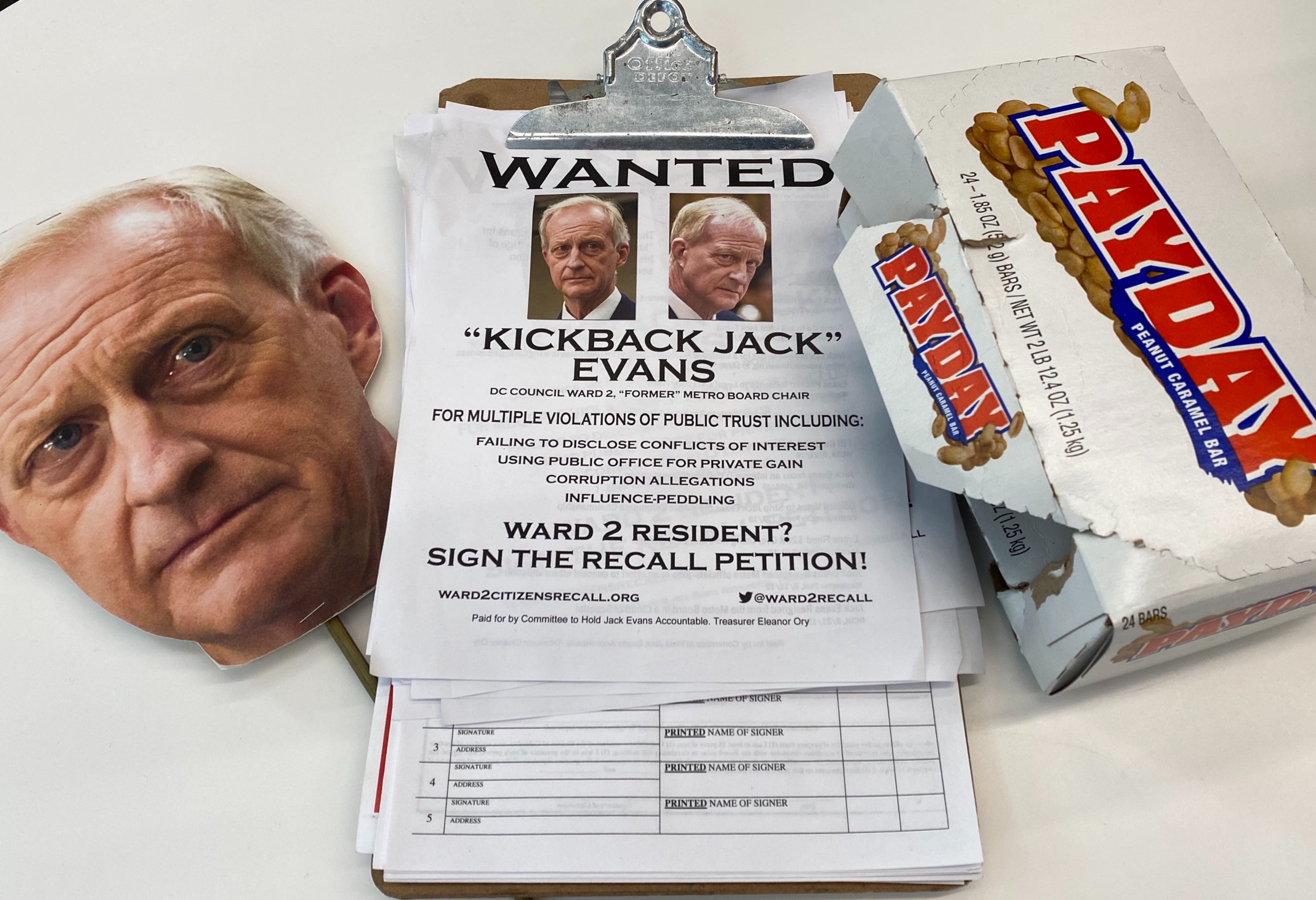
In what has otherwise been a bad week, embattled Ward 2 Councilmember Jack Evans got some good news today: organizers of an effort to recall him from office over instances of ethical misconduct did not obtain the necessary number of signatures to trigger a special election.
The D.C. Board of Elections announced Thursday morning that a review it conducted found that of the 5,627 signatures submitted by recall proponents, only 3,885 were actually valid, leaving the effort short of the 4,949 needed to prompt an election that would let Evans’ constituents decide if he should remain in office or not. But Evans is likely not long for the council either way, given that his council colleagues unanimously agreed to move forward with expelling him from his seat on Tuesday.
During its review the election board found that at least 1,700 signatures submitted as part of the recall effort were invalid, largely because they belonged to people who did not live in Ward 2 or were not registered to vote there. Under D.C. law, anyone signing a petition to get a candidate or initiative on the ballot has to be registered to vote in the city, and for ward seats, the signer has to be registered in that ward.
Evans submitted his own challenge to the recall effort late last week, saying almost half of the signatures submitted to trigger an election against him were forged or fraudulent. Recall proponents rejected those claims, but with the board’s decision Thursday, the issue is largely moot.
Adam Eidinger, the leader of the effort to recall Evans from office, expressed opposition to the board’s decision. He says that volunteers collecting signatures found the names of many people who are still listed as being registered to vote in Ward 2 but no longer live there. That, he said, artificially inflated the total number of signatures the effort had to collect; by law, it’s 10 percent of the number of registered voters.
“From our door-to-door canvassing, we found over 7,000 people that are truly not in the ward but are on the voter rolls. We think the number we were asked to bring in is well over 1,000 higher than what we should bring in,” he says.
Board member Michael Gill expressed sympathy with Eidinger’s frustration with the signature-gathering process—which all candidates and political causes have to go through to get something on the ballot—but said there was little they could do but reject the recall petition.
“This process in collecting signatures is very antiquated for where we are with technology,” Gill said. “The big bulk of these folks weren’t, according to our records, duly registered at that address in the ward. That’s what we have to go with. We have to rule how we have to rule.”
No effort to recall a councilmember or mayor has ever gotten on the ballot. Eidinger could take the matter to D.C. Superior Court, but says he has not yet decided if he will.
Thurday’s news is probably of little solace to Evans, though, who just this week was dealt a significant blow when all 12 of his colleagues recommended that he be expelled from the seat he has held for almost three decades because of instances of ethical misconduct that were revealed by the press and lawyers hired by the Council. A final vote on whether to expel Evans—which would be a first in the city’s history—is expected in mid-January.
Eidinger did say that there is a link between his attempt to recall Evans from office and this week’s decision by his colleagues to recommend that he be expelled. “I believe the recall has played a role in getting the political pressure to get the councilmembers to do the right thing,” he says.
If the council does decide to expel Evans, the seat will be vacated immediately. The elections board will then have to schedule a special election to fill the seat for the remainder of Evans’ term, which ends in January 2021. The board will likely have the flexibility to time the special election to coincide with the June 2 Democratic primary, where Evans already has a half-dozen challengers.
But that means that Ward 2 will be facing two different elections on the same day: the special election, which is open to any voter, and the primary, which is limited to voters registered with political parties.
The post has been updated to reflect the fact that the elections board invalidated more than 1,700 signatures, not 1,064 as was first reported. That number is how far below the 4,949-signature threshold the recall proponents ended up.
There’s No Paywall Here
DCist is supported by a community of members … readers just like you. So if you love the local news and stories you find here, don’t let it disappear!