Rachel Kurzius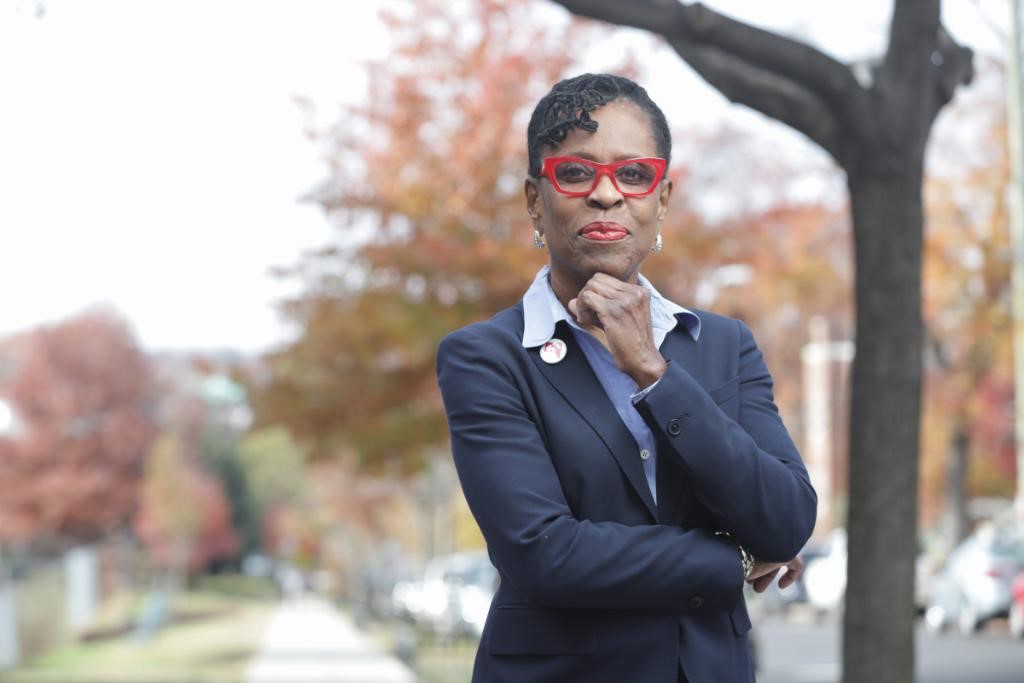
Since the summer, the story of the primary race in Ward 4 seemed to emerge with clarity: incumbent Brandon Todd, a protégé and close ally of Mayor Muriel Bowser, fending off a challenge from Janeese Lewis George, a former D.C. assistant attorney general who quickly began racking up progressive support and endorsements.
But an announcement from a different Bowser shortly before Thanksgiving has complicated the story. Renée Bowser, a labor lawyer, seven-term Advisory Neighborhood Commissioner in Petworth, and Ward 4 Democratic State Committeemember, is running to represent the District’s northernmost ward, and says she’s the real candidate holding the progressive mantle. (She is not related to the mayor.)
Bowser is no stranger to Ward 4 council races—she’s run five times, including twice against Todd, who was first elected to the Ward 4 seat in a 2015 special election after Muriel Bowser vacated the seat to become mayor. But this time is different, she says, because she can devote all of her time to the race (previously, she was also working full-time) and because of the city’s new public financing laws, which she hopes to use. George is also running with public funding, while Todd is not.
She says she’s running because, in D.C., “people are striving, but few people are moving forward. We need to create equitable pathways so all people in our city can realize their full potential.”
Bowser says that she wants to represent Ward 4 as part of her efforts to “change the government culture of giving away public money like we do without securing lasting tangible benefits for the public.” As one example of this, she mentions Nationals Park—a stadium for a private organization built with city funds. She also wants to focus on education.
Like fellow candidate George, Bowser views the city government as too cozy with developers. “It’s like you’re building a city for people who aren’t even here and you’re leaving behind the people who are here,” says Bowser.
But Todd, the incumbent, maintains that the growth in Ward 4 has been intentional and focused. “Making great communities doesn’t just happen by mistake,” he says. “I’ve been bullish about economic development in our corridors, like Upshur Street. Five years ago, Upshur Street wasn’t on anyone’s radar.”
Todd, who’s seen as one of the council’s more business-friendly members, has been a target of progressive groups, many of which had their endorsements ready before Bowser entered the race. By November, the Jews United For Justice Campaign Fund, D.C. for Democracy, Working Families Party, Black Lives Matter DMV, and Metro D.C. Democratic Socialists of America had all endorsed George. And that endorsement means more than a line on a mailer—it often comes with significant canvassing and organizational support.
Zach Weinstein, the D.C. campaign manager for the Jews United For Justice Campaign Fund, says that the group endorsed earlier than ever (in both wards 2 and 4) because “we felt like the balance of power on the council right now still tilts more towards corporate interests and wealthy donors, and we felt like there’s a real opportunity in Ward 2 and Ward 4 to shift that balance of power.” (This endorsement process happened before the D.C. Council backed expelling Ward 2’s Jack Evans, the body’s most corporate-minded member.)
An endorsement from the group means “we’re going to be working over the next few months to mobilize our members, our leaders, to get out the word about these candidates,” says Weinstein. “We endorsed early because, for a challenger to win, you need months and months of doing that for it to have the maximum impact.”
Bowser maintains that she is the best candidate to represent working people. “If different organizations say they are for certain issues—housing affordability, [speaking up] for workers—I would think that the person who has the most on the ground experience and commitment, both personally or professionally, would be the best candidate to rally around,” she says. “I just have to pursue my goal of trying to bring the best representation to Ward 4. I know my record of activism is second to none, and far exceeds the other candidates that are currently in the race.”
George declined to comment for this story.
The common wisdom is that crowded primaries help incumbents, because they already have higher name recognition and challengers split those vote among those disaffected with the politician currently in office, especially if they’re running on similar platforms.
And indeed, both Bowser and George, who spoke with DCist in August, have similar criticisms of Todd. One is concern over his vote to overturn Initiative 77, the voter-approved measure that would have eliminated the tipped wage. “They were overturning the will of the people,” says Bowser, adding that the workers who testified against Initiative 77 in a marathon public hearing were “not representative of the tipped workers of the city.” Another is Todd’s vote on the controversial single-source sports gambling contract, which has been criticized for the winning vendor’s close connections at the Wilson Building.
And overall, both contend that Todd isn’t tackling the city’s most important issues, like displacement and affordability. “I’m willing to take on the complex issues,” says Bowser. “It’s really great to get someone a trash dumpster, because that’s a needed thing, but I will dig deep and work on the issues that have a great impact on people.”
Todd disagrees with this characterization of his work on the D.C. Council. He says he’s a pragmatist. “I’ve never been a pie-in-the-sky leader,” he says. “I feel like I have a big vision, bold views, but I also operate in reality and I like to champion things that I know will benefit all of my community.”
Among the things he says he’s most proud of from his more than five years on the council include the opening of Ward 4’s two standalone middle schools, creating and preserving affordable housing in the ward, and three Main Street designations in four years. “I’ve always run campaigns very focused on what we’ve made commitments for, what we’ve done,” he says. “I’ve never commented on what other folks are or aren’t doing.”
While George has said that Todd is too close to the mayor, he views his relationship with the city’s chief executive as a good thing for Ward 4 residents. ” I think that it is a plus to have good relationships with leaders in the city, and I don’t think the mayor should be any different,” Todd says. “I would hope that anyone looking to join the council would want to have a good relationship with the mayor, whoever the mayor is, and plan to have good relationships with their colleagues on the council … What it really takes is getting into the kitchen with all the leaders and making the sausage.”
Todd’s campaign currently has about $175,000 on hand as of July 31, according to the most recent filings available from the Office of Campaign Finance. Donors who gave the maximum of $500 include executive branch workers like Interim Deputy Mayor for Planning and Economic Development John Falcicchio and Angie Gates, the director of the Office of Cable Television, Film, Music, and Entertainment, as well as the political action committee of Washington Gas and other corporations. He declined to participate in the new public financing program, despite calls from some progressive elected officials in Ward 4 to do so after a series of fines for campaign violations; one of the people who signed the letter to Todd, Zachary Teutsch, is now the chairman of George’s campaign.
But Todd says the key to his campaign is his door-knocking—”I’ve already worn through a pair of shoes”—and plans to open a campaign office soon.
George qualified for public financing within days of announcing her candidacy. D.C.’s Fair Elections Program matches every dollar from a D.C. resident with $5 in public funds, so long as candidates don’t accept donations from PACs or corporate and business entities, with contribution limits at $50 rather than $500. In George’s first month on the trail, she raised almost $105,000, including matching funds.
Bowser is looking to use the fair election program as well. It requires 150 small-dollar contributors for a ward council race.
There’s No Paywall Here
DCist is supported by a community of members … readers just like you. So if you love the local news and stories you find here, don’t let it disappear!