Racial housing segregation in the United States wasn’t created “by accident or the result of private prejudices,” but through “racially explicit policy on the part of federal, state, and local governments.” It was enacted by conservative Republicans and liberal Democrats alike—and the resultant inequality persists to this day.
That was the damning message of a 17-minute film screened in the District’s wealthiest, whitest ward on Saturday afternoon during one of the D.C. government’s “Continuing Conversations of Housing.”
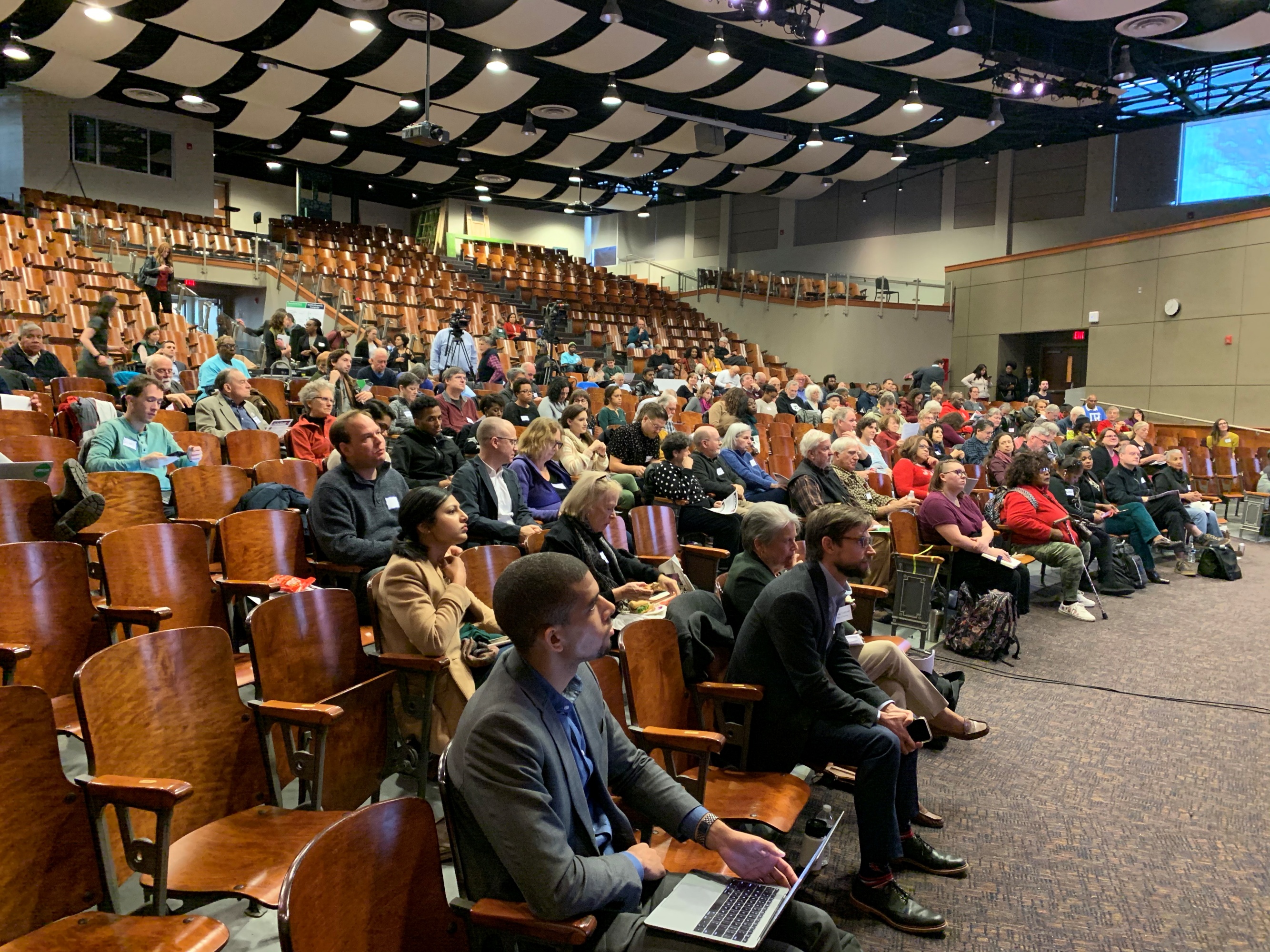
Ward 3 residents and community leaders shook their heads and let out audible gasps over the history of racist policy described in Segregated By Design, an animated work narrated by Richard Rothstein, author of 2017’s The Color of Law: A Forgotten History of How Our Government Segregated America. But when the screening ended, the mostly white crowd in Woodrow Wilson High School Auditorium in Tenleytown was left with the obvious question: What should be done about it now?
This conversation comes as D.C. faces a housing affordability crisis.
On average, D.C. residents are “paying a greater share of their income for rental housing than before, an effect that disproportionately burdens low-income residents,” Mayor Muriel Bowser’s government noted in an October report on housing equity. A study published last spring by the Institute on Metropolitan Opportunity found that, from 2000 to 2016, D.C. has “experienced the strongest gentrification and displacement of any city in the country.”
Washington City Paper recently reported that the average monthly rent for market-rate one-bedrooms in the District was nearly $2,000 a month last year and roughly half of renters devoted almost a third of their income to housing. The number of households with extremely low incomes facing severe housing hardship has gone up 50 percent over the past 10 years, per the D.C. Fiscal Policy Institute.
Earlier this year, Bowser set the ambitious goal of 36,000 new housing units across the District—including 12,000 affordable units for low-income residents—by 2025. In October, she announced her plan to put significant affordable housing options in some of D.C.’s highest-income neighborhoods.
The weekend’s forum offered a preview of how the mayor might sell her agenda in neighborhoods where new development often faces skepticism: leveraging the liberal guilt of highly educated and politically attuned white Washingtonians who benefitted from the very decisions Segregated By Design describes. (Bowser has previously forecasted that she would counter the “not in my backyard” attitude by saying that “We have to come up with another way to explain what we’re doing that they can embrace. Or at least, if they don’t embrace it, they will look shameful,” WAMU reported.)
As Rothstein says in the film’s last line, “We should first contemplate what we have collectively done and—on behalf of our government—accept responsibility to fix it.”
That includes the history of Fort Reno Park, directly across Chesapeake Street from Wilson High School. Neil Flanagan, a Tenleytown native and associate at Maginniss + del Ninno Architects who was among the featured speakers at Saturday’s program, explained that the park used to be a growing black community with up to 400 families about a century ago.
“There was a deliberate campaign, first by private developers and then very enthusiastically joined by neighbors and the District government, to clear it,” Flanagan said. “Once they had removed the African-Americans from Fort Reno, there was a lot of effort taken to ensure they stayed out.” Black schools and recreation centers were kept away from the neighborhood.
Willow Lung-Aman, an associate professor in urban studies and planning at the University of Maryland, College Park, who spoke alongside Flanagan, urged the audience not to assume racist housing policies were a thing of the past.
“This is really a discussion about the present,” she said. “These policies have shifted, but they have not gone away, and we are continuing to adopt policies that reinforce this landscape every day.”
Lung-Aman stressed that a more racially and ethnically diverse city benefits all its residents and “makes us a more interesting, vibrant, and sustainable place.” She talked up policies like inclusionary zoning and rent control, which D.C. has already adopted, as well as “more innovative” ideas from across the country such as banning single-family zoning that prevents dense development.
“Single-family zoning is something that has been commonplace in zoning since it was enacted in the 1920s,” she said, but it’s increasingly seen by critics as “exclusionary and not helping communities to achieve the goals of integration.” The State of Oregon and the city of Minneapolis, Minnesota, recently ended this practice, which Lung-Aman acknowledged “may sound a little bit more radical.” But she believes it will create “a more equitable landscape.”
Bowser has not proposed banning single-family zoning, which takes up three-quarters of all tax lots in the city, according to the D.C. Policy Center.
“It would not be popular” in Ward 3, longtime community activist Matt Frumin tells DCist. “It is the case that the root of it was segregation, but now it’s not always associated with segregation.” Frumin questioned the wisdom of discussing such a ban at D.C. government forums if it isn’t part of the mayor’s agenda.
But Lung-Aman is “not a policymaker in D.C.,” Office of Planning Director Andrew Trueblood tells DCist. He said the value of the forum was to convey that “the planning profession has been implicated in this, so we have to accept responsibility. If we’re doing that through policies, through the Comprehensive Plan, and residents don’t have a sense of that context, then it might seem confusing or be harder to accept.”
Bowser wants at least 15 percent of housing to be affordable within each Planning Area of D.C.’s Comprehensive Plan by 2050. By 2025, she wants to add 1,990 affordable units in what the Office of Planning calls “Rock Creek West”—a portion of Northwest primarily comprised of Ward 3, which the office estimates to have just 470 affordable units today.
Rock Creek West’s production goals are the most ambitious in the District, though the mayor aims to have 1,500 new affordable units in “Rock Creek East,” largely in Ward 4, and 1,400 in “Capitol Hill,” mostly in Ward 6.
Some residents of Ward 3 may well be moved to support Bowser when forced to grapple with segregation past and present — the kind of people who gave Segregated By Design hearty applause in the auditorium.
But standing on the sidewalk across from Fort Reno after the forum, Van Ness residents Kate Dell and Barbara Bates told DCist they needed to hear more specifics from their mayor.
“Most of us know this horror of our history,” Dell says, but Ward 3 still needs family houses with at least two bedrooms. “There’s a big push to get us all out of our cars, but there’s a whole demographic that still needs cars,” she says. “The planning is not balanced in that way, and it’s more in favor of the young, up-and-coming, and striving.”
The success of Bowser’s push may rest on how effectively she can avoid those feelings of division.
There’s No Paywall Here
DCist is supported by a community of members … readers just like you. So if you love the local news and stories you find here, don’t let it disappear!