Elliot C. Williams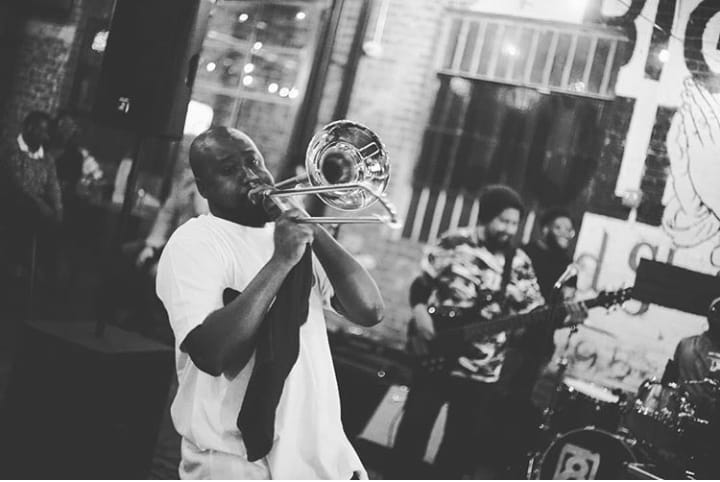
It’s Thursday night at Penn Social, a sports bar in Penn Quarter, and the so-called Trombone King is winning over the basement crowd. He hops off stage with expert showmanship and a version of “Get You” by Daniel Caesar that rivals the original, and follows it with a Stevie Wonder medley that attracts customers to mingle with strangers on the dance floor. “Feel-good-funky music,” he calls it.
The Trombone King, aka 35-year-old Travis Gardner, is joined by six band mates who make up the Experience Band and Show.
Someone in the crowd makes an offhand comment about the group’s history—“Isn’t this the band that used to play outside Gallery Place?”—and, as the word spreads throughout the bar, even the people drinking by themselves start paying attention.
The band is performing R&B and rap covers just a few blocks from where they used to play for commuters every day. The difference is, they now perform indoors with twice as many members as they started with two years ago, and their old tip bucket is nowhere in sight. But their energy is just the same.
After driving for Metro for five years and working at a Prince George’s County animal shelter, Gardner started performing at Gallery Place with Brass Connection, a nine-man family band from North Carolina, in 2014. The troupe gained a modicum of local fame, playing as the house band for the Mystics and counting Trey Songz as one of their early listeners. (They told the Washington Post in 2014 that the singer dropped a $500 tip in their bucket.)
The shows, which relied on crowd participation, fueled Gardner’s passion for the craft. And when the group dissolved, a bandmate convinced Gardner that he had the skills to start his own show.
Gardner formed a trio in 2017—with just a trombone, bass, and drum, at first—and named the group after artists who did more than just walk back and forth: “We give people an experience they would never forget, and we’re providing a show. We interact with you, we dance, we rap, we do it all.”
While he had all but claimed the corner of 7th and F Street NW as his own, Gardner wasn’t sure how many more nights he could spend charging the band’s power amplifier, or how many more chilly days he could spend working outside. The band needed a big break, and he knew it.
Last year, singer Lalah Hathaway announced a contest to open her show at the Warner Theatre, and Gardner sent in some of the band’s footage. Out of the 400 or so entrants, Hathaway picked the Experience Band and Show. The performance was a turning point for the band.
They’ve since performed with household names like Wale and Raheem DeVaughn, and one of the owners of Big Chief, a bar in Ivy City, hired them as the house band. The group plays about two or three shows every week at places like Union District Oyster Bar, Ivy City Smokehouse, and the Moxy hotel.
Sometimes, the Experience Band and Show returns to its roots, with street performances during last year’s Funk Parade and the most recent H Street Festival.
“I still want to perform at Gallery Place,” says Gardner, whose busy performance schedule includes more clubs and restaurants than street corners these days. “Every note you play is how you’re going to make your income. It’s not like a club where you’re guaranteed pay right after. These [commuters] are in a rush, and to get them to stop and circle around you is the greatest feeling. It shows you that you’re better than you thought you were. It gives you hope.”
But that doesn’t mean the busking life was easy. First, there’s the cost of maintaining the instruments and equipment. Then there are the winter months, when playing outside can be miserable. And Gardner says it can be hard to stay motivated when buskers get cast as failed musicians. Many went to school for music, or work multiple jobs to afford the gigs—Gardner, for instance, went to Bowie State on a band scholarship. “None of us are bums,” he says.
“If you really do the research, Marvin Gaye was a street performer at one time. Chuck Brown was a street performer at one time,” Gardner says. “Street performance was big in D.C. It’s always been a part of life in D.C.”
Perhaps that’s why the local music community took notice of the band first, before they started getting messages from listeners overseas (one U.K. fan liked the sound so much that he flew to D.C. to audition for lead guitar. Ultimately, he didn’t get the gig, but Gardner still likes to brag about it.)
Gregory “Sugar Bear” Elliot, of the famed go-go band Experience Unlimited (E.U.), took Gardner under his wing when he was still adding new members. Not only did Sugar Bear perform with Gardner’s band for the 30th anniversary performance of E.U.’s hit single “Da Butt,” but Sugar Bear also introduced Gardner to his future keyboard player, Jayson Suggs.
When it comes to some D.C. venues, go-go bands still get booked the easiest, Gardner says, so he added A.J. Brown to provide the ubiquitous bongos and cowbell. Other members include vocalist Joseph “Jodasho” Johnson, drummer Rafael Gerald, bassist Darren Redmond, and lead guitar player Jeremiah Boulware.
What’s next? A New Years Eve performance at Penn Social, for starters, once again down the street from where it all started. The group is also working on its debut EP, From the Streets to the Stage, and plans to start releasing original singles in February.
Gardner reminisces on the days when he hoped to catch the attention of busy commuters, and he offers advice for any budding musician with a dream:
“No matter how old you are, go after it,” Gardner says, before a long pause. “I didn’t believe in myself until all of this. I’ve opened so many doors for other acts because of my journey and gave other bands some of their first shows … There are a lot of people we’ve put on.” He lists other burgeoning local acts like 1 Identity, the Unknowns, and Micca among those the Experience Band has collaborated or otherwise shared the spotlight with.
In recent years, buskers have felt a mounting pressure as D.C. Council renews its efforts to limit outdoor noise in music-heavy areas. The Council re-introduced the Amplified Noise Amendment Act in January, and it’s still under review.
In the heat of the music community’s battle against the noise bill, Gardner was added to a group chat with hundreds of other local acts. He didn’t become one of the more vocal members of the group because he didn’t want the spotlight, he says. But, he stands with any street performers in any battle, even if he’s not at the center of the stage.
“We were here before all these big buildings and all these new people,” he says. “You can’t go to New York and say, ‘Cut off the lights, the lights are too bright.’ D.C. is a music town. You can’t cut off the music.”
There’s No Paywall Here
DCist is supported by a community of members … readers just like you. So if you love the local news and stories you find here, don’t let it disappear!