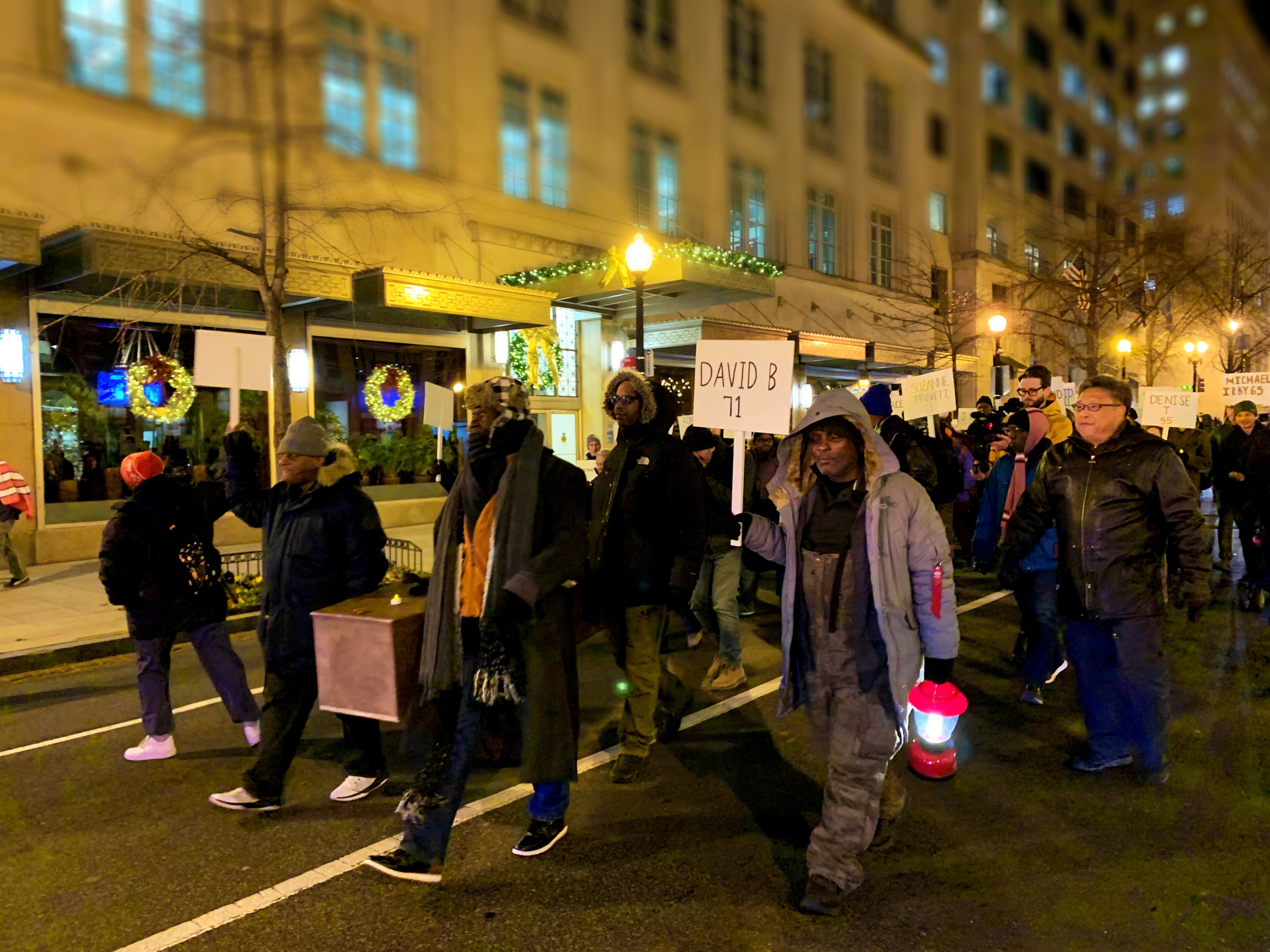
On frigid Thursday night, a crowd marched down 14th Street toward Freedom Plaza. They were of mixed ages and lived experiences, including an elderly veteran in a U.S. Army hat, young men passing handwarmers between each other, a handful of children in puffy jackets, and one trio of women with canes, arms linked together.
Each of them carried a small white sign with simple black lettering.
The signs were names: Alice Carter, age 35. J.W., age 29. Ronnie Higgs, age 64. One simply said anonymous. Another read Jane Doe.
With their signs held aloft, the group chanted: “Housing is a human right! Fight! Fight! Fight!”
Despite the signs and the chants, they weren’t so much a protest as they were a funeral procession. At the head of a group, four men carried an empty casket adorned with plastic candles.
It was a mass funeral for the 81 people who died in 2019 while experiencing homelessness in D.C., according to a count maintained by advocates.
People for Fairness Coalition, a housing advocacy organization made up of people who have experienced or are experiencing housing instability, has hosted the overnight vigil for the past seven years. Last year, they mourned 54 deaths.
Members of the group explain that they want the D.C. government to increase budget dollars for seven D.C. programs that produce and preserve housing for low-income residents. They’re calling for the government to invest $1.5 billion a year in housing programs. And PFFC also wants to see legislation passed that would give people experiencing homelessness full discrimination protections. On Friday, advocates will take to the Wilson Building to meet with councilmembers and discuss their demands.
But, on Thursday night, the focus was more on the lives lost. And even as the crowd marched down 14th street, electrified by the chants, a heaviness had settled.
Alice Carter, 35, died just this week. Members of the group that knew her were still grappling with disbelief and sadness, whispering her name to one another as they walked. More than a name on a sign, Carter had been a Street Sense vendor and a poet. One of her more recent poems, published in October, read: “I live in a lonely world, just trying to survive.”
In a social media post, one user said Alice was a regular on 17th Street NW and that she loved the color pink, strawberry milkshakes, and poetry. Donations in her memory were asked to be made to N Street Village.
Speakers described the toll homelessness takes on one’s health. Freezing temperatures on the streets take lives, including possibly a 77-year-old man whose body was found at Freedom Plaza last month. But it’s more often manageable illnesses, like diabetes and heart disease, left untreated and often exacerbated by the pressure of trying to survive without a home.
Ken Martin, a native Washingtonian and member of the coalition, described the intense stress he experienced while homeless in Foggy Bottom, worried about the next place he would be able to lay his head down to sleep.
Rashema Melson, a young woman who made national headlines when she graduated from Georgetown University in May after experiencing homelessness in her teens, said her experience made her feel unworthy of opportunities, including her college degree.
“It has a huge impact on your self-worth. I just want everyone to realize that,” she said.
An annual count, conducted in January 2019, found that 6,521 people were experiencing homelessness in the District. Overall, the city saw a drop in homelessness, buoyed by a significant decrease in homeless families, but the number of single individuals experiencing homelessness increased over last year.
And, as Martin pointed out, immense stress doesn’t only impact the homeless community; it also hurts their advocates.
“Staff burnout is just another barrier for the homeless,” Martin, now an advocate himself, said. “Mental illness is an issue on both sides of the desk.”
At times, as emotions rose, the toll on both the homeless community and their advocates became increasingly clear. Dr. Catherine Crosland, of Unity Health Care, cried as she described patients that had died this year, sometimes leaving behind children or dying of severe, yet treatable illnesses, often at much younger ages than their housed counterparts.
“I grieve that a 77-year-old man died alone, sleeping in the Freedom Plaza on a frigid night,” she said, her voice breaking. “Housing is healthcare.”
Others focused on the call for housing-first approaches, including Waldon Adams, a PFFC member, who said homelessness is a “multifaceted disease that has a cure.”
“The cure is housing,” he said.
He called himself lucky for having survived as long as he did on the streets, as did another formerly unhoused speaker, Tony Burns, who described lying in a hospital bed after being diagnosed with HIV and asking a doctor if he would die. He’d experienced homelessness first at six years old. In his 30s, he was again without a home, struggling with anxiety and depression, as well as his diagnosis. Around him, he said, others diagnosed with HIV “were dying by the droves.”
“There was something in me that did not want to die,” he said. A year later, he received a housing voucher. Now, after 31 years of being able to manage his HIV, Burns announced that he will turn 60 this year. The crowd erupted in cheers.
Laura Zeilinger, director of the D.C. Department of Human Services, also made an appearance Thursday night to present a leadership award to Matthew Doherty, who until recently was executive director of the U.S. Interagency Council of Homelessness. Doherty was replaced earlier this month by Robert Marbut, who has opposed housing-first policies.
While Zeilinger didn’t call out Marbut by name, she was quick to condemn the “dangerous ideas being put out there” by the Trump administration that impede housing efforts. “The contrast for who succeeded [Doherty] cannot be more striking,” Zeilinger said, adding that she felt it was important to honor those whose lives were lost not only by remembering them, but also by calling out policies that threaten people experiencing homelessness nationwide.
By 7 p.m., the crowd had marched to a tent set up in Freedom Plaza. Inside, they sat around tables to enjoy a meal of mashed potatoes, mac and cheese, and chicken. Volunteers served hot chocolate. Many of them planned to spend the night. According to Jesse Rabinowitz, advocacy and campaign manager with Miriam’s Kitchen, there would be overnight outreach activities to people experiencing homelessness before community action at the Wilson Building in the morning and another memorial service on Friday afternoon.
At the front of the tent, Robert Warren, PFFC’s director, stood next to the casket, now piled high with the signs carried down 14th Street. He said he wanted D.C.’s elected officials and residents to know that no one should die without a home and that housing is healthcare.
“I knew a white lady, who was 67-years-old, who died in a little, small tent, under a bridge in NoMa. She was there for three years. That just says it all for me,” he said, speaking in a low, soft voice. “She was a real nice lady. I don’t think she deserved to die like that.”
There’s No Paywall Here
DCist is supported by a community of members … readers just like you. So if you love the local news and stories you find here, don’t let it disappear!